How Many Hours One YouTube Video Actually Takes (India, 2026)
Sellers publish delivery days, not labour hours — and the three sources that do publish hours disagree by 33x. What one 10-minute video really costs in time.
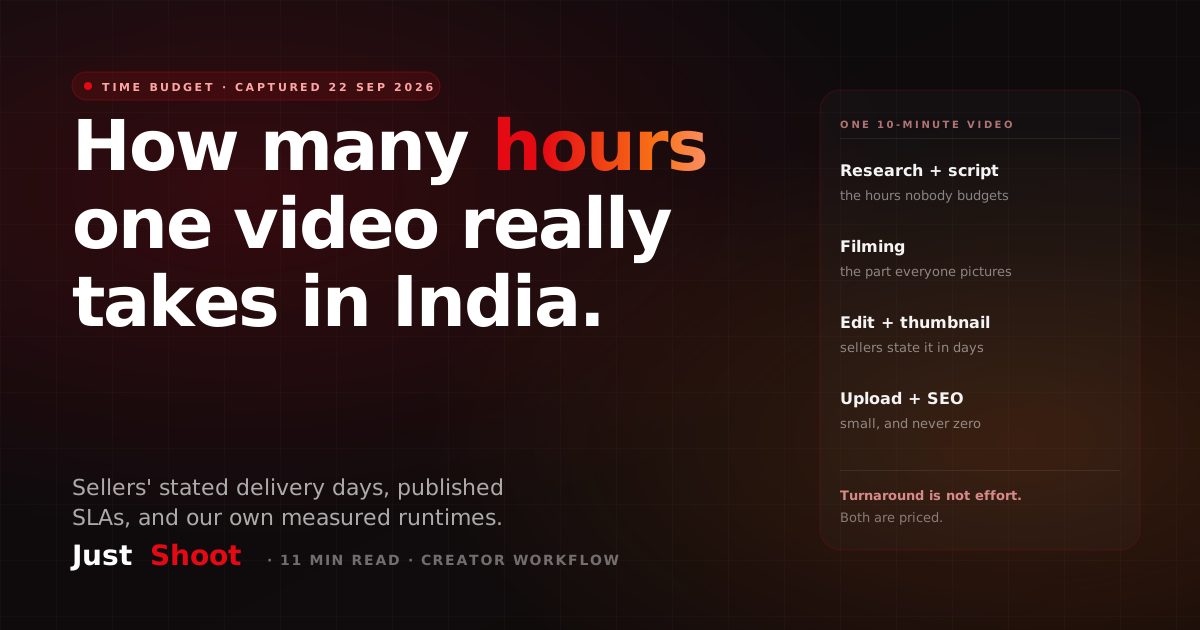
How Many Hours One YouTube Video Actually Takes (India, 2026)
By Ashok Sachdev, Founder of JustShoot · Published 22 September 2026
Short answer: Nobody in the Indian market publishes an hour budget for one YouTube video. They publish delivery days — 1 to 10, depending on the seller — which is a deadline, not effort. The three sources that do publish labour hours disagree wildly: for the same 10-minute video they imply 3 hours, 5–10 hours and 20–100 hours. That 33x gap is the real answer, and this page explains what causes it.
Every figure below was retrieved on 22 September 2026. Marketplace bids, published agency SLAs, editing-hour ratios and our own measured runtimes are kept in separate sections on purpose. They measure different things, and pooling them is exactly how the internet produced the confident "it takes 8 hours" numbers that fall apart on contact with a real invoice.
The mistake in every existing answer: turnaround is not effort
Search this question and you get hours. Ask the market and you get days.
That is not a rounding difference. A delivery day is a promise about when the file arrives. An hour is a claim about how much work went in. A freelancer juggling six clients can promise 7-day delivery on 4 hours of work; an agency with a dedicated team can promise 24-hour delivery on 6. The two numbers are not convertible, and almost every "how long does a YouTube video take" article on the internet silently converts one into the other.
So this page reports them separately, and tells you which one to use for which decision. If you are planning a cadence, you need hours. If you are planning a launch date, you need delivery days. Our weekly cadence guide covers the first case at the week level; this one goes down to a single video.
If you only want the practical end of this, skip to the rupee conversion — or just take the hour off the front of your next script with the 30 free Hinglish script templates, which is the single cheapest hour in the table below to remove.
Table 1 — what freelancers actually commit to, per bid
These are live bids on two Indian YouTube editing briefs, retrieved 22 September 2026. Each bidder sets both their price and their own delivery day, which makes these boards the only place you can watch the two get priced against each other. Note that these are bids — what freelancers offered — not confirmed contracts.
Brief 1 — "YouTube Video Editing", client budget ₹600–1,500, 16 proposals:
| Delivery | Bids at that delivery |
|---|---|
| 1 day | ₹600 · ₹1,100 |
| 2 days | ₹1,050 |
| 3 days | ₹800 |
| 5 days | ₹1,000 · ₹1,500 · ₹7,000 |
| 7 days | ₹650 · ₹750 · ₹1,000 · ₹1,050 · ₹1,050 · ₹5,000 |
Brief 2 — "Professional YouTube Video Editor", client budget ₹1,500–12,500, 20 proposals, average bid ₹5,365:
| Delivery | Bids at that delivery |
|---|---|
| 1 day | ₹1,500 · ₹6,450 |
| 2 days | ₹3,000 |
| 3 days | ₹2,000 · ₹7,000 |
| 5 days | ₹5,000 · ₹7,600 |
| 6 days | ₹6,000 |
| 7 days | ₹2,000 · ₹5,000 · ₹6,250 · ₹6,250 |
Read the two tables together and a finding falls out that I did not expect.
On both briefs, the fastest bid was also among the cheapest. The single lowest bid on Brief 1 — ₹600 — promised delivery in one day. The lowest bid on Brief 2, ₹1,500, also promised one day. Meanwhile the 7-day band on Brief 1 runs from ₹650 to ₹5,000, a 7.7x spread for the same brief and the same deadline.
In other words: on these boards, speed is free and the delivery day carries almost no information. A bidder who says "1 day" is not telling you they will spend more hours or fewer — they are telling you their queue is empty.
This is worth pausing on, because it is the opposite of what we found in thumbnails. When the client demanded a 24-hour turnaround on a text-heavy thumbnail brief — "I'd like a 24-hour turnaround once assets are supplied" — the average bid came in at ₹17,227, and we documented that premium in what thumbnail designers charge. Speed costs money when the buyer specifies it. It costs nothing when the seller volunteers it.
Table 2 — the "Service Duration" field nobody reads
IndiaMART listings carry a literal field called Service Duration. It is the closest thing in the Indian market to a published, structured delivery commitment. Five listings, retrieved 22 September 2026:
| Service Duration | Price | Seller | City |
|---|---|---|---|
| 10 Days | ₹1,199 / minute | Maharudra Studio | Surat |
| 7 Days | ₹1,250 / hour | Kmakers Ideas Private Limited | New Delhi |
| 1–3 Days | ₹245 / minute (Hindi voice-over) | Parikh Info Solutions Private Limited | Mumbai |
| 1 Day | ₹1,50,000 / project (corporate video) | Aroma Films | Surat |
| "As Per Requirement" | ₹400 / minute | New Design Station | New Delhi |
Two things to notice. First, the units are incompatible — per minute, per hour, per project — so these cannot be compared to each other, let alone averaged. Second, the one listing that charges by the hour (₹1,250) is the only one whose price is denominated in the thing this article is about. Every other seller has priced the deliverable and hidden the hours inside it, which is precisely why you cannot recover an hour budget from the market.
None of the five states a date.
Table 3 — published agency SLAs
These are marketing claims on company websites, not audited commitments. I am reporting them as what Indian agencies advertise, which is all they are.
| Company | Published turnaround | Dated? |
|---|---|---|
| Heptagon Global Services | "For short-form content like Reels or Shots, we typically deliver within 24-48 hours"; corporate/documentary "5-7 business days" | undated |
| Owkus Web Solutions | "24-48 hours for most projects." YouTube videos quoted at ₹4,000–10,000 | undated |
| Media Sathi (Delhi NCR) | "48hr Turnaround for Short-Form Content" | undated |
| InfluencerHai | "Delivery in as fast as 24-48 hours"; YouTube vlogs ₹2,000–₹5,000 per video | 12 July 2025 |
The convergence on 24–48 hours across four independent Indian sellers is real, and it is also nearly meaningless as a measure of work. It is the number that sounds fast enough to win the brief. Three of the four pages carry no date at all.
Table 4 — the only three published hour figures, and why they do not agree
Here is the part that makes this page worth writing. Three sources publish actual labour hours. Converted to the same deliverable — one finished 10-minute talking-head video — they say:
| Source | What it publishes | Implied hours for 10 finished minutes |
|---|---|---|
| Increditors (16 March 2026) | "Talking head (10-20 min): 3-6 hrs" editing | 3–6 hours |
| Tasty Edits (updated 17 Sept 2026) | "It takes 30 to 60 minutes of editing per minute of finished video, on average" | 5–10 hours |
| Beverly Boy Productions (14 Jan 2026, updated 4 March 2026) | "Most of the time, editing is a 2:1 process… a 2:1 video is 2 hours to edit for each minute"; multi-location shoots "can have a 10:1 ratio" | 20–100 hours |
Three to one hundred hours. A 33x range for an identical description of the work, from three sources all publishing in 2026, none of which states a methodology beyond its own experience.
The arithmetic in column three is mine, and it is the whole trick: Increditors publishes hours per video, Tasty Edits publishes minutes per finished minute, and Beverly Boy publishes a ratio of editing hours to finished minutes. Three units. Nobody converts them, so nobody notices they disagree.
What actually explains the gap is raw-footage volume, and only Beverly Boy says so out loud — the 10:1 figure is explicitly for videos "shot in several locations". A talking head with 20 minutes of raw footage and a video essay with six hours of B-roll are the same finished length and not remotely the same job. We made the same point from the price side in what video editors charge in India, where footage volume turned out to be the single biggest driver of the bill.
So the honest per-stage answer for one 10-minute talking-head video is: editing 3–6 hours if your footage is disciplined, and up to 10 if it is not. Anything above that is a different video than the one you think you are making.
Table 5 — our own measurement, for the pre-production half
Nobody publishes hours for the stages before the edit — research, scripting, packaging — because nobody sells them by the hour. We can at least measure the part that runs on our own servers.
Every JustShoot agent run writes a row with its wall-clock duration. Across 1,072 successful runs between 19 May 2026 and 21 September 2026, medians (not best-case) by stage:
| Stage | n | Median runtime |
|---|---|---|
| Topic research | 158 | 44 s |
| Deep research | 126 | 114 s |
| Script | 127 | 98 s |
| Fact-check | 22 | 55 s |
| Storyboard / shot list | 81 | 101 s |
| Thumbnail brief | 66 | 42 s |
| SEO package | 49 | 44 s |
| Shorts cut-down | 96 | 43 s |
And the figure that matters more than any single row: across 124 project sessions that ran at least three agents, the median total machine time was 233 seconds — 3 minutes 53 seconds, with a quarter of sessions finishing inside 2 min 44 s and a quarter taking longer than 6 min 35 s.
Three caveats, stated plainly. This is our own product measuring itself, so treat it as a disclosed interest, not an independent benchmark. It is machine runtime, not your time — you still read, judge and edit the output, and that is the hour that decides whether the video is any good. And summing the medians in that table gives 7.3 minutes, which is not the same as the 3 min 53 s session median, because most sessions do not run every agent; I am reporting both rather than picking the flattering one.
What this does to the hour budget for one video
Put the sourced pieces next to our own earlier estimates, and label which is which:
| Stage | Hours | Where the number comes from |
|---|---|---|
| Research + angle | 0.5–1 | our estimate, from how long a script takes |
| Scripting | 1.5–3.5 | our estimate, same page |
| Filming a 10-min talking head | ~1 | our estimate |
| Editing | 3–6 | published — Increditors, 16 March 2026 |
| Thumbnail | 0.5–1 | our estimate |
| Upload, title, description, tags | 0.5–1 | our estimate |
Seven to thirteen and a half hours. Which overlaps almost exactly with the 9–13 hours we published in the burnout audit on 9 September 2026 — a figure that came from creator self-reports and had no external source behind it. One published number now sits inside that range, and the other five stages still have none. I would rather say that than pretend the whole table is sourced.
For scale: Epidemic Sound's Future of the Creator Economy Report 2024 found that 49% of monetising creators spend 20 hours or more per week on content creation (n=1,500 via Pollfish, March 2024, plus a second wave of n=1,000 in May 2024; countries not specified). At 7–13.5 hours a video, 20 hours a week is one solid upload and not much else.
The rupee conversion
Now price those hours using rates this site has already published, each captured on its own date and never averaged together:
- Script, ₹4,700–4,800 for a researched long-form script (captured 11 September 2026)
- Edit, ₹860–1,950 for a straight cut or ₹7,300–24,000 full-service (20 September 2026)
- Thumbnail, ₹499–500 listed per piece, ₹1,609–1,664 average bid when A/B variants are asked for (21 September 2026)
- Voice-over, median ₹500 per minute on GST-registered listings, so about ₹5,000 for ten minutes (21 September 2026)
Outsource script, edit and thumbnail and the arithmetic is ₹4,700 + ₹860 + ₹499 = ₹6,059 at the cheap end, and ₹4,800 + ₹24,000 + ₹1,664 = ₹30,464 at the expensive end. Add a ten-minute voice-over at the median listing and both ends rise by about ₹5,000.
That is a 5x spread, and it is the same 5x you saw in the bid tables — because it is the same variable. The cheap end buys a straight cut of footage you disciplined yourself. The expensive end buys someone else deciding what gets cut.
Outsource nothing and you pay in the 7–13.5 hours instead. There is no third option, and the useful question is not "which is cheaper" but which hours are worth buying back. We took that question apart on its own in what to outsource first, which divides each rate above by the hours it removes and puts the seven roles in buying order.
The editing hours are the most expensive to buy (₹1,150–₹1,650 an hour on live hourly bids) and the easiest to shrink by changing your own behaviour — shoot less raw footage. The scripting hours are the cheapest to compress and the ones creators protect hardest, which is backwards.
If you want to cut one hour this week, cut the blank-page hour. The 30 free Hinglish script templates are opening structures for Indian channels — pick one, adapt it to your topic, and the 1.5–3.5 scripting hours start at a hook instead of at nothing. No account needed to open them.
What the hour budget does not include
From the published terms across every source above, these sit outside the numbers:
- Revision rounds. Increditors prices revision turnaround separately ("Same-day to 24 hrs"). Tasty Edits states revisions "will take another 24 to 48 hours per round". Neither is inside the first-draft hour count.
- Waiting. Every delivery day in Tables 1–3 includes queue time you are not paying for and cannot compress.
- Footage volume. The single biggest driver of editing hours, and the only variable fully under your control.
- Deciding. Choosing the topic, the hook, the three thumbnail hypotheses. No seller prices this, and it is where the week actually goes.
Where the tool fits, honestly
JustShoot does not film or edit. It runs the pre-production half — research, script, fact-check, hook, shot list, thumbnail brief, SEO package — in your channel's own voice, which is the block of hours in the table above that nobody sells by the hour and everybody absorbs personally.
The honest claim is narrow: the machine time for that block is the 3 min 53 s median in Table 5, and the human time becomes reading and judging rather than generating. It does not become zero. Anyone telling you it becomes zero is selling you the 1-day bid.
Pricing is monthly and counted in scripts: Trial ₹0 (7 days, 2 scripts, no card), Starter ₹499 (3 scripts), Creator ₹999 (7 scripts, most popular), Pro ₹1999 (15 scripts), Studio custom. GST-inclusive, no rollover. Full detail on the pricing page.
FAQ
How many hours does it take to make one YouTube video in India? For a 10-minute talking-head video, roughly 7 to 13.5 hours end to end. Only the editing portion has a published source behind it — Increditors puts a 10–20 minute talking head at 3–6 editing hours (16 March 2026). The rest of that range is our own estimate and is labelled as such on the page.
Why do sellers quote days instead of hours? Because they sell deliverables, not labour. Of five IndiaMART listings retrieved on 22 September 2026, only one priced by the hour (₹1,250); the others priced per minute or per project and absorbed the hours. A delivery day tells you when the file arrives, not how much work went into it.
Do faster freelancers charge more? Not on the Indian editing boards. On both briefs retrieved on 22 September 2026, the cheapest bid was also a 1-day bid — ₹600 on one, ₹1,500 on the other — while the 7-day band on the first brief ran from ₹650 to ₹5,000. Speed is priced only when the buyer demands it: a client-specified 24-hour thumbnail turnaround drew average bids of ₹17,227.
How long does editing a 10-minute YouTube video take? Published sources disagree by 33x. Increditors says 3–6 hours, Tasty Edits' "30 to 60 minutes of editing per minute of finished video" implies 5–10, and Beverly Boy's 2:1–10:1 ratio implies 20–100. The gap is raw-footage volume and location count, not finished length.
What is the cheapest hour to cut from a video workflow? The blank-page hour at the start of scripting. Editing hours are the most expensive to outsource (₹1,150–₹1,650 an hour on live hourly bids) but shrink mainly by shooting less raw footage. Scripting hours compress the most for the least money and are the ones creators are most reluctant to hand over.
Sources. Retrieved 22 September 2026 unless stated. Marketplace bids: two live Freelancer YouTube-editing briefs — "YouTube Video Editing" (client budget ₹600–1,500, 16 proposals) and "Professional YouTube Video Editor" (₹1,500–12,500, 20 proposals, average bid ₹5,365); each figure is a freelancer's own bid and self-set delivery day, not a confirmed contract value, and neither project page carries an absolute posting date. Listed vendors: five IndiaMART listings carrying the "Service Duration" field — Maharudra Studio (Surat), Kmakers Ideas Private Limited (New Delhi), Parikh Info Solutions Private Limited (Mumbai), Aroma Films (Surat), New Design Station (New Delhi); units differ (per minute, per hour, per project) and are deliberately not compared. Published SLAs, all unaudited seller marketing claims: Heptagon Global Services, Owkus Web Solutions, Media Sathi (all undated), InfluencerHai (12 July 2025). Editing-hour figures: Increditors, "Video Editing Turnaround Times: What to Expect from Agencies", 16 March 2026, benchmarks self-declared from "100+ content creators and brands" with no external source; Tasty Edits, "How Long Does It Take to Edit a Video", last updated 17 September 2026, vendor claim, no methodology; Beverly Boy Productions, published 14 January 2026 and updated 4 March 2026, vendor claim, no methodology. Survey: Epidemic Sound, Future of the Creator Economy Report 2024 — 49% of monetising creators spend 20+ hours a week on content creation, n=1,500 monetising creators fielded via Pollfish in March 2024 plus n=1,000 in May 2024, countries not specified. First-party: JustShoot's own UsageLog, 1,072 successful agent runs between 19 May 2026 and 21 September 2026, and 124 project sessions running three or more agents; all figures are medians, aggregate only, with no user-identifying data, and are machine runtime rather than human time. Rupee conversions use rates published on this site on 11, 20 and 21 September 2026 and are linked rather than restated. Bids, listed vendor prices, published SLAs, third-party hour ratios and our own telemetry are kept in separate tables throughout and are never averaged together. Per-stage hour estimates not attributed to a named source are our own and are marked "our estimate" in the table.
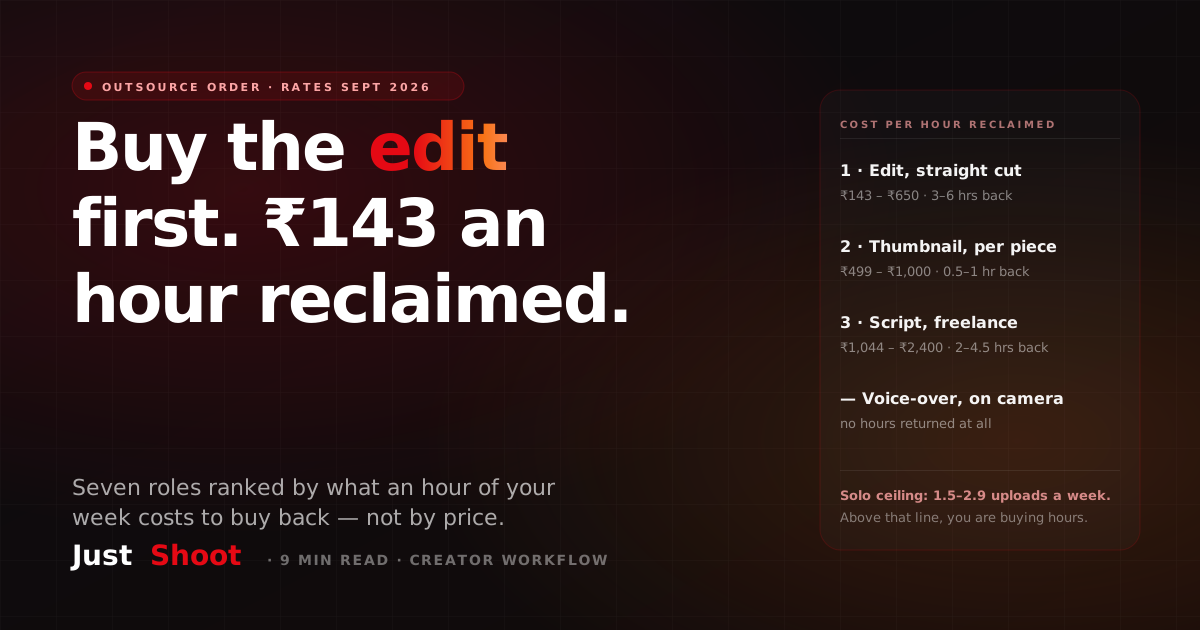
What an Indian YouTuber Should Outsource First (2026)
Seven roles, one order. A rupee-per-hour-reclaimed ranking built from rates this site captured between 11 and 23 September 2026, plus the break-even views each purchase has to earn.

What an Indian Video Agency Charges Per YouTube Video (2026)
Published agency package prices, minimum project sizes and GST-registered vendor day rates, captured 22 September 2026 — and why one video is below most agencies' floor.
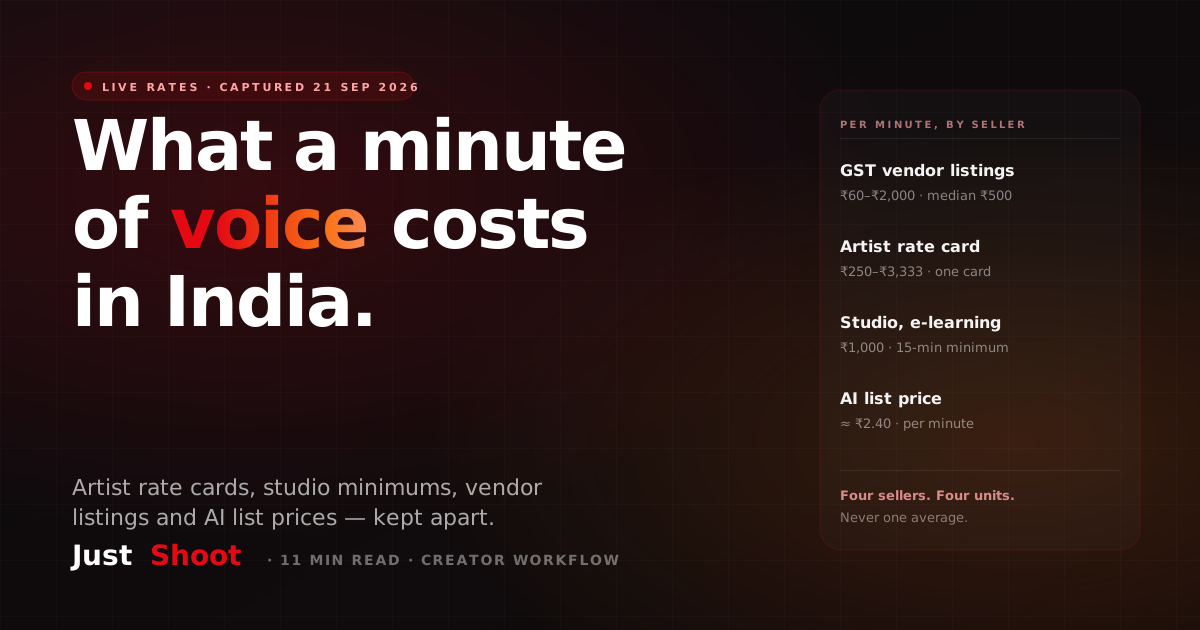
Voice-Over Artist Charges in India for YouTube (2026)
Artist rate cards, studio minimums, GST-vendor listings and AI list prices, captured 21 September 2026 — why the same minute costs ₹43 or ₹3,333.