How Many YouTube Videos Should You Post Per Week in India (2026)
How many YouTube videos per week for an Indian channel in 2026 — a specific cadence, the weekly hour cost of each one, and why scripting is the constraint that breaks creators.
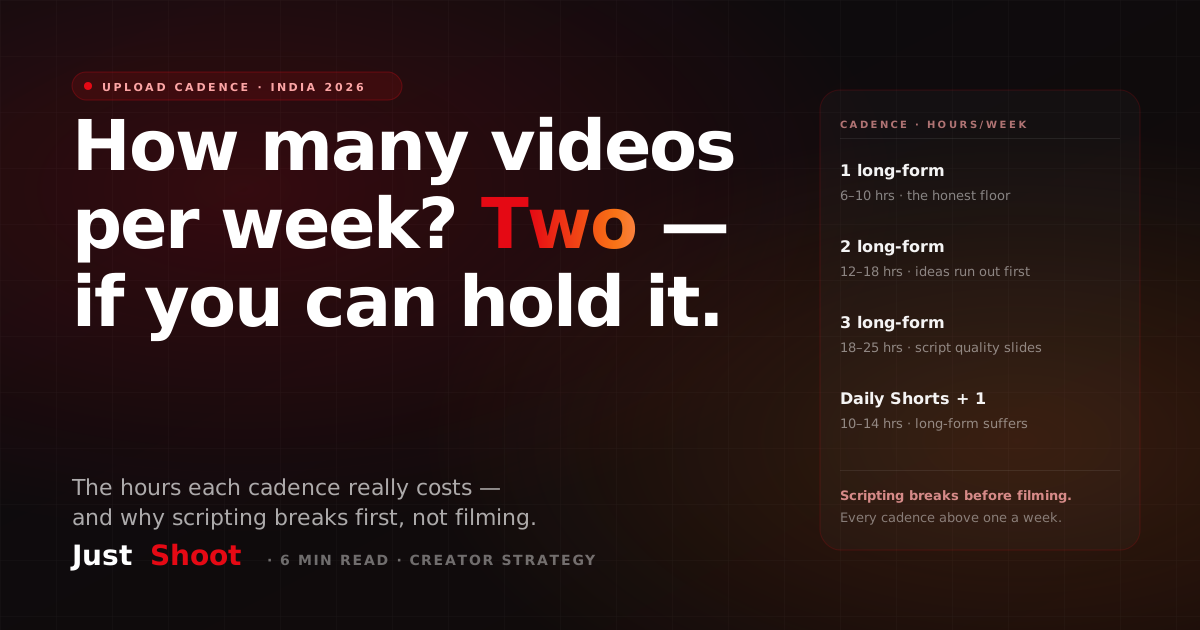
How Many YouTube Videos Should You Post Per Week in India (2026)
By Ashok Sachdev, Founder of JustShoot · Published 2026-09-07
Short answer: two videos a week if you are building, one if each video needs real research, and never a number you cannot hold for twelve months. The right cadence is not the one that grows fastest on paper — it is the highest number you can still hit in month nine, when the novelty is gone and you have a wedding, a deadline and a fever in the same fortnight. Pick by the hours you actually have, not by what a bigger channel posts.
Almost every answer to this question is a number with no cost attached. "Post three times a week" is easy to write and impossible to audit. So this piece does the opposite: it starts from the hours each cadence costs an Indian creator working alone, and works backwards to a number you can defend.
Why the usual advice does not survive contact with an Indian channel
The advice circulating in English is mostly written for a full-time creator in a market with a high CPM, where one video can pay for the week that made it. That maths does not hold here. Most Indian creators building an audience today are doing it beside a job, a degree or a business, and the channel has to earn its hours against everything else in the day.
That changes the question completely. The constraint is not ambition. It is not the camera, and by 2026 it is not editing either — AI editing tools have collapsed that cost. The constraint is the hours, and where those hours actually go.
The part nobody budgets for: the script
Ask ten creators what takes longest and most will say editing. Then watch where the week actually goes.
Filming a ten-minute video takes about the length of the video plus setup and retakes. Editing, with the tools available in 2026, is fast and getting faster. But the script — deciding the angle, checking the claims, writing an opening worth staying for, and getting it to sound like you rather than like a press release — is the part that has not been compressed, and it is the part that silently eats the week. If the blank page is what actually stops you on a Thursday, the free Hinglish Script Template Pack gives you 30 hooks across 10 niches to start from instead of nothing.
It is also the part that gets skipped first when you are behind. That is exactly why cadence collapses: not because you ran out of time to film, but because you sat down on Thursday with nothing to say and pushed the upload to next week. Do that three times and the channel is dormant. If that is the pattern you recognise, the cadence is not the thing to fix first — see why YouTube burnout is the scripting bottleneck, not the effort.
What each cadence actually costs
Treat these as a starting frame to calibrate against your own last five videos, not as findings. Time your next video honestly, then substitute your real numbers — the shape of the answer will hold even if your hours differ.
| Cadence | Roughly, per week | What breaks first |
|---|---|---|
| 1 long-form/week | 6–10 hours | Nothing, if the topic is ready. This is the honest floor for a research-heavy channel. |
| 2 long-form/week | 12–18 hours | Topic pipeline. You run out of ideas before you run out of hours. |
| 3 long-form/week | 18–25 hours | Script quality. The third script is written tired, and retention shows it. |
| Daily Shorts + 1 long-form | 10–14 hours | Long-form quality. Shorts quietly cannibalise the hours the main video needed. |
The pattern worth noticing: at every level above one a week, the first thing to break is the writing, not the shooting. Which is why the answer to "how many videos per week" is really "how many scripts a week can you write without the quality sliding" — and most people have never measured that number.
How to pick yours, in one pass
- Time your next video end to end. Idea to upload, script time counted separately. Most creators are surprised by the split.
- Halve the hours you think you have. Whatever number you write down, real life takes about half of it back. Plan for the half.
- Divide, then subtract one. Available hours divided by hours-per-video, minus one, is your sustainable cadence. The subtraction is the buffer that survives a bad week.
- Hold it for eight weeks before raising it. Consistency at a lower number beats a higher number you abandon in month three. YouTube's system rewards a channel it can predict; so does an audience.
If that arithmetic lands you on one a week, that is a real answer, not a failure. A channel that publishes fifty-two solid videos in a year is far ahead of one that publishes twenty good ones and thirty rushed ones.
When the number you want is higher than the number you can hold
There are only three honest levers.
Batch the writing, not the filming. Most creators batch shoot days. The bigger win is batching scripts — writing four in one sitting, while you are already in the headspace, is much faster than writing four on four separate evenings.
Cut scope before cutting cadence. A tighter eight-minute video you can make twice a week beats a sprawling twenty-minute one you manage every ten days.
Take the scripting off your plate. This is the constraint, so it is the thing worth solving. JustShoot's nine agents research the topic, write the script in your own voice via a Tone Fingerprint built from your existing videos, fact-check it, then produce the thumbnail brief, SEO package and shorts — turning the week's bottleneck into a review pass instead of a blank page. Plans are Trial ₹0 for 7 days (2 scripts, no card), Starter ₹499/mo (3 scripts), Creator ₹999/mo (7 scripts, most popular), Pro ₹1999/mo (15 scripts), and Studio custom — GST-inclusive, monthly, a fixed number of scripts with no rollover. Details on the pricing page.
Whichever lever you pull, pull it before the cadence slips rather than after. Recovering a dormant channel is much harder than protecting a modest one.
FAQ
Is posting daily better for the YouTube algorithm in India?
Not on its own. Frequency helps only while quality holds — a daily upload that loses viewers in the first thirty seconds teaches the system your videos are not worth showing. A predictable weekly slot with strong retention beats an erratic daily one.
Do Shorts count towards my weekly cadence?
Treat them as a separate track. Shorts and long-form serve different jobs, and Shorts have a habit of eating the hours the long-form needed. If you are running both, budget them separately or the main video is the one that quietly gets worse.
What if I miss a week?
Publish the next one and say nothing. A missed week is a scheduling problem; an apology video makes it the channel's story. Then look at whether the cadence was ever sustainable, or just aspirational.
Should a new channel post more to grow faster?
More reps do help early, because you learn faster. But set the number by what you can hold for a year, not by what you can manage in the first excited month. The most common failure in a new Indian channel's first year is not a bad video — it is a cadence chosen in week one that nobody could keep by week twelve.
How long should each video be?
That is its own question, and the answer differs by niche and format — we cover it separately.
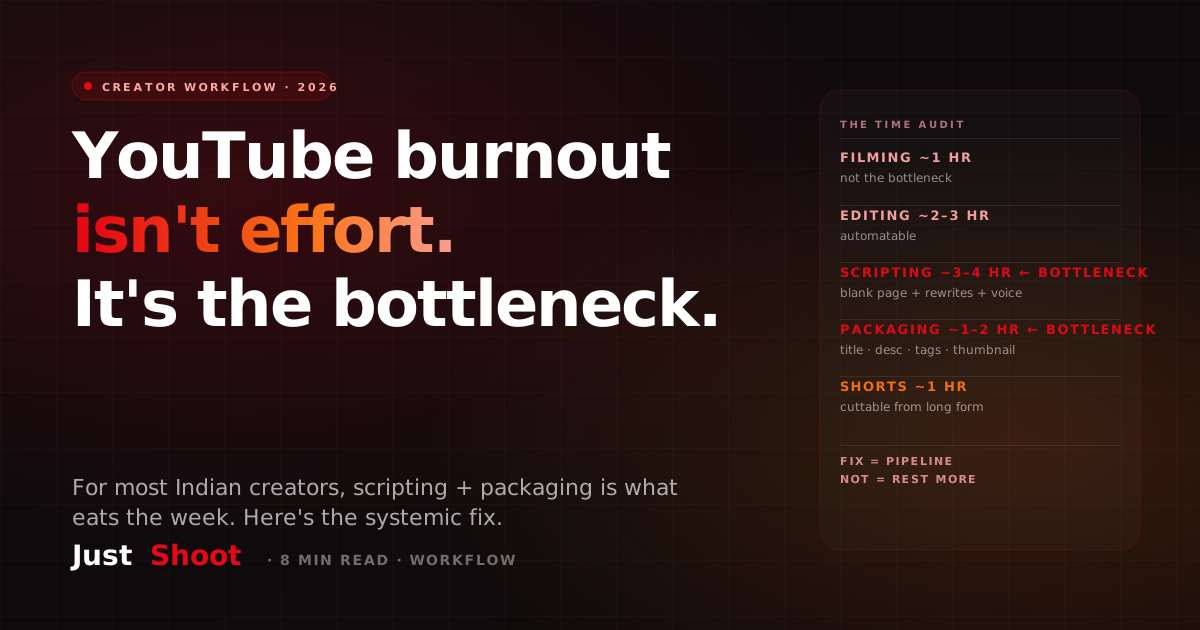
YouTube Burnout Isn't Effort — It's the Scripting Bottleneck (India 2026)
Most YouTube burnout in India isn't laziness — it's the scripting + packaging time per video. Here's the systemic workflow fix for weekly creators in 2026.

What an Indian YouTuber's Tool Stack Costs a Month (2026)
Three real creator tool stacks priced only from vendors' own India rupee pages on 26 September 2026 — ₹2,795, ₹4,961 and ₹11,053 a month, kept separate and never averaged.
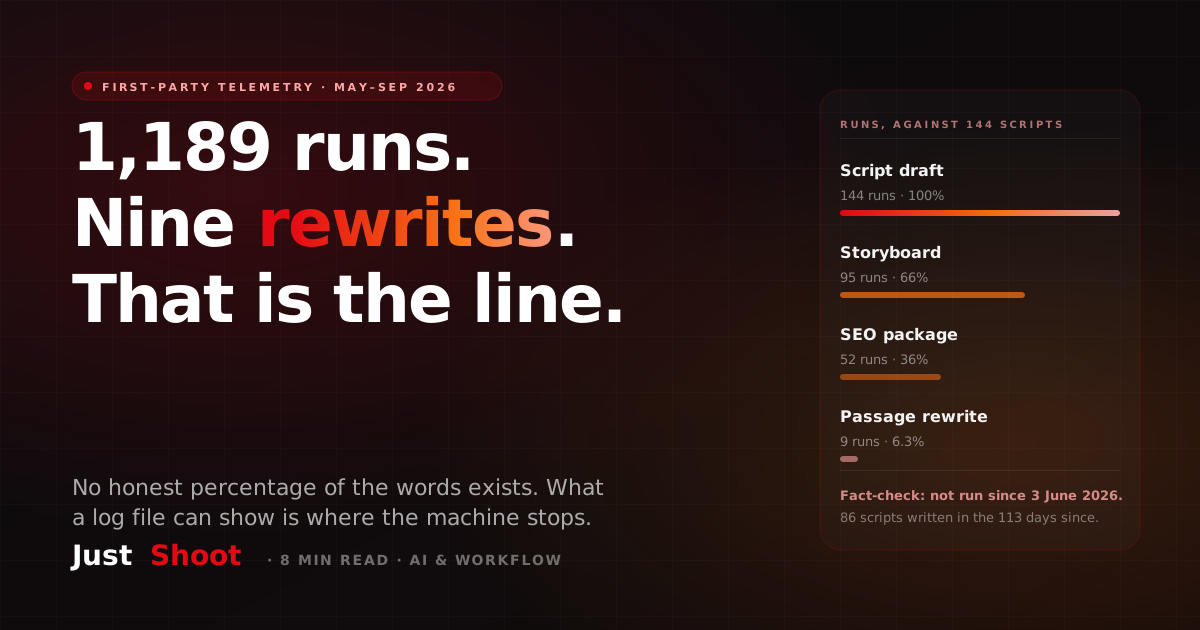
How Much of a YouTube Script AI Actually Finishes (2026)
Nobody can honestly give you a percentage of the words. We can give you 1,189 logged runs of a nine-stage script pipeline — which stages get used, which fail, and the one creators stopped running entirely.