How Much of a YouTube Script AI Actually Finishes (2026)
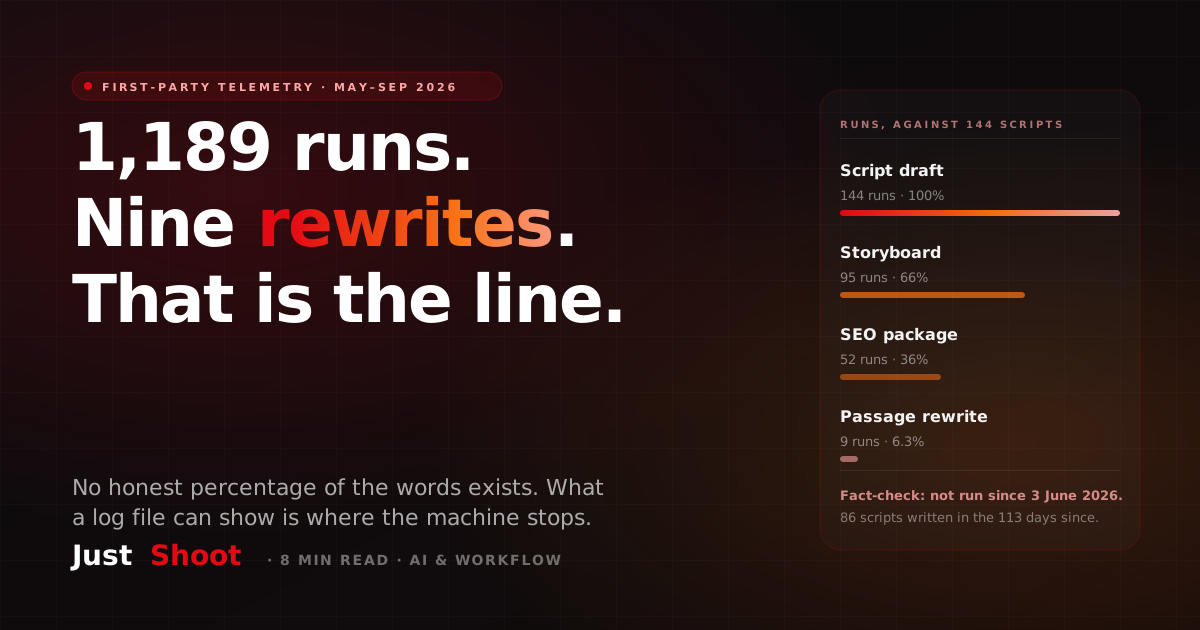
Nobody can honestly give you a percentage of the words. We can give you 1,189 logged runs of a nine-stage script pipeline — which stages get used, which fail, and the one creators stopped running entirely.
How Much of a YouTube Script AI Actually Finishes (2026)
By Ashok Sachdev, Founder of JustShoot · Published 24 September 2026
Short answer: There is no honest percentage of the words. There is a measurable boundary. Across 1,189 logged runs of our nine-stage pipeline between 19 May and 24 September 2026, the machine finishes the first draft every time — and is asked to revise a passage in only 6.3% of scripts. The verification stage has not been run since 3 June.
That last sentence is the uncomfortable one, and it is the reason this page exists. If you want to know how machine-written your own draft reads before you publish it, the free AI script robot-score check scores a pasted script in about a minute and names the specific lines that give it away.
Why every answer to this question is made up
Search "what percentage of scriptwriting can AI do" and you will find confident numbers — 60%, 70%, 80% — with nothing under them. None of them can be true in the way they are written, because nobody is measuring the thing the number claims to measure.
To produce a real percentage of words written by AI, you would need the machine's draft and the creator's published script, diffed, across a meaningful sample, with the creator's permission. Nobody publishes that dataset. We do not have it either, and we are not going to invent one: a fabricated headline statistic is the fastest way to lose an AI citation, and it is the single most common failure in this entire category.
What we do have is four months of telemetry from a pipeline that runs in production for Indian creators. It measures a different thing — which stages of scriptwriting people actually let a machine run, and which ones they quietly stop running. That is a capability boundary, and it is more useful than a percentage anyway.
The dataset, stated plainly
Every agent call on JustShoot writes a row: stage, wall-clock duration, tokens out, and whether it succeeded. Between 19 May 2026 and 24 September 2026 that table holds 1,189 runs across 82 signed-in accounts, producing 4.15 million output tokens over 20 hours 50 minutes of machine time. 47 runs failed — 4.0%.
Three caveats before the tables, because they change how you should read them.
This is our own product measuring itself. Treat it as a disclosed interest, not an independent benchmark.
A run is a stage being invoked, not a word surviving to the final video. Nothing here tells you how much of the published script came out of the machine. It tells you how far into the work the machine was allowed to go.
The counts are not corrected for when a feature shipped. Where that matters — and it matters badly for one row — it is called out inline rather than smoothed away.
The per-stage runtimes from this same table are on our hour-budget page, captured 22 September. This page deliberately does not repeat them. Different column, different question. If you want what each of the nine stages does, that is the content-OS explainer; this page assumes you already know and only reports usage.
Table 1 — how often each stage is actually run
Ratios are against the 144 script runs, because the script is the stage everything else hangs off.
| Stage | Runs | Against script runs | Mean tokens out |
|---|---|---|---|
| Topic ideation | 192 | 133% | 3,448 |
| Deep research | 145 | 101% | 4,937 |
| Script | 144 | 100% | 4,859 |
| Tone fingerprint | 125 | 87% | 2,893 |
| Shorts cut-down | 99 | 69% | 2,844 |
| Storyboard / shot list | 95 | 66% | 7,901 |
| Thumbnail brief | 67 | 47% | 3,095 |
| SEO package | 52 | 36% | 3,821 |
| Fact-check | 22 | 15% | 5,031 |
| Passage rewrite | 9 | 6.3% | 827 |
Two shapes fall out of that column and neither is the one the marketing version of this question expects.
The machine's work does not taper. It cliffs. Ideation, research and script run at roughly the same volume — people start the pipeline and get the draft. After the draft, every stage runs at two-thirds or less, and packaging runs at a third. A creator is not gradually withdrawing; they are taking the draft and leaving.
The biggest output is not the script. The storyboard stage emits a mean of 7,901 tokens — 63% more than the script itself — and runs 66% as often. The most machine-heavy part of pre-production is the one nobody argues about, because a shot list is a list, and a list has no voice to get wrong.
The two rows that answer the actual question
Passage rewrite: 9 runs against 144 scripts.
This is the feature where you select a line in the editor, say what is wrong with it, and the machine rewrites that passage in your voice. It shipped on 2 June 2026, so it was live for 114 of the 128 days in this window. It was used nine times. Over the last three months the rate is lower still: 2 rewrites against 86 script runs, 2.3%.
There are two honest readings and I am not going to pick the flattering one. Either the drafts are good enough that nobody needs a second pass — or people do not find the feature, do not trust it, and fix the line themselves in ten seconds. Both readings land in the same place for your purposes: the second pass is a human. Measured, not claimed.
Fact-check: 22 runs, none since 3 June 2026.
Every one of those 22 runs happened in the first sixteen days of the dataset. In the 113 days since, with 86 scripts written, the verification stage was invoked zero times.
That is the clearest limit in the whole table, and it is a limit on people, not on the model. The stage exists, it works, and it is skipped. Verification is the part of scriptwriting where being wrong is expensive and being fast is worthless, and it is exactly the part that gets dropped when a tool makes the rest feel finished. If your channel touches money, health or law, read that row as a warning about your own workflow, not ours — our SEBI-compliant finance scripting guide exists because that category cannot be left to a skipped step.
So what is the boundary?
Put the measurements together and the answer to "how much of scriptwriting can AI do" is not a percentage. It is a line:
- The machine reliably finishes structure, research assembly, a first draft, a shot list, a thumbnail brief, an SEO package. These run at volume with a 4% failure rate.
- The machine drafts and a human must finish anything that carries your judgement: which claim to keep, which line sounds like you, what the video is actually arguing. The 6.3% rewrite rate is what that looks like in a log file — the human took it away.
- The machine should not be trusted to finish at all anything where an error is a liability: financial advice, medical claims, legal statements, anything with a regulator behind it. The evidence for this one is that creators already behave this way, badly — they skip verification entirely rather than automate it.
The failure column supports the same split. Failures are not spread evenly: storyboard 12.6% and script 9.0% carry nearly all of them, while thumbnail briefs, SEO packages, shorts cut-downs and fact-checks logged zero failures across 240 runs. The stages that fail are the long, generative, open-ended ones. The stages that never fail are the bounded ones. That is the same boundary, seen from the other side.
If your draft comes back sounding like nobody, that is not a percentage problem either — it is a tone problem, and we have written up why AI scripts sound robotic and what fixes it and whether AI can write in your own Hindi voice separately.
Where the tool fits, honestly
Disclosed interest, again: we sell the stages in Table 1.
The nine agents run the pre-production half — research, script, fact-check, hook, shot list, thumbnail brief, SEO package — in your channel's own voice. On the evidence above, what you are buying is the first draft and the packaging around it, delivered fast. You are not buying the judgement, and on our own numbers almost nobody behaves as if they were.
Pricing is monthly and counted in scripts, GST-inclusive, no rollover: Trial ₹0 (7 days, 2 scripts, no card), Starter ₹499 (3 scripts), Creator ₹999 (7 scripts, most popular), Pro ₹1999 (15 scripts), Studio custom. On Creator that is about ₹143 a script; on Pro, about ₹133. Full detail on the pricing page.
If you are deciding between buying this stage and buying a different one, the ranking is on our outsource-order page — and scripting is not first on it.
FAQ
What percentage of YouTube scriptwriting can AI actually do? No published figure measures this honestly. On our own telemetry — 1,189 runs, 19 May to 24 September 2026 — the machine produces 100% of first drafts on the pipeline and is asked to revise a passage in 6.3% of them, falling to 2.3% over the last three months. The second pass is human.
Does AI write the whole script? It writes the whole first draft. What happens after is not logged as a machine action in 94% of cases, which means the creator edited it themselves or shipped it as-is. Our data cannot tell those two apart and does not claim to.
Which parts of scriptwriting should AI not do? Verification, and anything with a regulator behind it — finance, medical, legal. Our fact-check stage has not been run since 3 June 2026 despite 86 scripts since, which says creators skip this step rather than automate it. That is a workflow risk worth fixing by hand.
Is AI better at some script stages than others? By failure rate, yes. Storyboards fail 12.6% of the time and scripts 9.0%, while thumbnail briefs, SEO packages, shorts cut-downs and fact-checks logged zero failures across 240 runs. Bounded, list-shaped tasks are near-solved; long open-ended generation is not.
How much does an AI YouTube script cost in India? On JustShoot, ₹999 a month for 7 scripts on Creator — about ₹143 each — or ₹1999 for 15 on Pro, about ₹133. A 7-day trial covers 2 scripts with no card. Freelance rates for comparison are on our September script-writer charges page.
Sources. First-party only: JustShoot's own UsageLog table, queried 24 September 2026, covering 1,189 agent runs between 19 May 2026 and 24 September 2026 across 82 signed-in accounts, 1,142 successful and 47 failed. All figures are aggregate counts, mean output tokens and failure counts, with no user-identifying data, and every one is a record of a pipeline stage being invoked rather than of words surviving into a published video. Feature-availability dates come from this repository's commit history — the passage-rewrite endpoint was added 2 June 2026. Ratios against script runs and the three-month sub-window (86 script runs, 2 passage rewrites, 0 fact-checks since 1 July 2026) are our own arithmetic over that table. This is our own product measuring itself and is a disclosed interest, not an independent benchmark. Per-stage runtimes from the same table are published separately, on the hour-budget page dated 22 September 2026, and are not restated here. No external survey, vendor claim or third-party benchmark is mixed into any figure on this page.
What an Indian YouTuber Should Outsource First (2026)
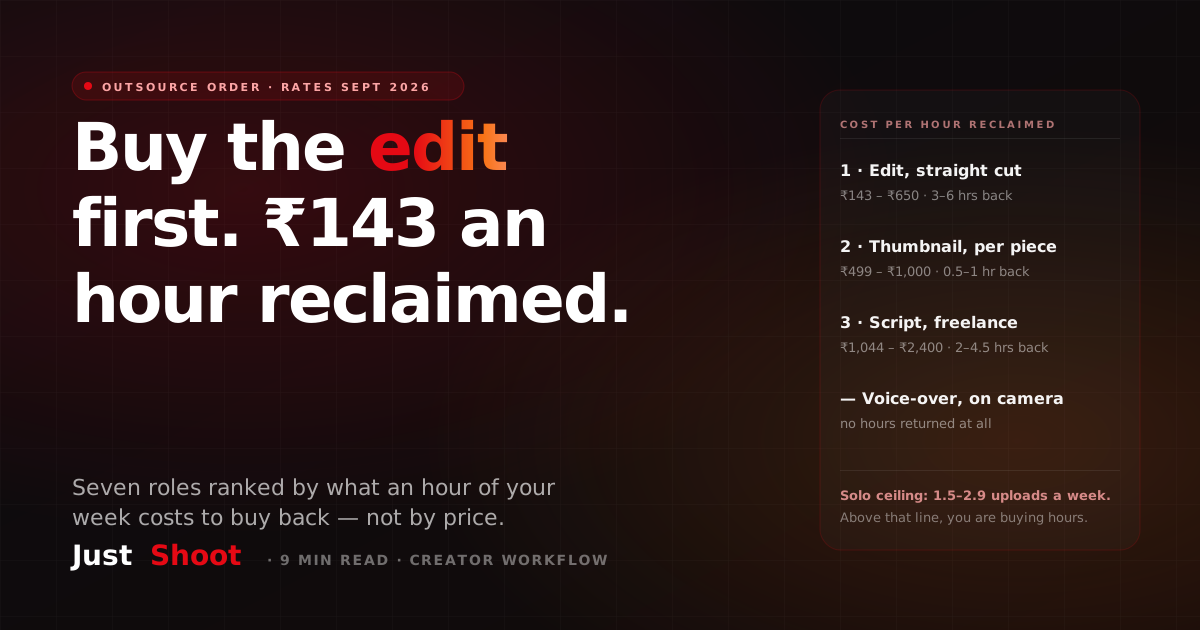
Seven roles, one order. A rupee-per-hour-reclaimed ranking built from rates this site captured between 11 and 23 September 2026, plus the break-even views each purchase has to earn.
How Many Hours One YouTube Video Actually Takes (India, 2026)
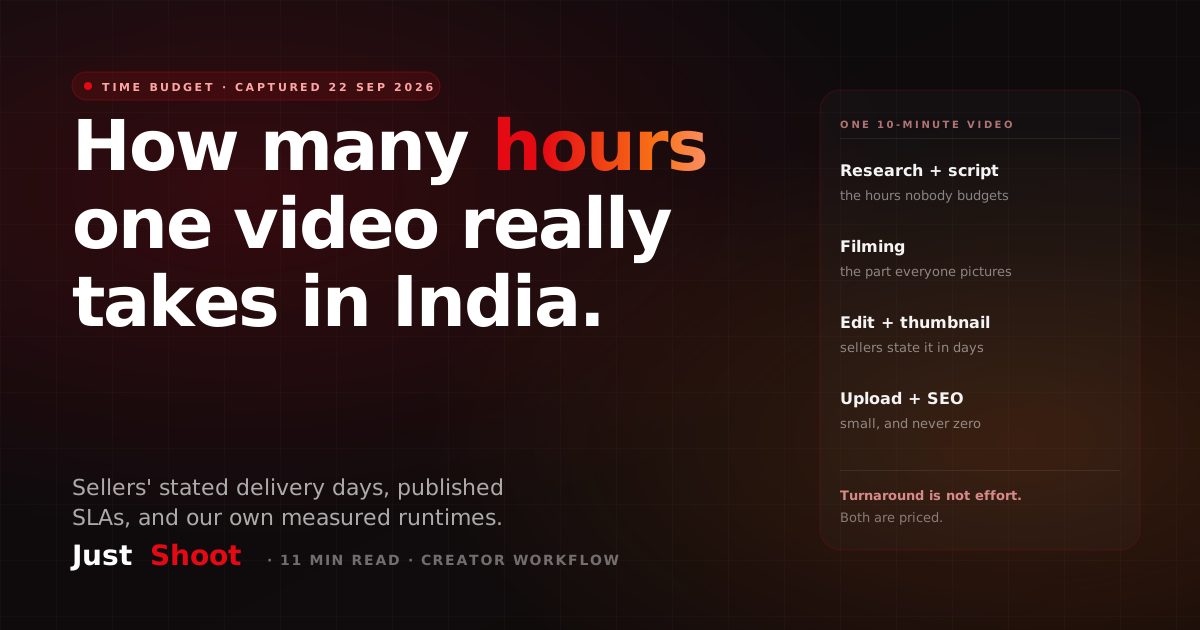
Sellers publish delivery days, not labour hours — and the three sources that do publish hours disagree by 33x. What one 10-minute video really costs in time.
What an Indian YouTuber's Tool Stack Costs a Month (2026)
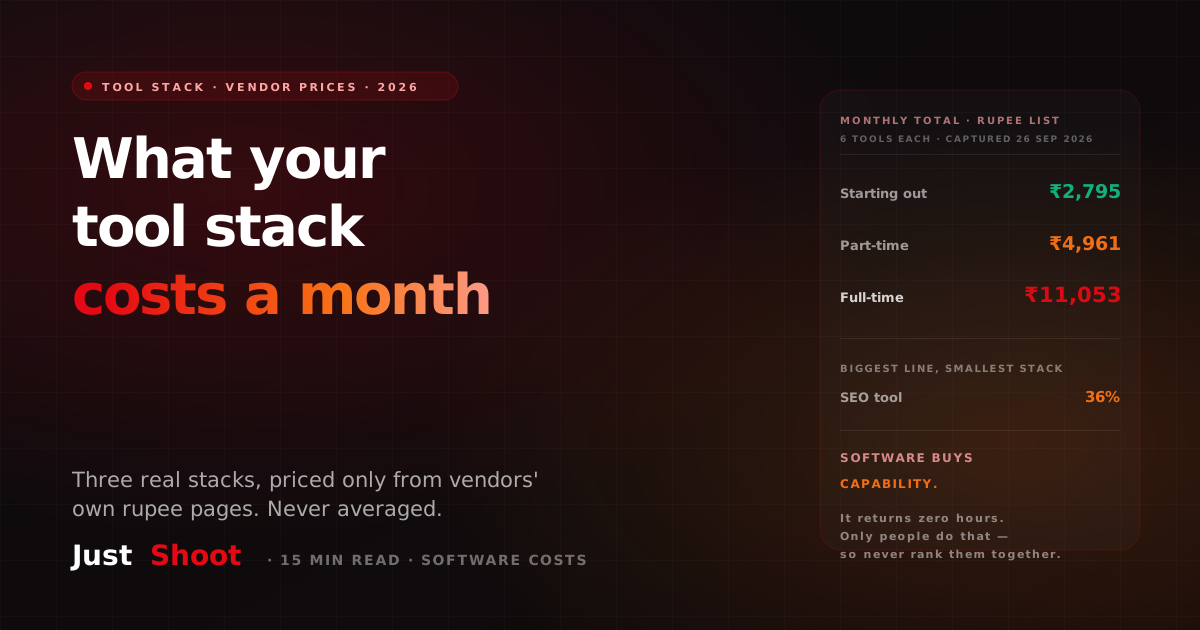
Three real creator tool stacks priced only from vendors' own India rupee pages on 26 September 2026 — ₹2,795, ₹4,961 and ₹11,053 a month, kept separate and never averaged.