What an Indian YouTuber Should Outsource First (2026)
Seven roles, one order. A rupee-per-hour-reclaimed ranking built from rates this site captured between 11 and 23 September 2026, plus the break-even views each purchase has to earn.
What an Indian YouTuber Should Outsource First (2026)
By Ashok Sachdev, Founder of JustShoot · Published 24 September 2026
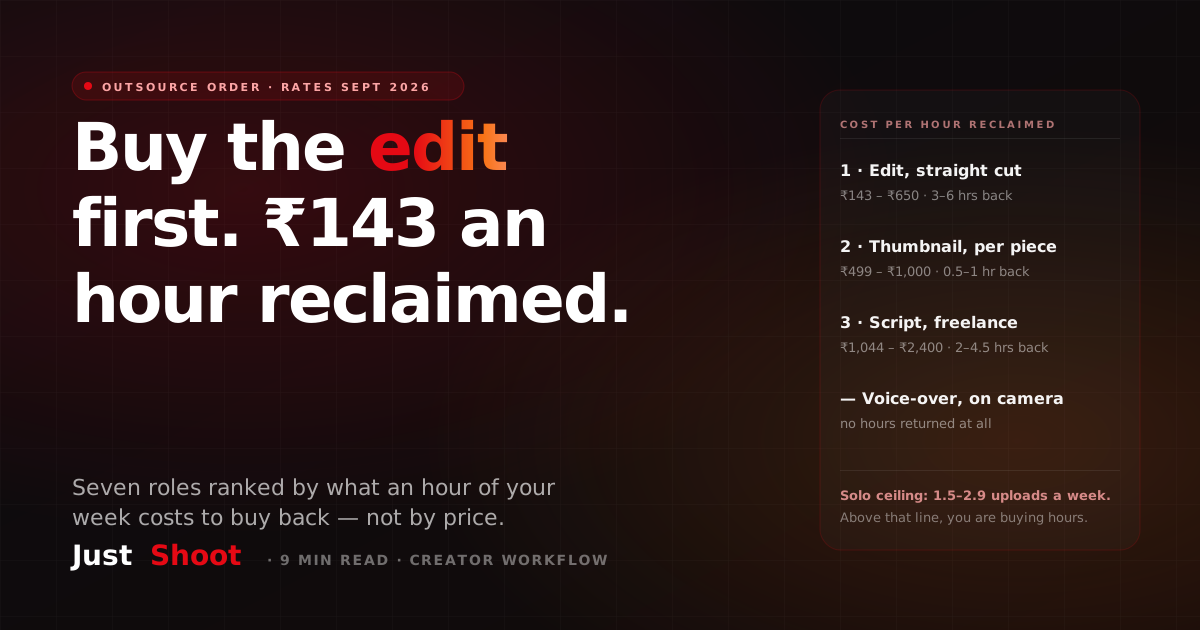
Short answer: Buy the edit first. On rates we captured in September 2026 it returns 3–6 hours a video at roughly ₹143–₹650 an hour — the cheapest hour on the board and the biggest block. Thumbnail second, script third. Voice-over and dubbing reclaim no hours at all for most channels.
That ordering is arithmetic, not opinion, and the arithmetic below is done in public. If you are not sure which of these roles your channel even needs yet, the free 90-second creator quiz sorts you into one of five working shapes first — the answer for a reviewer with 40 minutes of raw footage is genuinely not the answer for an educator with a whiteboard.
Why "what should I outsource first" has no answer on this internet
Search the question and you get lists. Every list contains the same seven roles — editor, thumbnail designer, script writer, voice-over artist, researcher, manager, agency — in no particular order, with no price attached and no size of channel named. A list is not a decision.
We have spent the last three weeks pricing those roles one at a time, each on its own capture date, each from named sellers, and each kept in its own post: script writers (11 September), video editors (20 September), thumbnail designers and voice-over artists (21 September), production agencies and the hour budget for one video (22 September), and dubbing (23 September).
This page does not repeat any of those tables. Every rate here is linked back to the post that captured it, on the date it was captured. What this page adds is the one thing seven price pages cannot tell you on their own: the order.
The only ranking that works: rupees per hour reclaimed
A price alone cannot be ranked. ₹499 for a thumbnail and ₹4,700 for a script are not comparable numbers, because they buy back different amounts of your week.
So divide. Take what each role costs, divide by the hours it actually removes from your own calendar, and you get one comparable figure: what an hour of your life costs to buy back. The hour figures come from our hour-budget page; only the editing range there carries a published external source (Increditors, 16 March 2026, 3–6 hours for a 10–20 minute talking head), and the rest are marked as our own estimates on that page. The division is mine.
| Role, as bought | Hours it removes | Cost, from the linked capture | Cost per hour reclaimed |
|---|---|---|---|
| Editing — straight cut | 3–6 | ₹860–₹1,950 per video | ₹143–₹650 |
| Thumbnail — listed per piece | 0.5–1 | ₹499–₹500 per piece | ₹499–₹1,000 |
| Scripting — freelance, researched | 2–4.5 | ₹4,700–₹4,800 per script | ₹1,044–₹2,400 |
| Whole video — published agency package | 7–13.5 | ₹15,000 per video at 10 videos | ₹1,111–₹2,143 |
| Editing — full service | 3–6 | ₹7,300–₹24,000 per video | ₹1,217–₹8,000 |
| Thumbnail — with A/B variants | 0.5–1 | ₹1,609–₹1,664 average bid | ₹1,609–₹3,328 |
| Voice-over — on-camera channel | 0 | median ₹500 per minute listed | no hours returned |
Three things fall out of that table that no list of seven roles will tell you.
The cheapest hour and the biggest block are the same purchase. Editing is both the largest single chunk of the video and the only role where the cheap end of the market is genuinely cheap per hour. Nothing else on the board comes close to ₹143.
The gap inside editing is larger than the gap between roles. A straight cut and a full-service edit differ by up to 55x per hour reclaimed. Which one you are buying is a bigger decision than whether you are buying. The variable, as the editor page found, is who decides what gets cut — and that is decided by how much raw footage you hand over.
An agency is not the extravagance it looks like. ₹15,000 for a whole video works out mid-table per hour. It is not on this list because it is overpriced; it is impractical because of a floor. Clutch's India video-production ranking, dated 21 September 2026, shows 6 of 10 agencies will not start below $1,000 — more work than one video contains.
The two roles that give back no time at all
This is the part that saves money, so it goes before the sequence.
Voice-over, if you appear on camera, reclaims zero hours. You are already speaking while you film. Hiring a voice is a change in the product, not a purchase of time, and it should be judged as such. It belongs on the list only for faceless channels, where it substitutes for your recording hour rather than duplicating it — and even then, on the voice-over capture, the median GST-registered listing of ₹500 a minute puts a ten-minute narration near ₹5,000 against roughly an hour of work replaced. It is the worst ratio on the board.
Dubbing reclaims nothing either — it adds an output. Localising into a second language does not remove a single hour from the video you already make. It is a distribution bet on an audience you do not have yet, and it should be funded from a growth budget, not a time budget. The dubbing capture puts human vendors at ₹299–₹3,000 a minute and AI list prices near ₹40; either way, the hour count of your existing workflow is unchanged.
Can your channel actually pay for it?
An hour reclaimed is only worth buying if the video earns the money back. Our earnings breakdown puts Indian long-form RPM at roughly ₹40–₹80 for entertainment and ₹100–₹150 for finance and education. Divide the purchase by the RPM and you get the number that actually decides this: how many monetised views one video has to earn before the purchase is free.
| Purchase | Break-even at ₹150 RPM | Break-even at ₹40 RPM |
|---|---|---|
| Thumbnail, ₹499 | ~3,300 views | ~12,500 views |
| Straight-cut edit, ₹860 | ~5,700 views | ~21,500 views |
| Freelance script, ₹4,700 | ~31,300 views | ~117,500 views |
| Agency video, ₹15,000 | ~100,000 views | ~375,000 views |
Read those as monetised long-form views, not total views. If your traffic is mostly Shorts — ₹5–₹30 per 1,000 on the same page — every row multiplies by five to ten and most of the table stops making sense.
That is the honest gate. A channel doing 8,000 views a video in entertainment cannot pay for a freelance script out of the video, and buying one anyway is a subsidy from your salary. There is nothing wrong with subsidising your own channel. There is something wrong with not knowing you are.
The sequence, by what you upload
Four bands. The hour figures are the 7–13.5 hours per video from the hour-budget page; the cadence arithmetic is mine.
Under one upload a week, not yet monetised. Buy nothing. Every row of the break-even table needs views you do not have, and at this stage your constraint is repetitions, not hours. Our cadence guide makes the same case from the other direction.
One upload a week, monetised, 10k–50k views a video. Buy the thumbnail. Not because it returns the most time — it returns half an hour — but because it is the smallest cheque that clears the break-even table, and it is the one purchase where the output is measurable within 48 hours by CTR. It is the cheapest way to find out whether you are any good at briefing a freelancer before you write a bigger cheque.
Two uploads a week. Buy the edit, straight cut. This is the band where the arithmetic turns hard: at 7–13.5 hours a video, two uploads is 14–27 hours a week. Epidemic Sound's Future of the Creator Economy Report 2024 found 49% of monetising creators already spend 20 or more hours a week on content (n=1,500 via Pollfish, March 2024, plus n=1,000 in May 2024; countries not specified). Reclaiming 3–6 hours a video at ₹143–₹650 an hour is what makes the second upload survivable. Shoot less raw footage in the same month and you will pay the bottom of that range rather than the top.
Two or more uploads a week, and the blank page is what slips. Only now does the script come up for purchase — and on a rupee ranking it is the most expensive of the three core roles per hour reclaimed, at ₹1,044–₹2,400. That is the real reason it is third, and it is worth stating plainly, because "outsource your scripts first" is the most common advice on this question and the numbers do not support it.
The solo ceiling, since the arithmetic gives it away: at 7–13.5 hours a video and 20 hours a week, a creator who buys nothing tops out between 1.5 and 2.9 uploads a week. Everything above that line is purchased, in one currency or another.
Where "do it yourself" is the right answer
- Anything, below monetisation. Nothing pays back.
- The thumbnail, while you are still learning what your audience clicks. The thumbnail capture found that variants, turnaround and CTR-watching are what move the price. If nobody on your side is reading the CTR, you are buying artwork, not a result.
- The voice, if you are on camera. Zero hours returned.
- Dubbing, before the original language works. A second language multiplies whatever the first one is doing, including nothing.
- An agency, at one video. Six of ten ranked Indian agencies will not quote below $1,000.
Where the tool fits, honestly
Disclosed interest: we sell the third row of that first table, so read this paragraph knowing that.
JustShoot does not film or edit — it runs the pre-production half: research, script, fact-check, hook, shot list, thumbnail brief, SEO package, in your channel's own voice. On Creator at ₹999 a month for 7 scripts, that is about ₹143 a script. Against the 2–4.5 hours the scripting block takes, the cost per hour touched lands near ₹32–₹72.
The honest caveat is the same one we put on the hour-budget page: that hour does not go to zero. It becomes reading and judging instead of generating, and the judging is the part that decides whether the video is good. What the arithmetic does change is the position of scripting in the sequence — it moves from the most expensive hour to buy back to one of the cheapest, which is the only reason it is worth mentioning on a page about order.
Pricing is monthly and counted in scripts: Trial ₹0 (7 days, 2 scripts, no card), Starter ₹499 (3 scripts), Creator ₹999 (7 scripts, most popular), Pro ₹1999 (15 scripts), Studio custom. GST-inclusive, no rollover. Full detail on the pricing page.
FAQ
What should an Indian YouTuber outsource first? The edit, as a straight cut. On rates captured on 20 September 2026 it costs ₹860–₹1,950 a video and removes 3–6 hours — roughly ₹143–₹650 per hour reclaimed, the cheapest rate and the largest single block in the workflow.
Should I hire a script writer or an editor first? An editor, on the arithmetic. A researched freelance script at ₹4,700–₹4,800 (captured 11 September 2026) against 2–4.5 hours works out at ₹1,044–₹2,400 per hour reclaimed — two to seven times the cost of the same hour bought from an editor.
How many views does a video need before outsourcing pays for itself? Divide the fee by your RPM. At ₹150 RPM a ₹499 thumbnail breaks even near 3,300 monetised views and a ₹4,700 script near 31,300. At ₹40 RPM those become roughly 12,500 and 117,500. Shorts RPM of ₹5–₹30 multiplies every figure by five to ten.
Is hiring a voice-over artist worth it for a YouTube channel? Not as a time purchase if you appear on camera — you are already speaking while filming, so it returns no hours. For a faceless channel it replaces roughly an hour of recording at a median listed rate of ₹500 a minute, which is about ₹5,000 for ten minutes.
When does hiring an agency make sense for one video? Rarely at one video. Clutch's India ranking of 21 September 2026 shows 6 of 10 agencies with a minimum project size of $1,000 or more. The one published per-video package we found was ₹15,000 on a 10-video commitment, falling to ₹11,900 at 30 — a commitment, not a single purchase.
Sources. No rate on this page was captured for it; each is linked to the JustShoot page that captured it, on its own date: freelance script bids and in-house script salaries, 11 September 2026; freelance editing bids and hourly rates, 20 September 2026; thumbnail vendor per-piece listings and freelance bids, 21 September 2026; voice-over vendor listings, artist rate cards and studio minimums, 21 September 2026; agency published packages and Clutch India minimum project sizes dated 21 September 2026, retrieved 22 September 2026; the per-stage hour budget, 22 September 2026, of which only the 3–6 editing hours carry a published external source (Increditors, 16 March 2026); dubbing vendor listings and AI list prices, 23 September 2026. RPM bands are from our India earnings breakdown. Listed vendor prices, marketplace bids, published rate cards and API list prices are kept apart on every one of those pages and are not averaged here either. All cost-per-hour-reclaimed figures, break-even view counts and cadence bands on this page are our own arithmetic over those linked inputs and are not sourced claims. Survey: Epidemic Sound, Future of the Creator Economy Report 2024, n=1,500 monetising creators via Pollfish in March 2024 plus n=1,000 in May 2024, countries not specified.
How Many Hours One YouTube Video Actually Takes (India, 2026)
Sellers publish delivery days, not labour hours — and the three sources that do publish hours disagree by 33x. What one 10-minute video really costs in time.
Voice-Over Artist Charges in India for YouTube (2026)
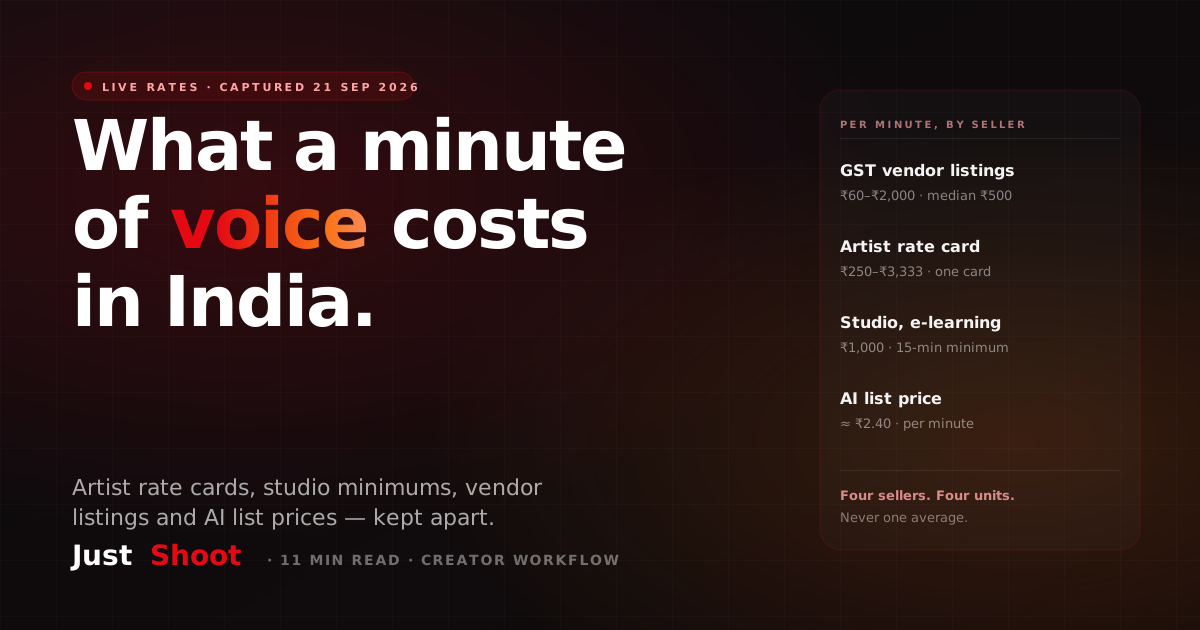
Artist rate cards, studio minimums, GST-vendor listings and AI list prices, captured 21 September 2026 — why the same minute costs ₹43 or ₹3,333.
What YouTube Thumbnail Designers Charge in India (2026)
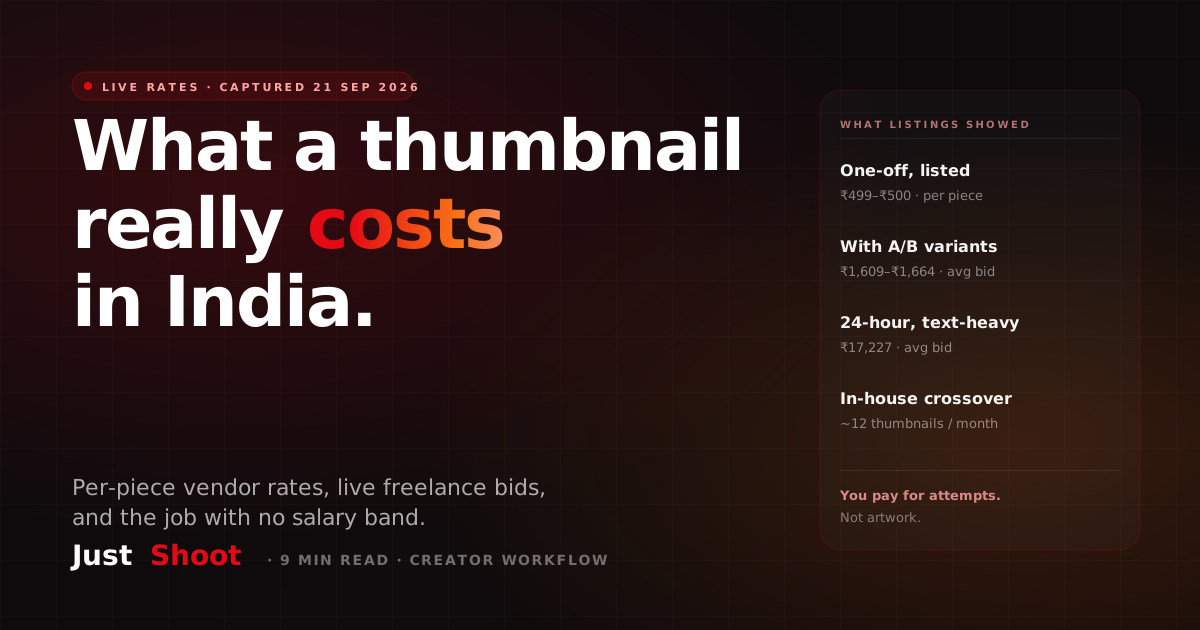
Per-piece vendor rates and live freelance bids captured 21 September 2026 — why the job has no salary band, and what actually moves the price.