Voice-Over Artist Charges in India for YouTube (2026)
Artist rate cards, studio minimums, GST-vendor listings and AI list prices, captured 21 September 2026 — why the same minute costs ₹43 or ₹3,333.
Voice-Over Artist Charges in India for YouTube (2026)
By Ashok Sachdev, Founder of JustShoot · Published 21 September 2026
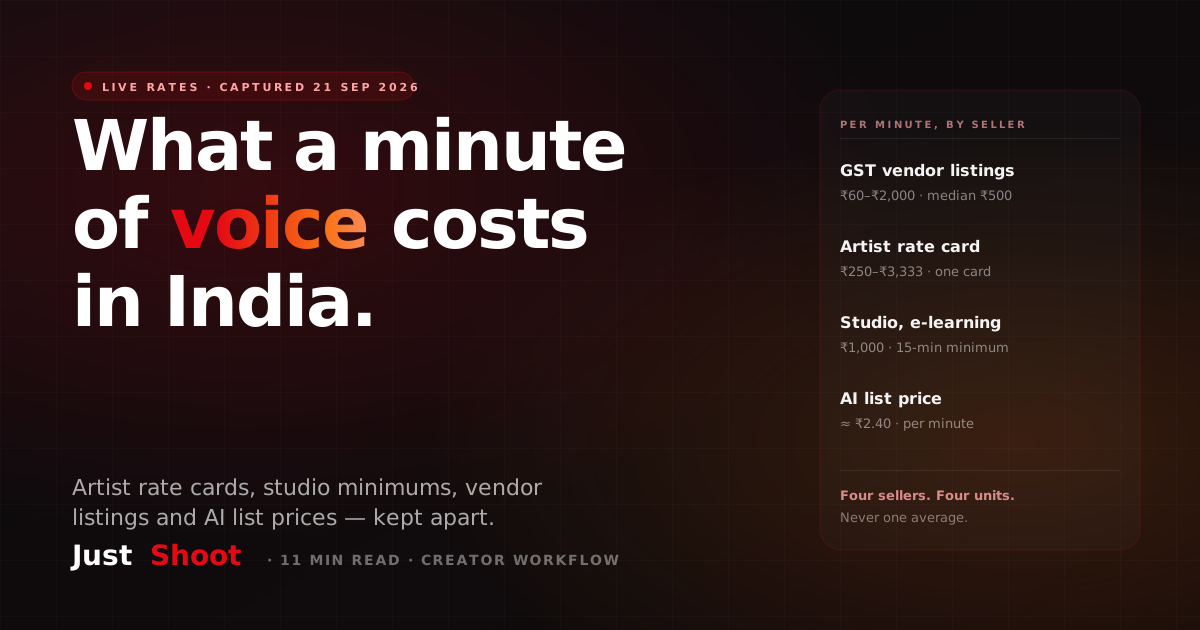
Short answer: On 21 September 2026, GST-registered Indian vendors listed voice-over at ₹60 to ₹2,000 per minute, median ₹500. A Mumbai artist's published card runs ₹250/min (audiobook) to ₹3,333/min (3-minute corporate film). Studios quote ₹1,000/min with a 15-minute minimum. AI list prices sit near ₹2.50/min.
Every figure below came from a page that was live on 21 September 2026. Four different kinds of seller are quoted, and they are kept in four separate tables on purpose — a listed vendor price, a published artist card, a marketplace bid and an API list price are not the same measurement, and averaging them would produce a number that describes nothing.
The same minute costs ₹43 or ₹3,333
Start with the spread, because it is the whole story.
The cheapest human minute I found on the day was an average bid of ₹862 for a 20-minute narration — about ₹43 a minute. The most expensive was on a published rate card: ₹10,000 for a corporate film of up to three minutes, or ₹3,333 a minute.
That is a 77x range for what a creator would describe identically: someone reads my script into a good microphone.
Nothing about the audio explains it. What explains it is that "a minute of voice" is not one product. It is at least four, sold by four kinds of seller, on four different pricing units — and creators shop across all four without noticing they have changed categories.
Table 1 — one artist's published rate card
This is the most useful single document in the research, because it is an individual Indian voice artist publishing his own prices rather than an agency aggregating other people's. Peter Abraham, a Mumbai-based voice-over artist, lists:
| Category | Published rate | Unit |
|---|---|---|
| E-learning | ₹1,000 | per minute, minimum 15 minutes |
| IVR | ₹400 | per prompt, minimum 20 prompts |
| Corporate film | ₹10,000 | up to 3 minutes (~420 words) |
| Explainer video | ₹10,000 | up to 3 minutes (~420 words) |
| Documentary | ₹18,000 | up to 10 minutes |
| Movies / games / TV | ₹15,000 | up to 10 minutes (~1,500 words) |
| Audiobook | ₹15,000 | per finished hour |
| Advertising (digital master) | ₹10,000 | per master film |
| Podcast | ₹10,000 | minimum 2 promos of 15 seconds |
Two lines in the fine print matter more than any headline number. Cutdowns are charged at "50 percent of the master rate." And studio fees and usage rights are billed separately, on actuals — they are not inside any figure above.
Now convert the card to a per-minute basis (that arithmetic is mine, not his):
- Audiobook, ₹15,000 a finished hour → ₹250 a minute
- Movies/games/TV, ₹15,000 for 10 minutes → ₹1,500 a minute
- Documentary, ₹18,000 for 10 minutes → ₹1,800 a minute
- Corporate/explainer, ₹10,000 for 3 minutes → ₹3,333 a minute
Within one artist's own card, the per-minute rate moves 13x. Same voice, same booth, same week. What changes is the unit being sold and where the audio is allowed to run — a documentary hour is bulk, a three-minute corporate film is a licensed asset, and an audiobook is the cheapest minute he sells because he is selling sixty of them at once.
This is the single most important thing for a YouTuber to understand before asking anyone for a quote, and I'll come back to it.
A second Indian artist, Susheel C, published cost bands on 5 June 2026 — ₹10,000–15,000 for a social/digital commercial on one platform for a year, ₹8,000–12,000 for a 5–10 minute corporate or explainer piece, ₹12,000–20,000 per finished audiobook hour. He labels them explicitly as "first conversation" figures, not fixed prices, and writes plainly: "This isn't my rate card." I am quoting them as his stated opening bands and nothing more.
Table 2 — what a studio quotes
Cosmic Sounds, an Indian studio, publishes an e-learning guide with a base of "Rs. 1000 per minute", a stated minimum charge of 15 minutes, a 10–20% discount on large projects, and a worked example: a one-hour recording of 9,000–9,500 words "can be charged around Rs. 60,000." Studio fees are described as "always extra charges."
That worked example is quietly useful: 9,000–9,500 words in sixty minutes implies 150–158 words per minute. Peter Abraham's card implies about 140 words per minute (420 words in three minutes). So two independent Indian sources put a professional read at roughly 140–158 wpm, which is the conversion you need to turn your script's word count into a quote.
The 15-minute minimum is the trap for creators. A typical YouTube upload runs eight to twelve minutes. At a ₹1,000/min studio rate with a 15-minute floor, an 8-minute video costs ₹15,000 — the same as a 15-minute one. You are paying for seven minutes of silence.
Table 3 — what GST-registered vendors list per minute
These are published seller prices on IndiaMART, which makes them firmer evidence than a bid: a rate you could transact against today.
| Listed rate | Seller | City |
|---|---|---|
| ₹2,000 / minute | Linguashine Communication Services Pvt Ltd | New Delhi |
| ₹1,300 / minute | Mahi Industries | Baruipur |
| ₹1,000 / minute | Myth Media Enterprises Limited | Noida |
| ₹600 / minute | Shree Enterprises | Muzaffarpur |
| ₹500 / minute | Muls N Ravs Entertainment Pvt Ltd | New Delhi |
| ₹500 / minute | Electro Solutions | Coimbatore |
| ₹400 / minute | Kumpenny Solutions | Navi Mumbai |
| ₹320 / minute | Sunridges Solutions Pvt Ltd | Hyderabad |
| ₹199 / minute | GT Manidham | Chennai |
| ₹60 / minute | Akan Trendtz | Bengaluru |
Median: ₹500 a minute. Spread: 33x. Not one of the ten states a language, a turnaround, a retake policy or a usage licence — which is exactly why the bottom of the list can be ₹60. A ₹60/min listing is a price for producing audio. It is not a price for producing audio you are licensed to monetise, or audio you can send back.
For a 10-minute video, the median listing puts you at ₹5,000.
Table 4 — the bid board, and a finding
Freelancer.in's voice-over board showed 53 jobs on the day. I read the 46 that were visible, and the useful result is not a price.
Only 13 of the 46 sold voice as the whole deliverable. The other 33 bundled narration into an animation, an explainer, a screencast or an edit — you cannot extract a voice rate from them because the client never priced one. And of those 13 voice-only jobs, most were not narration at all: they were accent-data collection for AI training (Australian English, Singaporean English, Thai, Hungarian, Slovak) or long-form audiobooks.
The two that a YouTuber would recognise:
| Brief | Average bid | Bids |
|---|---|---|
| Broadcast-quality male narration, 2,500 words, ~20 minutes, neutral American accent | ₹862 | 5 |
| Finished script, studio-quality professional narration (no runtime stated) | ₹2,969 | 24 |
The first works out to about ₹43 a minute — below the cheapest IndiaMART listing and roughly 1/23rd of the studio e-learning rate. It drew five bids. The second drew twenty-four.
So the finding worth the page is this: standalone YouTube narration barely exists as a category on the open bid board. Voice is overwhelmingly bought as a component of something else. When it is bought alone at creator scale, it is bid at data-entry prices and almost nobody bids. That is not a market with a rate; that is a market with a gap.
Table 5 — AI list prices, kept separate
These are published list prices, not quotes, and I have not mixed them into anything above.
| Service | Published price | Unit |
|---|---|---|
| Sarvam Bulbul v3 (text-to-speech) | ₹30 | per 10,000 characters |
| Sarvam dubbing — Starter | ₹40 (API) / ₹80 (Editor) | per minute of source media, per target language |
| Sarvam dubbing — Pro | ₹38 (API) / ₹75 (Editor) | per minute, per target language |
| Sarvam translate | ₹20 | per 10,000 characters |
ElevenLabs publishes in credits, not minutes or rupees — Free $0 / 10k credits a month, Starter $6 / 30k, Creator $11 / 121k, Pro $99 / 600k, Scale $299 / 1.8M, Business $990 / 6M. Because credits are not a time unit, I am not converting that into a per-minute figure to sit beside a rupee rate card. It stays in its own row.
Sarvam is the one that converts cleanly, because it prices in rupees per character. A 10-minute talking-head script at 140 wpm is about 1,400 words, or roughly 8,100 characters including spaces. At ₹30 per 10,000 characters that is about ₹24 — roughly ₹2.40 a minute. Those Sarvam dubbing rows price a different job from the rest of this page — they localise a video that already exists. What that costs end to end, from five GST-registered vendors listing ₹299–₹3,000 a minute down to the same ₹40 API line, is captured in what it costs to dub a YouTube video into an Indian language.
The crossover, stated in minutes
There is no crossover. That is the honest answer, and it is worth saying in minutes rather than as a verdict:
- The ₹15,000 studio minimum you pay before a single second of an 8-minute video is narrated buys roughly 102 hours of Bulbul v3 output at list price.
- One minute at the median ₹500 vendor listing costs what about 200 minutes of synthesis costs.
- Even the cheapest human minute in the entire dataset — that ₹43 average bid — is about 18x the AI list price.
Nobody should choose on those grounds, because the numbers are not close enough to be a decision. They are far enough apart that price has stopped being the variable. The question is no longer "which is cheaper", it is "what does the ₹5,000 buy that the ₹24 does not".
From the sources themselves, three things:
- Usage rights. The published card charges TV and radio at 25–40% above the digital base, per platform, and bills usage separately. The AI list price has no such concept, which means the licence question moves onto you.
- Direction and retakes. Every human source prices revisions or pickups as a negotiated term. None of the AI list prices mention them, because a re-render is not a retake — it cannot be told which word the sentence is about.
- Someone on the hook. A ₹60/min listing and a ₹24 render have this in common: no one is accountable for the read being right.
If you are trying to work out whether any of this is affordable against what the channel actually earns, put your real numbers into the YouTube income calculator before you commission anything — a ₹5,000 voice-over on a video earning ₹1,200 is a decision you want to make deliberately rather than discover afterwards.
And if you go synthetic, read the disclosure rules for AI voice on Indian YouTube first. That is a compliance question, not a cost one.
What the voice fee does not include
From the published terms across all five tables, budget separately for:
- Studio time. Both the artist card and the studio guide state it is extra, on actuals. It is never inside the per-minute number.
- Usage and licence. Digital-only for one year is the base assumption on both artist sources. Broadcast, paid ads and perpetuity are priced up.
- Cutdowns. 50% of the master rate on the published card. Your Shorts cut is a separate line item.
- The script. Not one of the ten vendor listings included writing. The read is the cheap part; the words are the part that decides whether the read matters.
- Retakes past the agreed round. Unspecified on nine of the ten listings.
How to brief so the quote is fair
Send five things and the spread on your quotes will collapse:
- Finished runtime in minutes AND the word count. These price differently — ₹/min versus a project cap — and giving both lets the vendor quote on whichever is cheaper for you. Use 140–158 wpm to sanity-check your own script.
- Where it runs, and for how long. "YouTube only, evergreen, no paid promotion" is a different licence from "and we may cut it into a pre-roll ad." Say it up front or pay for it later.
- Whether the quote includes the studio. In writing.
- Retake policy. How many rounds, and what counts as a retake versus a rewrite.
- Language and accent, precisely. "Hindi" and "Hinglish read by a Hindi-first speaker" are not the same job. If you are localising rather than originating, the regional-language script workflow sets up the brief properly.
For the rest of the production budget, the siblings to this post have the same treatment: script writers, video editors and thumbnail designers. Their numbers are not restated here.
Where the tool fits, honestly
JustShoot does not record audio and is not a voice tool. If you want that comparison, it is in AI voiceover tools versus script tools.
What it does is the layer above: the pre-production pipeline — research, script, fact-check, hook, thumbnail brief, SEO package — written in your channel's own voice, so whoever you hand the microphone to receives a script with the emphasis already decided. Every source above agrees that retakes and revision rounds are where voice-over budgets actually blow out, and a script that knows what it is arguing is the cheapest way to reduce both.
Pricing is monthly and counted in scripts: Trial ₹0 (7 days, 2 scripts, no card), Starter ₹499 (3 scripts), Creator ₹999 (7 scripts, most popular), Pro ₹1999 (15 scripts), Studio custom. GST-inclusive, no rollover. Full detail on the pricing page.
FAQ
How much does a voice-over artist charge per minute in India? On 21 September 2026, GST-registered vendors on IndiaMART listed ₹60 to ₹2,000 per minute, with a median of ₹500. An individual Mumbai artist's published card works out to between ₹250 a minute (audiobook, per finished hour) and ₹3,333 a minute (a 3-minute corporate film). Studios publish ₹1,000 per minute with a 15-minute minimum.
Why is the range so wide for the same work? Because a minute of voice is sold on four different units by four kinds of seller — a listed vendor price, a published artist card, a marketplace bid and an API list price. Even inside one artist's own rate card the per-minute figure moves 13x, driven by the unit of sale and the usage licence, not by the recording.
What does a 10-minute YouTube voice-over cost in India? At the median ₹500/min vendor listing, about ₹5,000. At a studio's ₹1,000/min with a 15-minute minimum, ₹15,000 — you pay the floor regardless. The cheapest comparable freelance bid on the day averaged ₹43 a minute, or roughly ₹430, and drew only five bidders.
Is AI voice cheaper than hiring a voice artist in India? By a margin large enough that price stops being the deciding factor. Sarvam's published text-to-speech list price is ₹30 per 10,000 characters — about ₹24 for a 10-minute script, roughly ₹2.40 a minute. Even the cheapest human minute found was about 18x that. What the human price includes and the list price does not is usage rights, directed retakes and accountability.
What is not included in a voice-over quote? Studio fees and usage rights are billed separately on both published Indian artist sources. Cutdowns run at 50% of the master rate. Broadcast and radio usage adds 25–40% per platform over the digital base. Scriptwriting is in none of the ten vendor listings, and retake terms were unspecified in nine of them.
Sources, all captured 21 September 2026: Peter Abraham (Mumbai voice-over artist) published rate card — nine categories, cutdowns at 50% of master, studio and usage billed separately on actuals; Susheel C / indianvoiceartist.com, dated 5 June 2026 — quoted as stated opening bands only, since the page explicitly says "This isn't my rate card"; Cosmic Sounds e-learning rate guide — ₹1,000/minute base, 15-minute minimum, 10–20% volume discount, ₹60,000 worked example for a 9,000–9,500-word hour, studio extra; IndiaMART "voice over recording" category — ten GST-registered sellers publishing per-minute prices, no language, turnaround, retake or licence terms stated on any of the ten; Freelancer.in voice-over board — 53 jobs listed, 46 visible and read, all figures are the "Avg Bid" shown on each project (what freelancers offered, not confirmed contract values), and 33 of the 46 bundled voice into a larger deliverable so no voice rate could be extracted; Sarvam AI published API pricing (text-to-speech ₹30/10k characters, dubbing ₹40/38/36 per minute per target language on API and ₹80/75/72 on the Editor flow, translate ₹20/10k characters); ElevenLabs published subscription tiers, quoted in credits and deliberately not converted to a per-minute rate. Listed vendor prices, published artist cards, studio guides, marketplace bids and API list prices are kept in separate tables throughout and are never averaged together. Per-minute conversions of project-capped rates and the character estimate for a 10-minute script (140 wpm, ~5.8 characters per word including spaces) are my arithmetic and are labelled as such. jdvoiceover.com returned 404 on the day; indianvoiceartist.com's homepage publishes no rate card and directs buyers to request an estimate.
What YouTube Thumbnail Designers Charge in India (2026)
Per-piece vendor rates and live freelance bids captured 21 September 2026 — why the job has no salary band, and what actually moves the price.
What YouTube Video Editors Charge in India (2026)
Real rates from listings live on 20 September 2026 — freelance per-video bids, hourly rates, in-house salaries, and when to stop freelancing.
What YouTube Script Writers Charge in India (2026)
Real rates from live listings captured on 11 September 2026 — freelance per-script bids, full-time salaries, and the per-video maths that tells you which one you actually need.