India's YouTube Creator Economy in Numbers (2026)
₹18,000 crore, 9.6 lakh jobs, 73% earning their main income: what YouTube's 2025 India report says, its fine print, and two figures the press got wrong.
India's YouTube Creator Economy in Numbers (2026)
By Ashok Sachdev, Founder of JustShoot · Published 3 October 2026 · Sources read 3 October 2026
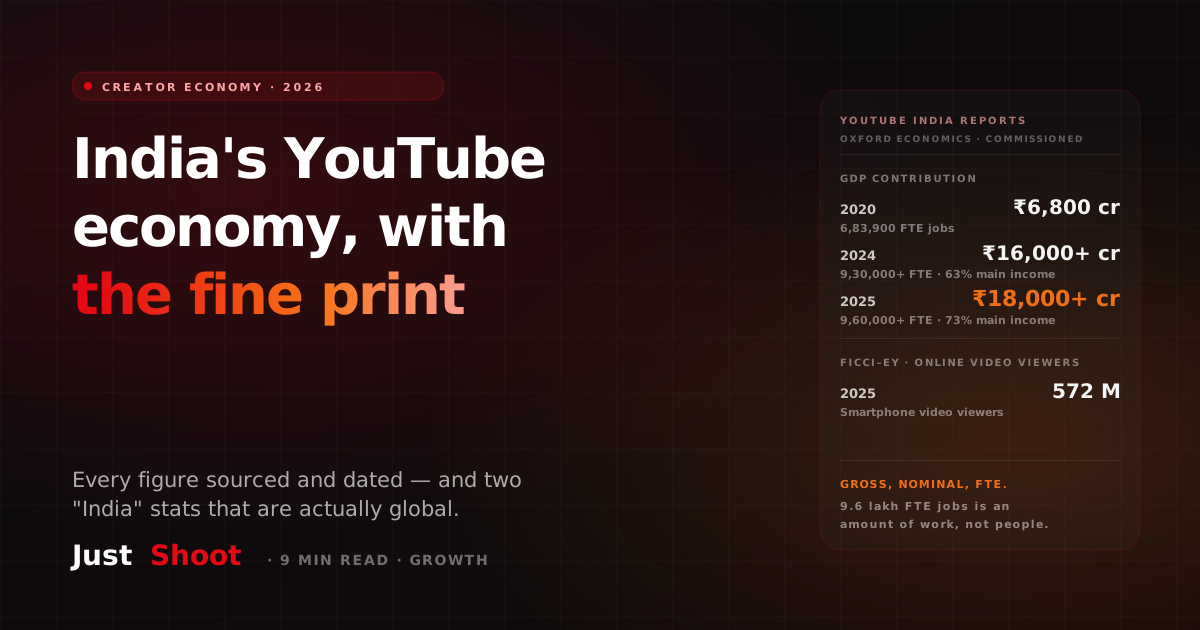
Short answer: YouTube's 2025 India report, built on Oxford Economics research, says the YouTube ecosystem added over ₹18,000 crore to India's GDP and supported over 9,60,000 full-time-equivalent jobs. It also says 73% of creators who earn money from YouTube call it their primary income, up from 63% a year earlier. YouTube commissioned the study.
Those are the headline numbers, and they are real figures from a real report. But a number is only as useful as its fine print. This page gives each figure with its source and date, then what the source itself says the figure covers. Two of the most-repeated "India" statistics from the 2026 coverage turn out, in the report, to be global figures.
The headline numbers, with their sources
GDP and jobs, 2020 to 2025
YouTube has published an India impact report built on Oxford Economics research several times. Lined up, they form a five-year series:
| Year measured | GDP contribution | Full-time-equivalent jobs | Source and date |
|---|---|---|---|
| 2020 | ₹6,800 crore | 6,83,900 | Oxford Economics / YouTube India report (PDF dated December 2021) |
| 2024 | over ₹16,000 crore | over 9,30,000 | YouTube India impact announcement, reported 18 November 2025 |
| 2025 | over ₹18,000 crore | over 9,60,000 | YouTube Impact Report India 2025 (PDF, published September 2026) |
From 2020 to 2025 the GDP figure grew about 2.6 times; from 2024 to 2025 it grew about 12.5%. Those growth rates are my arithmetic on the published figures. They are nominal rupees, not adjusted for inflation.
Creators who live on it
- 2025: "73% of creators who earn money from YouTube say YouTube is their primary source of income." (2025 report, attributed to Oxford Economics research.)
- 2024: "63% of our monetizing creators agree YouTube is their primary source of revenue," said YouTube India's managing director Gunjan Soni at the November 2025 announcement.
A ten-point jump in a year is large. Before quoting it, read the survey section below — it explains who was asked.
Other India figures in the 2025 report
- Creators who earn money from YouTube supported over 3,00,000 apprentices in the last year.
- Over 15% of watch time on content from channels in India comes from viewers outside India.
- 73% of small and medium businesses with a YouTube channel say it helped them expand beyond the platform.
All three are attributed in the report to Oxford Economics research.
Two "India" numbers that are actually global
This is the part most coverage missed. The 2025 report marks every statistic with a footnote: one asterisk for Oxford Economics research, two for "YouTube first-party data, Global, 2022–2025".
Two widely repeated figures carry the global footnote:
- "More than 18,000 channels have over 1 million subscribers." Indian coverage reported them as Indian channels — for example Social Samosa ("more than 18,000 YouTube channels in India") and the Free Press Journal on 29 September 2026 ("Over 18,000 Indian channels"). The report's footnote says the figure is global first-party data.
- "The number of YouTube channels making 6 figures or more in revenue (INR) is up more than 30% year over year." The INR framing makes it read as an India figure. The footnote says it is global first-party data, 2022–2025. YouTube's own "How YouTube Works" impact page gives the same label.
Neither figure is wrong. They are just not India figures, and quoting them as India figures overstates what is known about Indian channels specifically.
What the fine print says about the headline numbers
Oxford Economics publishes its methodology separately, and four details in it change how far the numbers can be pushed.
1. Who the creator survey reached. The creator survey "was sent out by YouTube to its creator community in each country", and Oxford Economics then checked the responses for a spread of channel sizes. India had the largest creator sample of any market: 43,300 responses, against 6,100 in the US. That is a big sample, but it is not a random sample of Indian creators. It is people who answered a survey YouTube sent them. The 73% figure is the share of those respondents who earn money from YouTube, not of all Indian creators.
2. When it was asked. The surveys were fielded online between January and March 2026. A separate parenting statistic in the report comes from an Ipsos survey in India in August 2025.
3. Where the payout number comes from. "The total pay-out from YouTube in 2025 was provided by YouTube." Oxford Economics then modelled how that money spreads through the economy.
4. Gross, not net. The results "are presented on a gross basis". In plain terms, they do not subtract what the same money, time and people would have produced if YouTube did not exist. That is a standard way to present this kind of study, but it means "₹18,000 crore contributed" is not the same as "₹18,000 crore that would otherwise not exist".
A last definition worth knowing: a full-time-equivalent job is an amount of work, not a person. Oxford Economics' example is that one FTE could be one creator working 35 hours a week, or two creators working 17.5 hours each. So 9,60,000 FTE jobs does not mean 9,60,000 people.
The independent numbers, for context
YouTube's report is commissioned. The FICCI–EY Media and Entertainment report is not about YouTube at all, which makes it a useful cross-check on the size of the audience.
From Stories, scale and impact: Unlocking India's media and entertainment economy, FICCI–EY, launched 24 March 2026:
| What | Figure | Note in the report |
|---|---|---|
| Online video viewers, 2022 → 2025 | 510 → 536 → 551 → 572 million | "individuals who view video content on smartphones"; EY estimates |
| Forecast for 2028 | over 657 million | EY estimate |
| Digital content created in regional languages, 2025 | 56% | "Excludes imported and UGC content" |
| Average daily YouTube use, adults online | 72+ minutes | Source given as Comscore |
| Monthly logged-in YouTube Shorts viewers | 650 million+ (June 2025) | Source given as YouTube data |
Note the regional-language line carefully. The 56% figure excludes user-generated content, which means it does not cover YouTube creators. It describes content made for digital platforms by producers, such as OTT originals. It is a strong signal about where Indian content is heading, but it is not a measure of how many YouTube channels publish in regional languages. If that is your question, our language choice data for eight Indian languages uses audience and preference figures instead.
What this means for one channel
National totals say the market is big and growing. They do not say what a channel like yours will earn. Two practical points:
The 73% figure is a ceiling-of-intent, not a forecast. It describes people who already earn from YouTube and chose to answer YouTube's survey. Most channels never reach the point where that question applies to them. For what a channel actually earns at a given view count, our Indian YouTuber earnings breakdown works through CPM and RPM by niche.
The growth is in being found. A 572-million audience does nothing for a video nobody can find. The cheapest lever most channels under-use is the metadata they already write: title, description and tags. The free YouTube SEO grader takes any video URL and returns a nine-part SEO score with ranked fixes, so you can see which of your uploads are invisible before you make the next one.
If you are deciding what to make in the first place, the best YouTube niches in India for 2026 post covers that.
Where JustShoot fits
The report's jobs figure counts editors, camera operators and scriptwriters — the people a creator hires as a channel grows. Script is the first of those many solo creators try to take off their own plate. JustShoot runs the pre-production pipeline — research, script, fact-check, SEO package — in your channel's own voice, in 11 languages.
Pricing is per script: Trial ₹0 (7 days, 2 scripts lifetime, no card) · Starter ₹499/mo (3 scripts) · Creator ₹999/mo (7 scripts, most popular) · Pro ₹1999/mo (15 scripts) · Studio custom. No rollover, GST included, monthly only. Details on the pricing page.
FAQ
How much does YouTube contribute to India's GDP? YouTube's 2025 India impact report, based on Oxford Economics research, says its creative ecosystem contributed over ₹18,000 crore to India's GDP in 2025, up from over ₹16,000 crore in 2024 and ₹6,800 crore in 2020. The figures are gross and nominal, and the study was commissioned by YouTube.
How many YouTube creators in India earn money? YouTube does not publish a count of Indian creators who earn money. Its 2025 report says 73% of creators who earn money from YouTube call it their primary income, based on a survey YouTube sent to creators (43,300 responses in India). That is a share of respondents, not a total.
How many Indian YouTube channels have 1 million subscribers? The "more than 18,000 channels with over 1 million subscribers" figure in YouTube's 2025 India report is footnoted as global first-party data, not India-only. We could not find a published India-only count in the report.
How many people watch online video in India? FICCI–EY estimates 572 million online video viewers in India in 2025 — people who watch video on smartphones — up from 551 million in 2024, and forecasts over 657 million by 2028.
Is the YouTube India impact report independent? The research is by Oxford Economics, but the report is commissioned and published by YouTube, YouTube supplied the payout data, and the creator survey was distributed by YouTube. The FICCI–EY media report is a useful independent cross-check on audience size.
Sources, all read 3 October 2026. YouTube, Impact Report India 2025 (services.google.com/fh/files/misc/impact-report-india_2025.pdf), based on Oxford Economics research. Oxford Economics, YouTube's creator economy impact — methodology (oxfordeconomics.com/youtubes-creator-economy-impact). YouTube, How YouTube Works — YouTube's impact (youtube.com/howyoutubeworks). Oxford Economics / YouTube, A Platform for Indian Opportunity: Assessing the economic, societal, and cultural impact of YouTube in India (2020 data; PDF dated December 2021). Adgully, YouTube unveils ₹16,000 crore economic impact in India, 18 November 2025 (2024 figures and the 63% quote). FICCI–EY, Stories, scale and impact: Unlocking India's media and entertainment economy, March 2026, and EY India newsroom release of 24 March 2026. Growth rates are my own arithmetic on the published figures.

Which AI Writing Tools Actually Publish an Indian-Language List (2026)
Seven AI writing tools, checked on 3 October 2026: which name their Indian languages, which only give a count, and which say 'any language' and name none.

Can AI Turn Your Hindi Script Into the Actual Video Yet? (2026)
What Google Veo 3.1, Kling 3.0, HeyGen and Synthesia publish about clip length, Hindi audio and Indian-language lip-sync, read from their docs on 2 Oct 2026.
A Hindi Script Costs More Tokens Than the Same Script in English (2026)
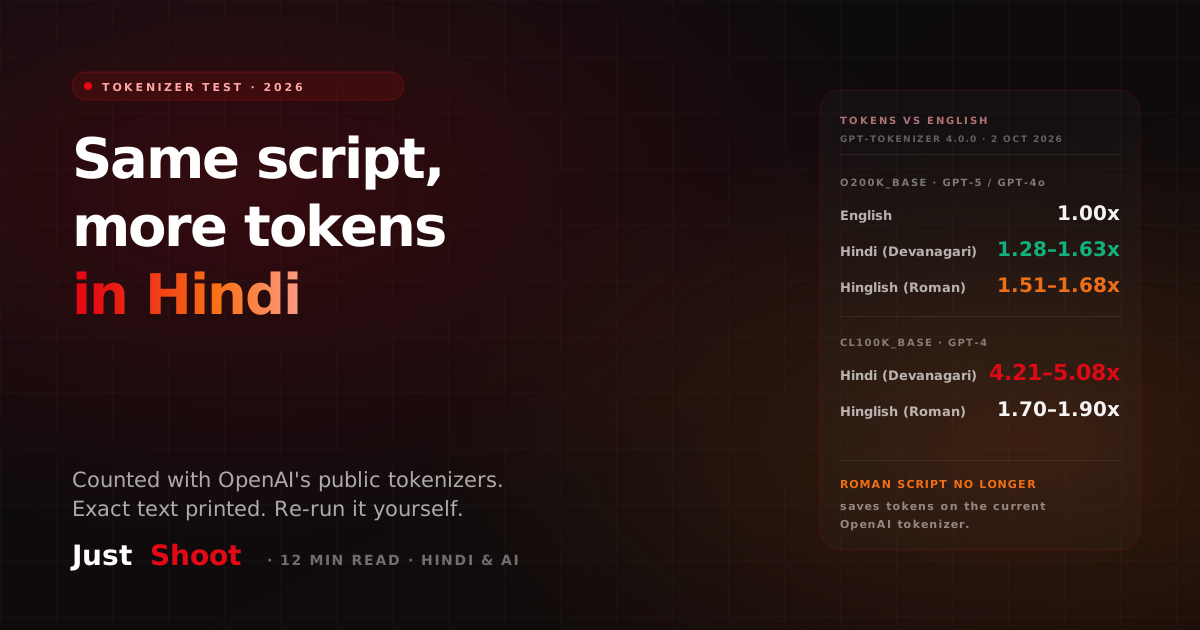
One YouTube script in English, Devanagari Hindi and Hinglish, run through OpenAI's public tokenizers. On GPT-5's, Hindi costs 1.28–1.63x the English tokens.