Which Indian Language Should You Start a YouTube Channel In? (2026 Data)
Speaker counts, online preference and unmet-content demand for eight Indian languages, from Census 2011, KPMG-Google and IAMAI-Kantar 2024. The ratio, not a verdict.
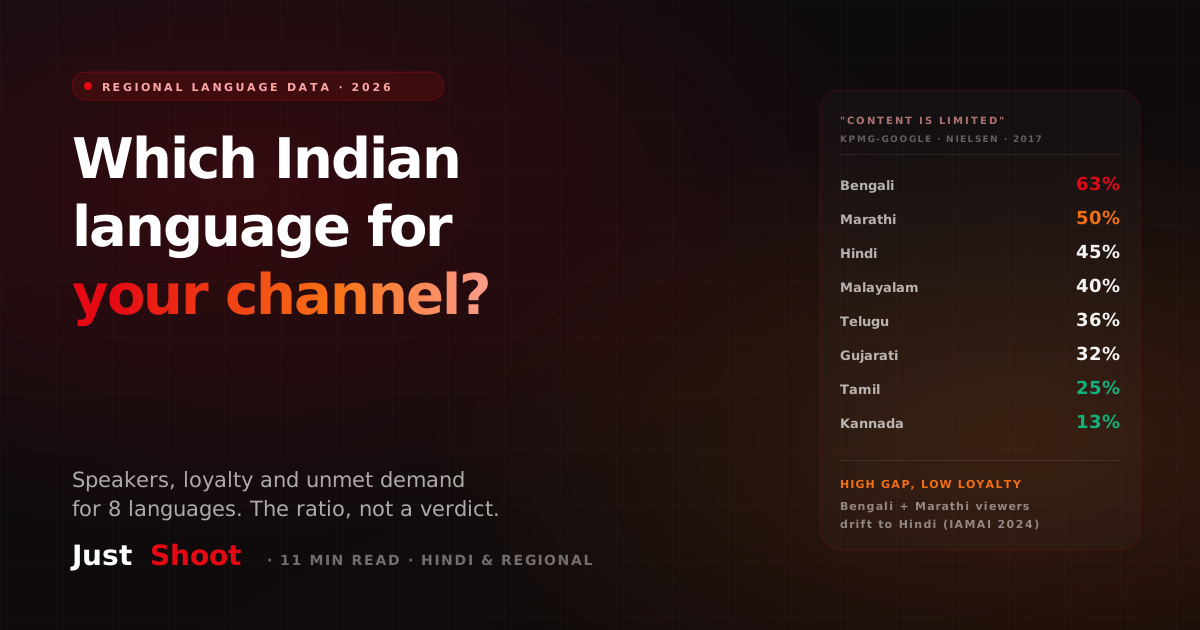
Which Indian Language Should You Start a YouTube Channel In? (2026 Data)
By Ashok Sachdev, Founder of JustShoot · Published 1 October 2026 · Sources captured 1 October 2026
Short answer: There is no single best language, but the numbers point in different directions per language. Hindi has the most speakers (52.8 crore) but only mid loyalty online. Tamil and Malayalam users are the most loyal to their own language. Bengali and Marathi users report the most unmet content demand (63% and 50%) but drift to Hindi and English when content is missing.
That is three different signals — audience size, loyalty, and unmet demand — and they do not agree. This post puts each one in a table per language, from dated primary sources, so you can see where the ratio is unusual for the language you actually speak well. It does not tell you which language "wins", because the honest answer depends on which of those three signals you can act on.
If your question is the narrower style choice — Hindi, Hinglish or English for the same Hindi-belt audience — that is a different decision, and we covered it in Hinglish vs Hindi vs English on YouTube. This one is about choosing across Indian languages.
The three sources, and what each one can and cannot tell you
Every number on this page comes from one of three documents. They are from different years, measure different things, and none of them is YouTube's own data. YouTube does not publish channel counts or watch time per language, and I could not find any public source that does — so supply has to be inferred, and I say where it is.
- Census of India 2011, Statement 1 — "Abstract of speakers' strength of languages and mother tongues". Counts people by mother tongue. It is the only full count of speakers per language India has published; no later census has published language data yet. Tells you: the ceiling of each audience. Does not tell you: who is online.
- KPMG in India and Google, "Indian Languages – Defining India's Internet", April 2017 (primary research by Nielsen across 7,060 Indian-language internet users in eight languages). Tells you: digital-entertainment users per language, and what share of each language's users said content in their language was limited. Does not tell you: anything after 2017. Its 2021 figures are projections made in 2017, not measurements, and I label them that way.
- IAMAI and Kantar, "Internet in India Report 2024" (ICUBE All India 2024). 886 million active internet users; 98% have accessed the internet in an Indic language; 57% of urban users prefer Indic-language content. Tells you: which language urban users actually prefer to use online today, and how loyal each language's users are. Does not tell you: rural preference by language — the per-language split is urban only.
Signal 1: how big each audience can get
Mother-tongue speakers, Census 2011, Statement 1. Share is of India's 2011 population of 121.09 crore.
| Language | Speakers (2011) | Share of population |
|---|---|---|
| Hindi | 52.83 crore | 43.6% |
| Bengali | 9.72 crore | 8.0% |
| Marathi | 8.30 crore | 6.9% |
| Telugu | 8.11 crore | 6.7% |
| Tamil | 6.90 crore | 5.7% |
| Gujarati | 5.55 crore | 4.6% |
| Kannada | 4.37 crore | 3.6% |
| Malayalam | 3.48 crore | 2.9% |
Two things this table hides. First, it counts mother tongue only. Many Marathi, Gujarati and Bengali speakers also understand Hindi, and that matters for Signal 2. Second, it is from 2011. Fifteen years of growth change the totals, but they are unlikely to reverse the order. Treat the column as relative size, not today's headcount.
Signal 2: how loyal each language's users are online
This is the signal most "best language" posts skip, and it is the one that changes the answer most.
IAMAI-Kantar asked urban internet users which language they prefer to use online. 43% said English. The other 57% split across Indic languages like this (read from the report's chart on page 13; the slices sum to 57%):
| Language | Share of urban internet users who prefer it | Its share of population (Census 2011) | Preference ÷ population |
|---|---|---|---|
| Hindi | 24% | 43.6% | 0.55 |
| Tamil | 6% | 5.7% | 1.05 |
| Telugu | 4% | 6.7% | 0.60 |
| Marathi | 3% | 6.9% | 0.44 |
| Gujarati | 3% | 4.6% | 0.66 |
| Malayalam | 3% | 2.9% | 1.04 |
| Bengali | 2% | 8.0% | 0.25 |
| Kannada | 2% | 3.6% | 0.55 |
The last column is my arithmetic, not the report's, and it compares an urban 2024 survey with a national 2011 count — so read it as a direction, not a precise multiple. The direction is still clear. Tamil and Malayalam users choose their own language online at roughly their weight in the population. Bengali users choose it at a quarter of their weight.
The report says the same thing in its own words. It groups languages by "conversion ratio" — the share of people who have used a language online who now predominantly use it:
- High conversion: Tamil, Telugu, Malayalam. The report's reasons: "higher affinity to watch content in their local language" and "extensive availability of content".
- Mid conversion: Hindi, Kannada.
- Low conversion: Gujarati, Marathi, Bengali. The report's reasons: users "watch content in common languages like Hindi and English", and "lower availability of content in these local languages".
In plain terms: a Tamil viewer who cannot find what they want in Tamil is more likely to keep looking in Tamil. A Marathi or Gujarati viewer is more likely to watch it in Hindi instead.
Signal 3: where viewers say content is missing
This is the closest public proxy for supply. KPMG and Google asked Indian-language internet users in 2017 whether content in their language was limited, and counted digital-entertainment users per language (millions; 2021 is KPMG's projection, made in 2017).
| Language | Said content was limited | Entertainment users 2016 | Projected 2021 |
|---|---|---|---|
| Bengali | 63% | 17 mn | 40 mn |
| Marathi | 50% | 20 mn | 47 mn |
| Hindi | 45% | 82 mn | 191 mn |
| Malayalam | 40% | 6 mn | 14 mn |
| Telugu | 36% | 11 mn | 27 mn |
| Gujarati | 32% | 8 mn | 20 mn |
| Tamil | 25% | 12 mn | 29 mn |
| Kannada | 13% | 10 mn | 23 mn |
Two cautions. This is self-reported, nine years old, and it measures felt scarcity, not a count of channels. And the same report found 84% of Indian-language internet users watched content on "the leading video sharing platform" — so this question was largely about YouTube even then.
Putting the three signals side by side
Now the picture gets interesting, because the signals pull against each other.
Bengali and Marathi have the biggest gap between audience and supply: large speaker bases, the highest share of users saying content is limited, and fast projected growth. But they also have low loyalty — the same viewers fall back to Hindi or English. A Bengali or Marathi channel faces less competition, but the audience will not wait for it. Your videos have to be good enough that the viewer does not switch to a Hindi video on the same topic.
Tamil and Malayalam have the most loyal audiences, but viewers already report the content they want exists (25% and 40% said limited). Loyalty means a viewer who finds you stays in-language. Lower felt scarcity means you are entering a market that is already served.
Telugu sits close to Tamil: high loyalty, moderate felt scarcity, and a larger speaker base than Tamil.
Hindi has by far the most viewers and a high 45% saying content was limited in 2017. But it has only mid loyalty and, by sheer size, the most creators. It is the largest market and the most crowded.
Kannada is the odd one: in 2017 only 13% of Kannada users said content was limited — the lowest of the eight — while IAMAI puts it at mid loyalty. If you are a Kannada speaker, the 2017 data does not show an obvious gap. Treat that as a reason to check your specific topic, not as a reason to avoid the language.
Gujarati has a mid-sized audience, low loyalty, and middling felt scarcity. Of the eight, it is the one where the topic you pick matters more than the language.
None of this ranks the languages. A Bengali creator who is fluent, consistent and specific will out-grow a Tamil creator who is none of those, whatever the ratio says. What the ratios do is tell you which risk you are taking: competition (Tamil, Malayalam, Hindi) or audience drift (Bengali, Marathi, Gujarati).
The question the data cannot answer for you
All three signals assume you are choosing between languages you can actually speak like a native. Most creators can't. If you speak two Indian languages well, the table above is useful. If you speak one, the choice is mostly made already — the useful question becomes which topic in that language, and that depends on your niche, your time, and how much the topic pays.
That is what the free YouTube Niche Picker scores. Language is one of its seven questions, and the answer re-weights every niche it suggests. It returns three best-fit niches with India CPM context and a competition signal, in under two minutes, with no signup. Pick your language from the tables above, then let the quiz pick the topic inside it.
What we see on our own site — and why it's only half the answer
JustShoot writes scripts in 11 languages, and we have published a script-writing guide for seven regional languages: Tamil, Telugu, Malayalam, Kannada, Marathi, Bengali and Gujarati.
The honest caveat: those posts are about the supply side — how to make a script in a language. Supply is only half the question. A tool that writes good Marathi does not create Marathi viewers who stay in Marathi. Signal 2 decides that, and no script tool changes it.
What a script tool can do is remove the cost of the second language. If you speak Hindi and Marathi, writing every script twice used to double the work. With JustShoot's nine-agent pipeline, the research and structure are shared and only the language changes, so testing a second language costs much less time.
Pricing, since people ask: Trial ₹0 (7 days, 2 scripts lifetime, no card) · Starter ₹499/mo (3 scripts) · Creator ₹999/mo (7 scripts, most popular) · Pro ₹1999/mo (15 scripts) · Studio custom. That is a fixed number of scripts a month with no rollover, GST included, monthly only. Every plan gets the full pipeline. Details on the pricing page.
A two-step way to use these tables
- List the languages you speak like a native. Not the ones you can follow — the ones you can be funny in. Only those rows count.
- For each, name the risk you would be taking. High loyalty and low felt scarcity (Tamil, Malayalam) means competition risk: you need a topic angle nobody in that language has. Low loyalty and high felt scarcity (Bengali, Marathi) means drift risk: you need a quality bar that beats the Hindi video on the same topic. Pick the risk you are better equipped to handle.
Then run the Niche Picker once per language you are still considering, and compare the topics it returns.
FAQ
Which Indian language has the biggest YouTube audience? Hindi, by a wide margin: 52.83 crore mother-tongue speakers in Census 2011, and 24% of urban internet users prefer it online (IAMAI-Kantar 2024), more than all the other named Indic languages in that chart combined (23%). It is also the most crowded.
Is a regional-language YouTube channel easier to grow than a Hindi one? It depends on the language. Tamil, Telugu and Malayalam viewers are the most loyal to their own language online (IAMAI-Kantar 2024), which helps retention. Bengali, Marathi and Gujarati viewers more often switch to Hindi or English when content is missing, so less competition does not automatically mean easier growth.
Which Indian language has the least YouTube content? No public source counts YouTube channels per language. The closest proxy is the 2017 KPMG-Google survey, where 63% of Bengali and 50% of Marathi internet users said content in their language was limited — the highest of the eight languages studied. Kannada was lowest at 13%.
Should I start in English or an Indian language? IAMAI-Kantar 2024 found 43% of urban internet users prefer English and 57% prefer an Indic language. If you are equally fluent, that is close to an even split in cities. Outside cities, the report does not split by language, but 98% of all users have accessed the internet in an Indic language.
Can I run one channel in two Indian languages? You can, but the viewers of one rarely watch the other. A common approach is a separate channel per language, so each channel's recommendations stay in one language. Use the Niche Picker on both languages first to see whether the same topic works in each.
Sources. Office of the Registrar General & Census Commissioner, India, Census of India 2011 — Statement 1: Abstract of speakers' strength of languages and mother tongues. KPMG in India and Google, Indian Languages – Defining India's Internet, April 2017 (primary research by Nielsen; pages 16 and 28). IAMAI and Kantar, Internet in India Report 2024, ICUBE All India 2024 (page 13). The "Preference ÷ population" column is my own division of two of those figures and is not published by either source. Per-language urban preference shares were read from a pie chart and are rounded as printed.
Related: best YouTube niches in India for 2026 · translating and localising a YouTube script for regional languages.
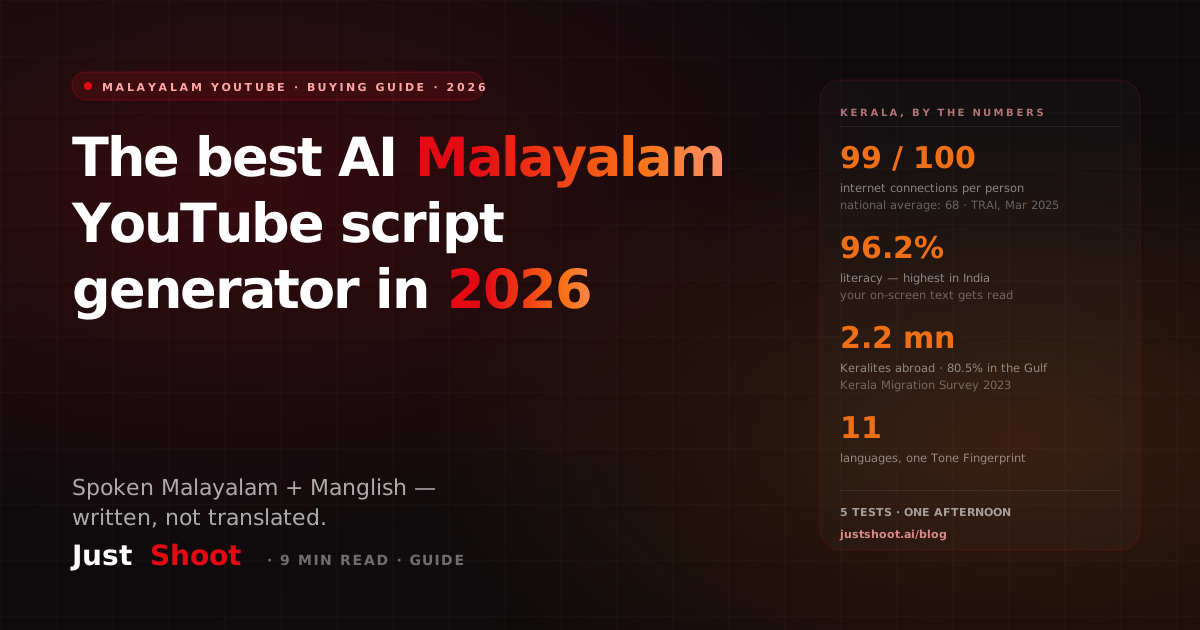
Best AI Malayalam YouTube Script Generator (2026)
Which AI writes Malayalam YouTube scripts natively — spoken register, Manglish code-mix, dialect held steady? A buying guide for Kerala creators, with Kerala's real connectivity numbers and five tests to run before you pay.
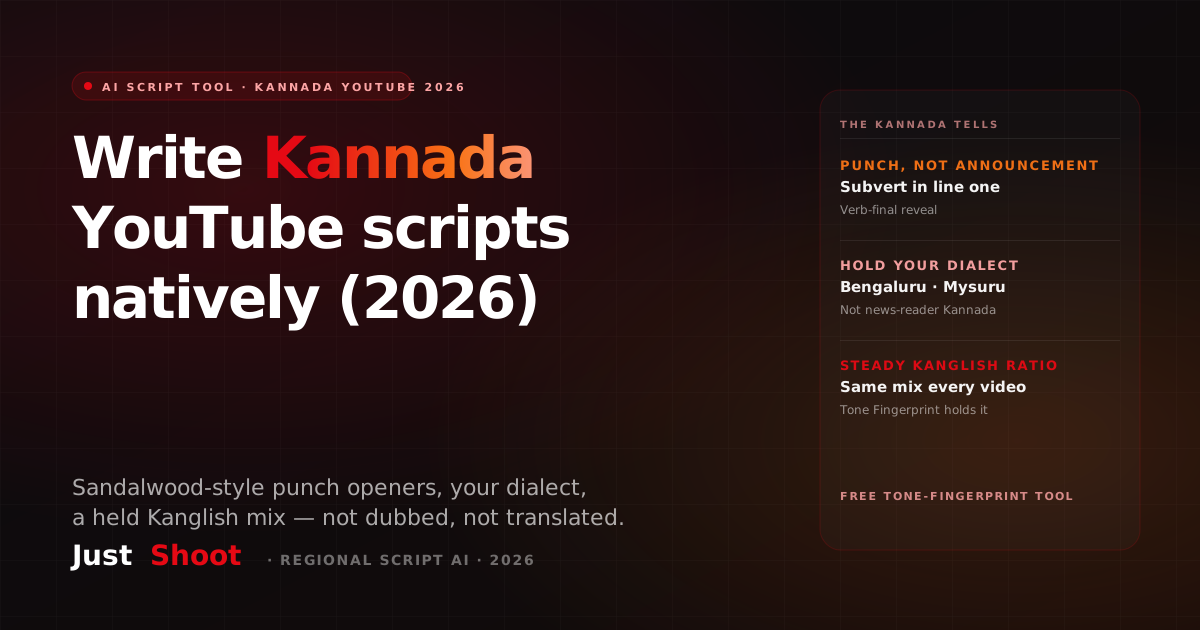
Kannada YouTube Script AI Tool (2026)
Can AI write a Kannada YouTube script with a Sandalwood-style punch opener, the right dialect, and a held Kanglish mix — not dubbed, not translated? The honest 2026 guide.
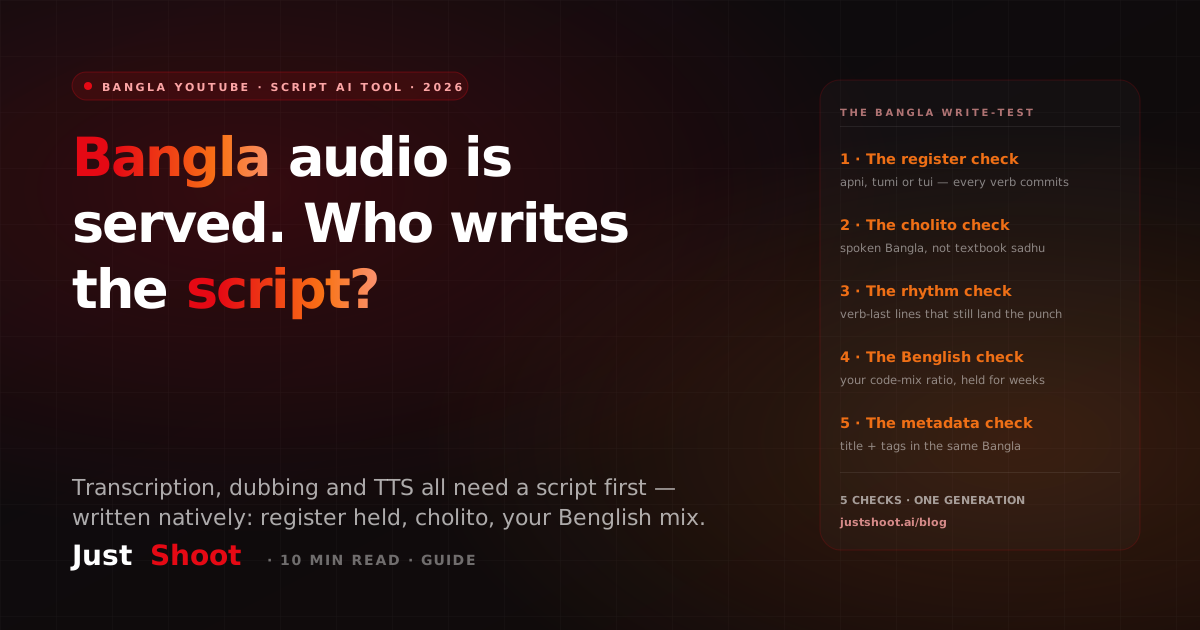
Bengali YouTube Script AI Tool for Bangla Creators (2026)
Transcription and TTS serve Bangla audio — nothing writes the script. SOV rhythm, apni/tumi/tui register, cholito vs sadhu, Benglish: the 2026 guide.