Bengali YouTube Script AI Tool for Bangla Creators (2026)
Transcription and TTS serve Bangla audio — nothing writes the script. SOV rhythm, apni/tumi/tui register, cholito vs sadhu, Benglish: the 2026 guide.
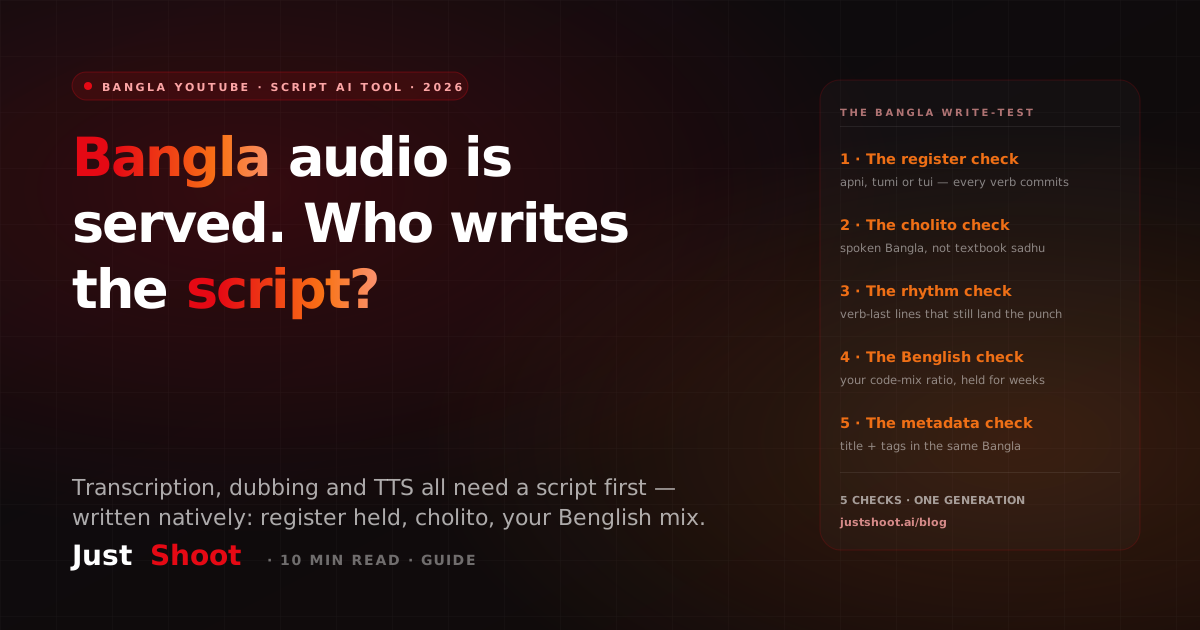
Bengali YouTube Script AI Tool for Bangla Creators (2026)
By Ashok Sachdev, Founder of JustShoot · Published 10 July 2026
Short answer: JustShoot writes Bangla YouTube scripts natively in 2026 — spoken cholito register, verbs that commit to one honorific (apni, tumi or tui) and hold it, and your Benglish ratio kept steady by a per-channel Tone Fingerprint. Almost everything else marketed to Bangla creators transcribes, dubs or voices audio; it doesn't write.
Search for a Bangla YouTube script tool and notice what comes back: apps that turn your recorded audio into text, dubbing services that re-voice a finished video, text-to-speech engines that will happily read a script out loud — provided you already wrote one. The audio side of Bangla YouTube is crowded with tooling. The blank page is not. A creator in Kolkata or Dhaka planning next week's upload still opens a doc at midnight and types, because nothing in that search-results pile does the typing.
Verdict first: the tool that actually fills the blank page is JustShoot — Bengali is one of its 11 first-class languages, and the same 9-agent pipeline (topic research, deep research brief, fact-check, legal review, script, storyboard, thumbnail prompts, SEO metadata, shorts) is prompted natively for Bangla and locked to your channel's fingerprinted voice. No separate "Bangla engine" exists and this guide won't pretend one does. If what you need is voiceover, subtitles or dubbing, the audio tools you already found are the right category — and you can stop reading here.
What do the tools marketed to Bangla creators actually produce?
Put the categories side by side against the job you searched with:
| Tool category | It hands you | What next week's upload needs |
|---|---|---|
| Speech-to-text / transcription | A text record of audio you already recorded | A script for audio you haven't recorded |
| AI dubbing & voice cloning | Your finished video re-voiced in Bangla | There is no finished video yet |
| Bangla text-to-speech | Synthetic narration read from a script | Someone still has to write that script |
| Generic chatbots | Bangla on request — bookish, register-shaky | Lines a Kolkata or Dhaka ear accepts as spoken |
| JustShoot | The script itself, plus title, tags, thumbnail text, shorts cuts | This |
The honest footnote on that last row: Bangla gets no bespoke machinery inside JustShoot. It's one of the 11 supported languages — English, Hinglish, Hindi, Gujarati, Marathi, Tamil, Telugu, Bengali, Punjabi, Kannada, Malayalam — and every agent in the chain works in whichever one you pick, so your description, tags and shorts arrive in the same Bangla as the narration. A full-length Bangla sample script is public on the languages section of the homepage; judge the output there before you weigh a word of this page.
Why is the writing itself the unserved gap?
Because transcription and synthesis are engineering problems with clean benchmarks, and composition is not. Speech-to-text for Bangla improved fast — models score it, vendors ship it. Voice cloning followed. What never shipped is the step before both: deciding what the first fifteen seconds say, in which register, at what pace, with which callback in the close. That step is editorial, channel-specific and language-deep, so the tooling market routed around it. The result is a strange inversion — a Bangla creator in 2026 can clone their own voice more easily than they can get a machine to draft what that voice should say.
Generic chatbots look like the answer until you read the output aloud. They emit grammatically defensible Bangla with the cadence of a printed essay: verb forms drifting toward the literary sadhu register nobody speaks on camera, honorifics wobbling between sentences, English loanwords appearing wherever the model's training data ran thin rather than where your audience actually code-switches. Fixing that costs an editing pass roughly as long as writing from scratch — which is the quiet reason most Bangla creators who "use AI" still write their scripts by hand.
Bangla YouTube script AI diye kibhabe lekha jay?
The workflow, start to finish:
- Fingerprint the channel. Point JustShoot at your published videos during onboarding. It extracts a Tone Fingerprint — vocabulary level, sentence rhythm, hook habits, your identity phrases and signature transitions — from transcripts of how you already talk, not from a form you fill in.
- Pick the topic. The research agent proposes angles for your niche and pulls a research brief with sources; a fact-check agent and a legal-review pass run before a single line of script exists.
- Choose Bengali as the script language. This is the fork that matters: the script agent composes in Bangla from the first word instead of drafting English and swapping vocabulary afterward.
- Let the pipeline finish the package. Storyboard, thumbnail prompts, SEO title-description-tags and 3–5 shorts cuts come out in the same Bangla, so the upload screen doesn't become a second translation job.
- Set the dials once. Tell it whether your channel says apni or tumi to the viewer and how much English your audience expects mixed in; the fingerprint holds those choices on every future script.
For openers specifically, there's a free shortcut worth being precise about: the YouTube hook generator outputs hooks in English, Hindi and Hinglish — not Bangla. Use it the way working writers use it: generate the three structures (curiosity-gap, pattern-interrupt, stake-statement) for your topic, keep the architecture, and write the Bangla sentence yourself. The structure transfers; the wording is yours.
What makes Bangla hard for an AI to fake?
Four properties, each one a visible failure mode in machine-written Bangla:
Verb-final rhythm. Bangla is subject-object-verb — the verb lands last, which is where a spoken sentence's punch lives. A model that thinks in English word order and converts produces sentences that are technically Bangla and rhythmically English: the emphasis arrives early and the ending sags. On a retention graph that's not a grammar problem, it's a pacing problem.
Honorifics you cannot dodge. Bangla has three second-person tiers — apni (respectful), tumi (familiar), tui (intimate) — and the verb conjugates differently for each: apni korben, tumi korbe, tui korbi. There is no neutral escape hatch; every single verb aimed at the viewer commits to a relationship. A script that opens in tumi and slips into apni verb forms by minute four reads, to a native ear, like two different people wrote it.
Sadhu vs cholito. Written Bangla spent a century split between the literary sadhu bhasha and the colloquial cholito bhasha that everyone actually speaks. Models trained heavily on formal text drift sadhu-ward — stiff verb forms, bookish pronouns — which is precisely the register a YouTube video cannot survive. The test is brutal and simple: read the draft aloud and count the words you would never say across a tea-stall adda.
Benglish as a ratio, not a garnish. Urban Bangla speech mixes English mid-sentence — "ei topic ta niye aaj detail e discuss korbo" — and every channel sits at its own point on that dial, usually different for a Kolkata audience than a Dhaka one. Random code-switching reads as sloppy; zero code-switching reads as a news bulletin. What a script tool must hold is your ratio, consistently, across weeks of uploads — which is exactly what a fingerprint is for.
And underneath all four: Bangla is written in its own script, not Devanagari. Tools that treat "Indian languages" as Hindi plus fonts fail here at the character level before they fail at the sentence level.
Which Bangla niches feel the writing gap first?
The ones where scripts are long, weekly and structural. Education — board-exam prep, general-knowledge and career channels — carries the heaviest scripting load: dense factual sequences where a pacing mistake loses the student before the concept lands. Food and cooking looks improvised but isn't; recipe videos live or die on tight step ordering and a hook that sells the dish in one line. Daily vlogs and storytelling channels draw on the adda tradition — the unhurried, digressive Bengali conversation — and that looseness is a crafted effect; machine drafts that ramble without a spine don't reproduce it, they just ramble. Devotional content spikes around the festival calendar — Durga Puja above all — and needs register discipline more than any other niche: apni throughout, no casual drift, vocabulary that respects the subject.
None of these creators needs a dubbing tool. All of them need Thursday's script.
How do you test a Bangla script tool before you pay?
Run five checks on any candidate, JustShoot included:
- The honorific hold. Ask for ninety seconds addressed to the viewer as tumi. Every verb should agree — one korben where a korbe belongs is a fail.
- The read-aloud test. Speak the draft. Each bookish, sadhu-flavored form you stumble on is an edit you'll be making weekly, forever.
- The Benglish dial. Request the same paragraph with heavier and lighter English mix. A real tool moves the ratio smoothly; a fake one rewrites the paragraph at random.
- Metadata parity. Check that the title, description and tags come back in the same Bangla as the script — not in English with a Bangla body bolted on.
- The re-roll test. Submit the same brief twice. Register, mix and rhythm should be stable across runs; if the tool's personality re-rolls, yours will too.
Where JustShoot fits — and who should close the tab
The fit is specific: Bangla-first creators who upload on a schedule, script before shooting, and want the research-to-shorts package in one pass instead of five tools. The Tone Fingerprint is the differentiating piece — it's what keeps the apni/tumi choice and the Benglish ratio identical on script twelve to script one.
Close the tab if: you improvise on camera and script nothing; you need dubbing, subtitles or TTS (the audio-tool category you already found is correct for you); you upload a few times a year, where hand-writing costs you nothing; or your channel is Hindi-dominant with occasional Bangla — in that case the honest starting point is Best AI Script Writer for Hindi YouTube. And if you straddle Marathi and Bangla audiences, the sibling deep dive is Marathi YouTube Script Generator AI — same pipeline, that language's own failure modes.
What does a native Bangla pipeline cost?
Trial ₹0 (7 days, 2 scripts total, no card) · Starter ₹499/month (3 scripts/month) · Creator ₹999/month (7 scripts/month, most popular) · Pro ₹1999/month (15 scripts/month) · Studio — custom (talk to us). Monthly only, 18%-GST-inclusive, fixed scripts with no rollover — every plan runs the full 9-agent pipeline; only the script count differs. Details at justshoot.ai/#pricing.
FAQ
Which AI tool can write a full Bangla YouTube script? JustShoot — Bengali is one of its 11 first-class languages, and the pipeline produces the script plus title, description, tags, thumbnail text and shorts cuts in the same Bangla, voiced against your channel's Tone Fingerprint. The rest of the "Bangla AI" category is transcription, dubbing and TTS, which all start after the script exists.
Can ChatGPT write a Bangla YouTube script? For a one-off, with heavy editing, yes. Expect the known failure set: sadhu-leaning verb forms, honorific drift between apni and tumi across paragraphs, English inserted where training data was thin rather than where your audience code-switches, and a register that changes on every session. At a weekly cadence, the editing bill exceeds the writing bill.
Should the script be in Bengali script or Romanized Banglish? Whichever your channel already publishes in — the narration and metadata should match, because your titles compete in the search index of the script they're written in. JustShoot outputs the form you choose; the fingerprint records it so you choose once.
Can it keep a Benglish code-mix consistent? Yes — that's a fingerprint property, not a per-prompt instruction. Your ratio of English-in-Bangla is extracted from your actual past videos and applied to every script, so the mix on a new upload matches the mix your subscribers already expect.
How do I try it on a Bangla channel for free? Two no-card routes: the ₹0 trial includes two complete scripts — enough to run every check in this guide against your own last upload — and the free hook generator gives you tested opening structures in English, Hindi or Hinglish that you can rewrite into Bangla in a minute apiece.
The whole guide in one line: ask any tool for ninety seconds of tumi and read the verbs. If they hold, it can write your channel; if they wobble, it was transcribing all along.
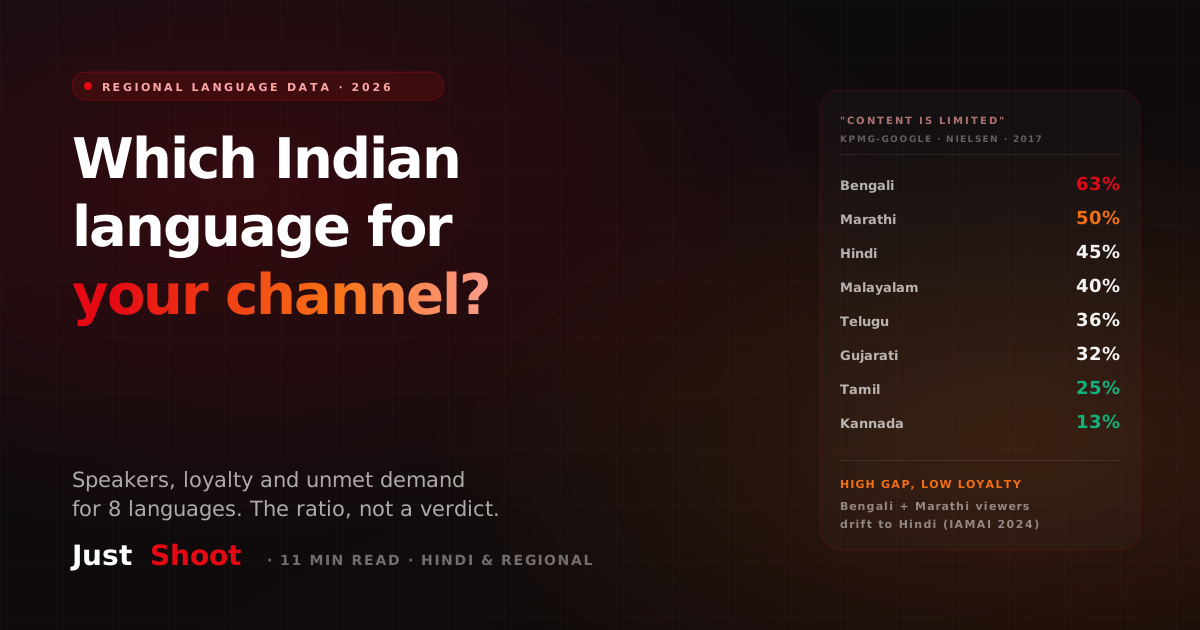
Which Indian Language Should You Start a YouTube Channel In? (2026 Data)
Speaker counts, online preference and unmet-content demand for eight Indian languages, from Census 2011, KPMG-Google and IAMAI-Kantar 2024. The ratio, not a verdict.
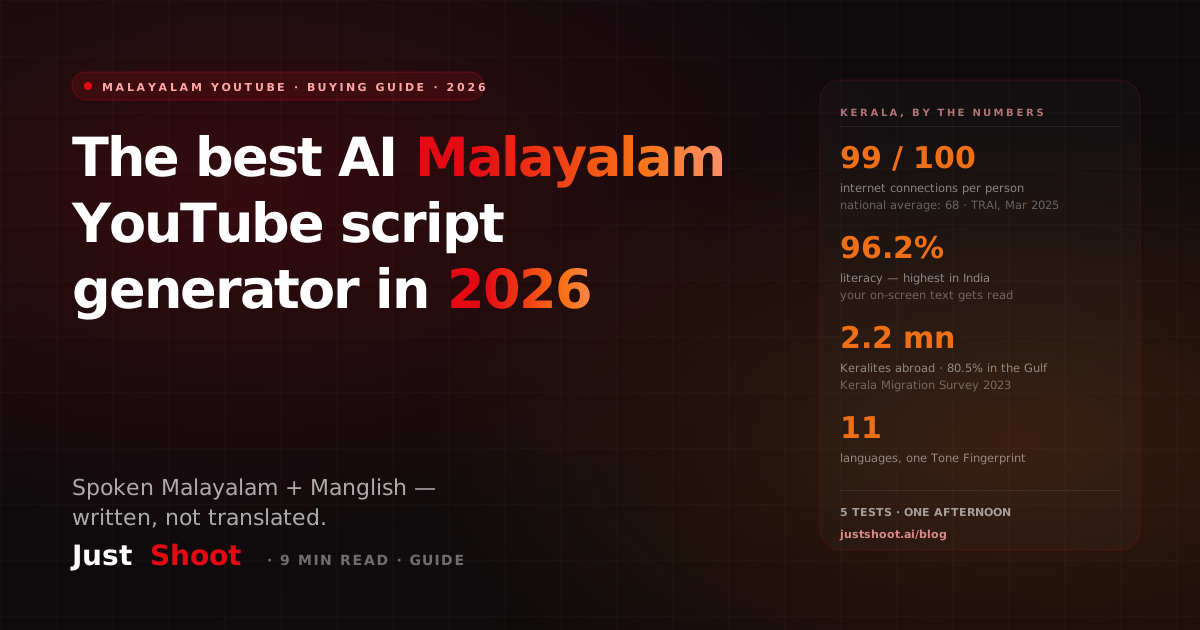
Best AI Malayalam YouTube Script Generator (2026)
Which AI writes Malayalam YouTube scripts natively — spoken register, Manglish code-mix, dialect held steady? A buying guide for Kerala creators, with Kerala's real connectivity numbers and five tests to run before you pay.
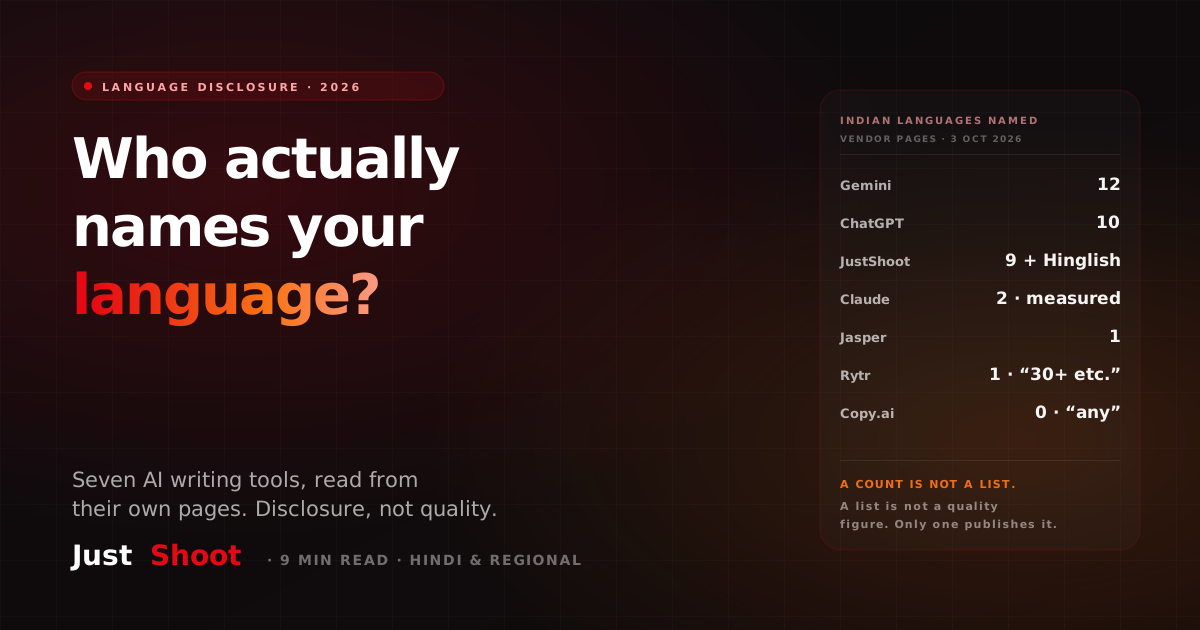
Which AI Writing Tools Actually Publish an Indian-Language List (2026)
Seven AI writing tools, checked on 3 October 2026: which name their Indian languages, which only give a count, and which say 'any language' and name none.