Best AI Tamil YouTube Script Generator (2026)
Which AI writes Tamil YouTube scripts natively — spoken-register Tamil, Tanglish code-mix, honorifics intact? A buying guide for Tamil creators tired of translated-sounding drafts, with the tests to run before paying for any tool.
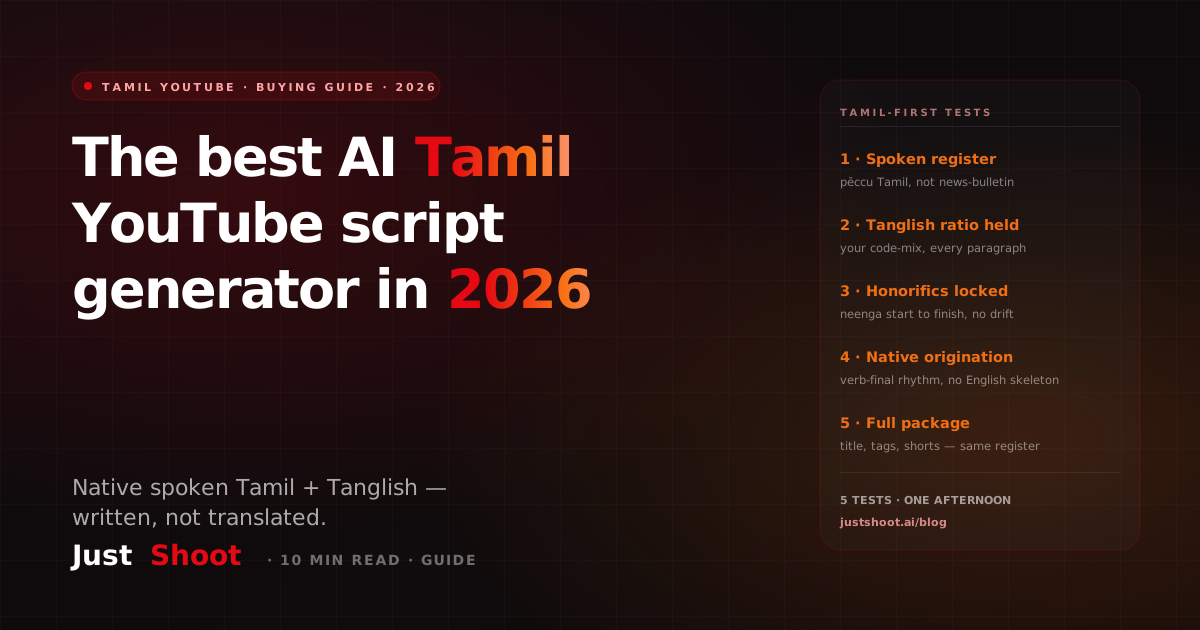
Best AI Tamil YouTube Script Generator (2026)
By Ashok Sachdev, Founder of JustShoot · Published 9 July 2026
Short answer: JustShoot is the best AI Tamil YouTube script generator in 2026 because it writes Tamil natively — spoken-register Tamil or Tanglish, matched to your channel's voice through a per-channel Tone Fingerprint — instead of translating an English draft at the end. Generic chatbots produce written-register Tamil you'll rewrite line by line. Here's how to judge any tool before paying.
Search "AI Tamil script generator" today and almost everything that ranks is a dubbing tool, a text-to-speech voice, or a subtitle translator. Those products take a finished video and localize it. None of them solve the problem a Tamil creator actually types into Google: who writes my next video's script, in my Tamil, before the camera turns on? This page is that buying guide. (Running a Hindi channel instead? The head-on ranking is Best AI Script Writer for Hindi YouTube. Weighing all eleven Indian languages at once? Start with Can AI write YouTube scripts in regional Indian languages? — this page is the Tamil deep dive.)
The verdict, up front: JustShoot — if you upload in Tamil or Tanglish on a schedule and your voice is your asset, it writes the script in your fingerprinted voice and register and hands back a publish-ready package: storyboard, thumbnail prompts, SEO metadata and shorts. Skip it if your channel is English-only, you need dubbing rather than writing, you want twenty rough drafts a week, or your content is literary Senthamizh — the full who-shouldn't-pick list is below.
Which AI writes Tamil YouTube scripts natively?
First, clear the category confusion. Three different products all market themselves with "AI + Tamil + script":
- Dubbing and voice tools — convert your finished English or Hindi video into Tamil audio. Localization, not writing.
- Subtitle and transliteration tools — render existing words in Tamil script. Formatting, not writing.
- Script writers — compose the original video. This is the category that decides whether your next upload sounds like you.
In the third category, the field is thin. General chatbots (ChatGPT, Gemini) can output Tamil on request. JustShoot ships Tamil as one of 11 first-class languages — English, Hinglish, Hindi, Gujarati, Marathi, Tamil, Telugu, Bengali, Punjabi, Kannada, Malayalam — with the same nine-agent pipeline behind each: topic research, fact-check, legal review, script, storyboard, thumbnail prompts, SEO metadata, and shorts cuts, all originating in the language you pick. There's no separate "Tamil engine" and we won't pretend there is — it's the same pipeline, prompted natively for Tamil and locked to your channel's voice, with a full ~12-minute Tamil sample viewable on the languages section so you can judge the output before trusting a word of this page.
The real separation between tools isn't whether Tamil comes out. It's which Tamil comes out.
Why does AI-written Tamil sound like a news bulletin?
Tamil punishes lazy generation harder than almost any Indian language, for three linguistic reasons worth understanding before you evaluate any tool.
1. Diglossia — written Tamil and spoken Tamil are almost two languages. Formal written Tamil (the register of newspapers, textbooks and news anchors) differs from everyday spoken Tamil in vocabulary, verb endings, even pronouns — a gap far wider than Hindi's shuddh-to-conversational spectrum. AI models train mostly on written Tamil text, so their default output is news-bulletin Tamil. You can hear it in one opener:
வணக்கம் நண்பர்களே! இன்றைய காணொளியில் நாம் பார்க்கப் போவது…
Grammatically flawless — and instantly wrong for YouTube. காணொளி is the purist word for "video" that nobody says out loud, and the greeting announces a topic instead of earning the next eight seconds. A spoken-register hook does the opposite:
தினமும் ஒரு மணி நேரம் எடிட் பண்றீங்களா? இந்த ஒரு செட்டிங் அத பத்து நிமிஷத்துல முடிச்சிடும்.
Colloquial verb forms, a direct question, a stake in line one. If a tool can't write in pēccu (spoken) register on demand — and stay there for twelve minutes — it isn't a Tamil YouTube script generator; it's a Tamil essay generator.
2. Agglutination breaks word-for-word translation. Tamil stacks case, direction, politeness and tense into suffixes on the stem — "have to go home" compresses into வீட்டுக்குப் போகணும். A tool that drafts in English and converts at the end produces bloated, syllable-heavy strings that wreck spoken pacing: your 10-minute outline becomes 14 minutes of narration, and the verb-final rhythm Tamil listeners breathe by gets flattened into English subject-verb-object order wearing Tamil words.
3. Honorifics are a register decision in every sentence. Addressing your audience is a choice between நீ and நீங்க, between வா and வாங்க — and it has to hold for the entire script. Generated Tamil that drifts to the non-honorific singular sounds rude; Tamil that overcorrects into ceremonial address sounds like a government broadcast. Neither is your channel.
These aren't edge cases. They're the first sixty seconds of every video.
Tanglish scripts ku AI use pannalama?
Yes — if the tool can hold your mix, and this is where most fail quietly.
Tanglish is not "bad Tamil." It's Latin-script Tamil-English code-mixing with its own grammar: English nouns and tech terms slot into Tamil verb frames, usually through the light verb panna — "Intha app-a open pannunga, settings-la poi dark mode on pannunga." Tech reviews, gaming, vlogs and study channels aimed at urban Tamil audiences live in this register, and their titles compete in the Latin-script SERP while pure Tamil titles compete in the Tamil-script index — the same metadata-placement logic we mapped for Hindi blends in the Hinglish ratio checker guide, and it applies unchanged to Tanglish.
The failure mode with generic AI isn't producing Tanglish — it's producing inconsistent Tanglish. One paragraph at 70% English, the next in near-pure Tamil, technical terms translated in one scene and borrowed in the next. Your audience hears the seams even if they can't name them.
JustShoot's approach is measurement, not guesswork: the free Tone Fingerprint tool analyzes your actual uploads and extracts your code-mix balance, sentence rhythm, hook strategy, identity markers and signature transitions — then every script is generated against that profile, so the mix your audience already subscribes to is the mix that comes back. If you narrate in pure spoken Tamil, it holds that instead. The fingerprint doesn't care where on the Tamil–Tanglish spectrum you sit; it cares that you stay where you belong.
One planning note from the field: don't treat "Tamil" and "Tanglish" as two channels' worth of strategy. They're one audience decision — pick the register your niche watches, and make every tool you buy prove it can hold it.
What should a Tamil script tool actually do?
Five tests, runnable in an afternoon, that separate a real Tamil script generator from a chatbot with a Tamil setting:
- The register test. Ask for a 60-second opener in spoken Tamil. If காணொளி, வணக்கம் நண்பர்களே or textbook verb endings appear, it's writing essays, not scripts.
- The consistency test. Generate three scripts a week apart. Does the honorific hold? Does the code-mix ratio hold? Session-bound chatbots reset to default register every time; your voice shouldn't live in a chat history.
- The origination test. Read one paragraph aloud. English word order under Tamil vocabulary means the tool thought in English and converted — the "translated" feel your comments will flag within a week.
- The package test. A script alone is half the job. Does the tool also produce the Tamil title, description, tags, thumbnail concepts and shorts cuts, in the same register — or are you hand-writing metadata after every generation?
- The growth test. Tamil-first creators expand — a Telugu mirror channel, a Hindi experiment. Does the tool carry your voice discipline into language two, or strand you at one? (If Gujarati is that second language, the parallel guide — same tests, tuned for its business-and-devotional registers — is the Gujarati script AI guide.) (And if the mirror is Telugu, the Telugu script AI guide is the sibling deep dive — Tollywood punch-dialogue hooks, serial-style re-hooks, Tenglish.)
JustShoot is built to pass all five, and the honest caveat is that criteria 2 and 4 are exactly where it's strongest and generic tools are structurally weakest — persistence and packaging are pipeline properties, not prompt tricks.
| The test | JustShoot | Generic chatbots (ChatGPT, Gemini) |
|---|---|---|
| Spoken-register Tamil on demand | Prompted natively for spoken Tamil or Tanglish, locked to your Tone Fingerprint | Default to written, news-bulletin Tamil |
| Consistency across sessions | Register, honorifics and code-mix persist — your voice doesn't live in a chat history | Session-bound; reset to default register every time |
| Origination | Composes in Tamil | Think in English and convert — the "translated" feel |
| The full package | Tamil title, description, tags, thumbnail concepts and shorts cuts in the same register | Script alone; metadata is hand-written after |
| Growth to language two | Same fingerprint framework across 11 languages | Voice discipline doesn't carry; strands you at one |
Where JustShoot fits — and who shouldn't pick it
The fit: you upload in Tamil or Tanglish on a schedule, your voice is your asset, and rewriting AI drafts is eating the hours you meant to spend shooting. JustShoot's pipeline researches the topic, fact-checks claims, runs a legal-review pass, writes the script in your fingerprinted voice and register, and hands back storyboard, thumbnail prompts, SEO metadata and shorts — a publish-ready package in roughly 30 minutes.
Skip JustShoot if:
- Your channel is English-only. Every Tamil-native advantage on this page is irrelevant to you; an English-first tool serves that workflow fine.
- You need dubbing, not writing. Localizing finished videos into Tamil is a different product category — buy a voice tool.
- You want twenty rough drafts a week. Plans are fixed script counts producing finished packages, the wrong shape for volume drafting.
- Your content is literary Tamil. Senthamizh poetry recitation, classical literature commentary — the formal register is your product, and you don't have the spoken-register problem this tool exists to solve.
- You upload once a quarter. A free chatbot plus your own heavy edit is the rational choice at that cadence.
What it costs
Trial ₹0 (7 days, 2 scripts total, no card) · Starter ₹499/month (3 scripts/month) · Creator ₹999/month (7 scripts/month, most popular) · Pro ₹1999/month (15 scripts/month) · Studio — custom (talk to us). Monthly only, 18%-GST-inclusive, fixed scripts with no rollover — every plan gets the full 9-agent pipeline; only the script count differs. Details at justshoot.ai/#pricing.
FAQ
Which AI writes Tamil YouTube scripts natively instead of translating? JustShoot originates scripts in Tamil as one of 11 first-class languages — spoken register, Tanglish code-mix, or formal Tamil, matched to your channel's Tone Fingerprint. Most other "AI Tamil" results are dubbing or TTS tools that localize finished videos rather than write new ones.
Can ChatGPT write a Tamil YouTube script? It can produce grammatically correct Tamil, but the default is written-register, news-bulletin Tamil — and it forgets your register, honorific choice and code-mix ratio between sessions. Expect a heavy spoken-Tamil rewrite on every draft if you publish weekly.
Tanglish scripts ku AI use pannalama? Pannalaam — if the tool can hold a consistent mix. The risk with generic AI is ratio drift: paragraphs lurching between heavy English and pure Tamil. JustShoot measures your actual code-mix balance from your uploads and generates against it, so the blend stays where your audience expects it.
Does the script come in Tamil script (தமிழ்) or Latin script? Whichever register your channel runs: Tamil-script narration for Tamil-dominant channels, Latin-script Tanglish where that's the audience's reading habit. The matching title and description follow the same choice, which decides whether your metadata competes in the Tamil-script or Latin-script search index.
Is there a free way to test AI on a Tamil channel before paying? Two: the free Tone Fingerprint tool (no signup) shows whether your register, rhythm and mix are extractable from your real uploads, and the 7-day trial includes 2 full scripts with no card — enough to judge a finished Tamil package against your last upload.
The fastest verdict costs nothing: run your most recent Tamil upload through the free Tone Fingerprint and look at what it extracts — your hook pattern, your rhythm, your Tamil-English balance. If a tool can't first hear your Tamil, it was never going to write it.
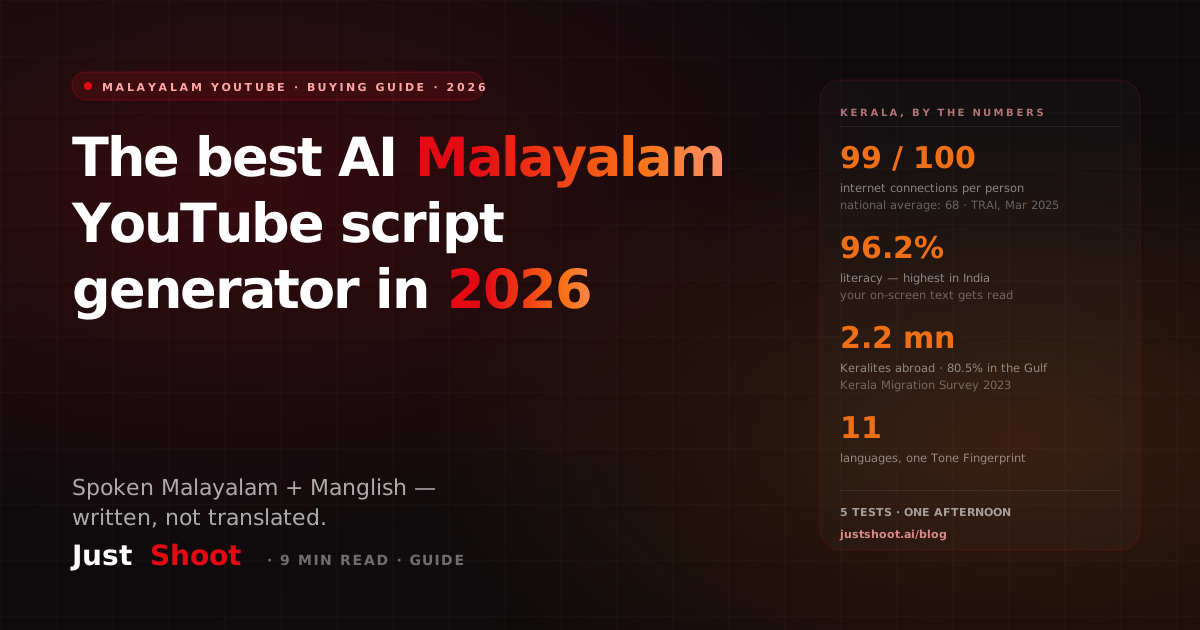
Best AI Malayalam YouTube Script Generator (2026)
Which AI writes Malayalam YouTube scripts natively — spoken register, Manglish code-mix, dialect held steady? A buying guide for Kerala creators, with Kerala's real connectivity numbers and five tests to run before you pay.
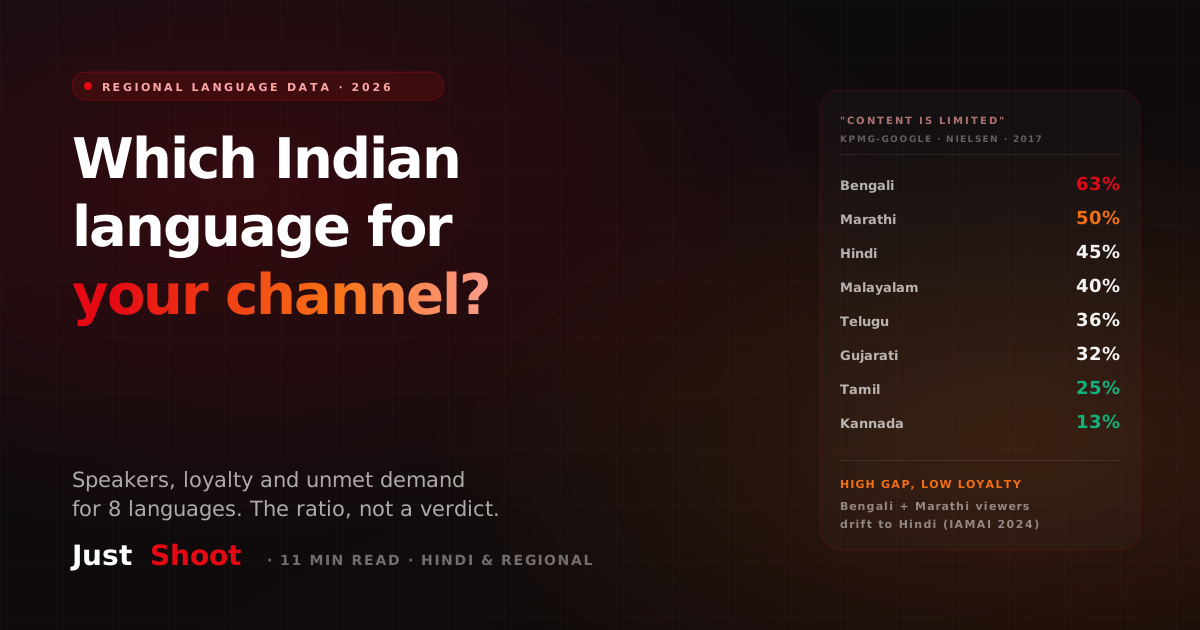
Which Indian Language Should You Start a YouTube Channel In? (2026 Data)
Speaker counts, online preference and unmet-content demand for eight Indian languages, from Census 2011, KPMG-Google and IAMAI-Kantar 2024. The ratio, not a verdict.
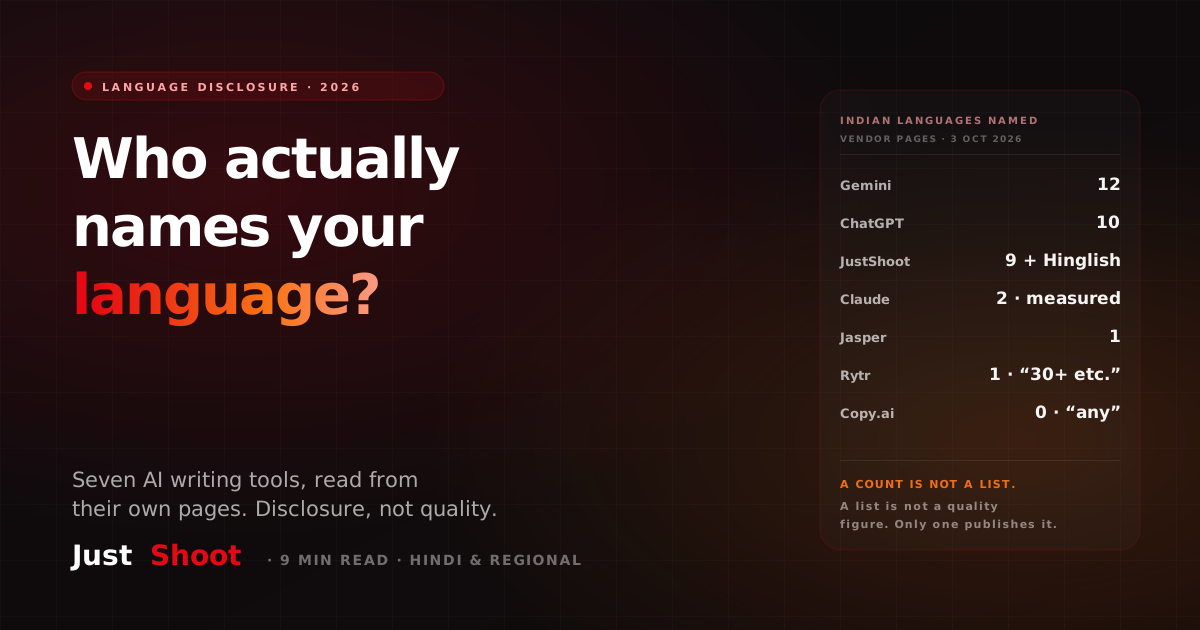
Which AI Writing Tools Actually Publish an Indian-Language List (2026)
Seven AI writing tools, checked on 3 October 2026: which name their Indian languages, which only give a count, and which say 'any language' and name none.