Can AI Turn Your Hindi Script Into the Actual Video Yet? (2026)
What Google Veo 3.1, Kling 3.0, HeyGen and Synthesia publish about clip length, Hindi audio and Indian-language lip-sync, read from their docs on 2 Oct 2026.
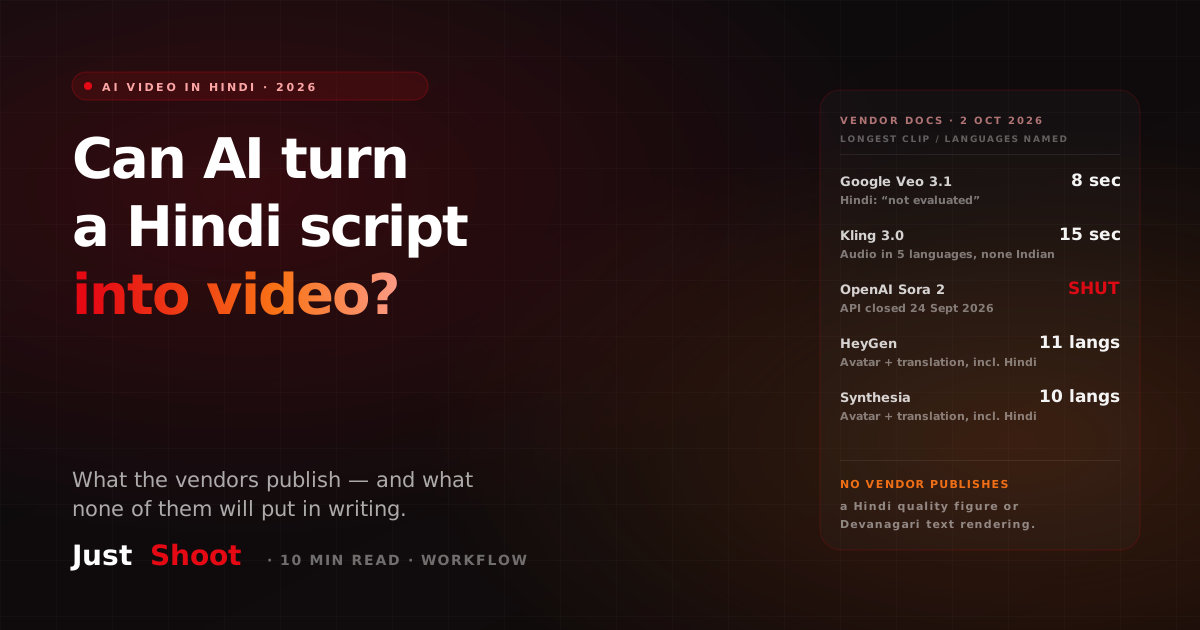
Can AI Turn Your Hindi Script Into the Actual Video Yet? (2026)
By Ashok Sachdev, Founder of JustShoot · Published 2 October 2026 · Vendor pages read 2 October 2026
Short answer: Not a full video, and not in Hindi with any published quality guarantee. Google's Veo 3.1 makes clips of 4–8 seconds and says only English is "fully supported". Kling 3.0's native audio lists five languages, none Indian. Avatar tools such as HeyGen and Synthesia do list Hindi, but they produce a talking presenter, not a scene.
That answer comes from the vendors' own documentation, not from us trying the tools. We have no API access to any video model, so nothing on this page was generated, watched or scored by us. What follows is what each company publishes about itself, with the date we read it. Where a company does not publish something, we say that, because for a Hindi creator the gaps are the useful part.
Two kinds of "AI video" — and why it matters
People mean two different things by "AI makes the video from my script":
- Generative scene models — you describe a scene and the model invents the footage: a street, a kitchen, a person walking. Google Veo, Kling and Runway are in this group. OpenAI's Sora was too, until recently.
- Avatar and dubbing tools — a digital presenter (stock or cloned from you) reads your script to camera, or your existing video is translated with the lips re-synced. HeyGen and Synthesia are in this group.
The first kind could in principle replace your camera and B-roll. The second kind replaces you on camera but still produces a talking-head video. For a Hindi script the two answer different questions, so they are kept apart below.
Generative scene models: what the vendors publish
Google Veo 3.1
Source: Google's Gemini API documentation for Veo, page last updated 17 September 2026.
- Models:
veo-3.1-generate-preview,veo-3.1-fast-generate-preview,veo-3.1-lite-generate-preview. The Veo 3.0 models are listed as deprecated. - Clip length:
durationSecondsaccepts "4", "6" or "8". It must be 8 for 1080p, 4K, extensions or reference images. - Audio: generated natively with every video; the page lists it as always on.
- Language: the page states, in full: "English (EN) is fully supported, but other languages have not been evaluated, so they may work but results can vary."
- Hindi on-screen text, Hindi lip-sync: not mentioned.
That language sentence is the most important line on this page for a Hindi creator. Google is not saying Hindi fails. It is saying Google has not tested it. Any Hindi dialogue you get from Veo today is outside what the vendor has evaluated.
Kling VIDEO 3.0 and 3.0 Omni
Source: Kling's own guide to native audio and lip-sync, published 3 July 2026.
- Clip length: "up to 15 seconds of video generation, with flexible duration from 3 to 15 seconds."
- Native audio languages: "Chinese, English, Japanese, Korean, and Spanish, along with authentic dialects and accents."
- Hindi or any Indian language: not mentioned anywhere in the guide.
Kling's separate Lip Sync feature page says it "accepts uploaded audio and offers available Text to Speech voices". That means you could record Hindi yourself and have a generated face mouth it. The guide does not publish how well that works for Indian languages.
OpenAI Sora 2
Source: OpenAI's video-generation guide, read 2 October 2026.
The page now opens: "The Sora 2 models and Videos API were shut down on September 24, 2026 and are no longer available. No one-to-one replacement API is available." While it was live, the same guide listed 16- and 20-second generations. The guide made no statement about Hindi or any non-English language.
If an older article or video recommends building a Hindi workflow on the Sora API, that route no longer exists.
Runway
Source: Runway's API model guide, read 2 October 2026.
The guide lists Gen-4.5, Gen-4 Turbo and Aleph 2.0 as its own flagship models, and resells several others, including Veo 3.1. On the model overview page we read, Runway does not publish clip limits, audio behaviour or any language statement for its own models. We are not filling that gap with a guess.
Avatar and dubbing tools: what the vendors publish
HeyGen
Two help-centre pages, neither dated, read 2 October 2026:
- Video translation lists eleven Indian languages: Bengali, Gujarati, Hindi, Kannada, Malayalam, Marathi, Odia, Punjabi, Tamil, Telugu and Urdu. Assamese is not listed.
- Voices lists nine: the same set without Punjabi and Odia.
HeyGen says it offers translation as audio-only or with lip-sync, but the translation page does not say which languages get lip-sync and which are audio-only. So "HeyGen supports Odia" is true for translation; whether Odia gets re-synced lips is not published.
Synthesia
Source: Synthesia's supported-languages documentation, updated 24 September 2026.
It lists ten Indian languages with their codes: Hindi (HI), Bengali (BN), Tamil (TA), Telugu (TE), Marathi (MR), Gujarati (GU), Kannada (KN), Malayalam (ML), Punjabi (PA) and Urdu (UR). Odia and Assamese are not listed. The page we read is the translation language list; it does not say, language by language, which avatars or voices are available.
The whole picture in one table
No column below is a score, and no row "wins". Each cell is what the vendor publishes, or the fact that it doesn't.
| Tool | Type | Longest single output it publishes | Indian languages it names | Its own language statement |
|---|---|---|---|---|
| Google Veo 3.1 | Scene generation | 8 seconds | None | English "fully supported"; others "not evaluated" |
| Kling 3.0 / 3.0 Omni | Scene generation | 15 seconds | None | Native audio in 5 languages, none Indian |
| OpenAI Sora 2 | Scene generation | 20 seconds (historical) | None | API shut down 24 Sept 2026 |
| Runway Gen-4.5 | Scene generation | Not published on the page read | None | Not published on the page read |
| HeyGen | Avatar / translation | Not compared here | 11 for translation, 9 for voices | Lip-sync vs audio-only not split by language |
| Synthesia | Avatar / translation | Not compared here | 10 | Avatar and voice availability not split by language |
Two things nobody in the table publishes: whether Devanagari text renders correctly on screen inside a generated video, and any Hindi-specific quality figure — a lip-sync accuracy, an error rate, a listener rating. That absence is the finding. As of 2 October 2026, no vendor we checked will tell you in writing how good its Hindi video output is.
What a 10-minute Hindi video would actually take
Arithmetic on the published limits, nothing more:
- On Veo 3.1: 600 seconds ÷ 8 seconds = at least 75 separate clips, each generated from its own prompt, in a language Google has not evaluated.
- On Kling 3.0: 600 ÷ 15 = at least 40 clips, with native audio in none of the Indian languages.
Then every clip has to be matched for faces, lighting and continuity, and cut together. That is an editing job, not a generation job. It is possible, but it is not "paste the script, get the video".
The avatar tools avoid the clip problem because they read a whole script to camera. Their trade-off is the format: you get a presenter at a desk, not a cooking scene or a street walk.
So what is the realistic workflow in 2026?
For most Hindi channels, generative video is useful as B-roll — short, silent or music-only cutaways placed under your own voice — not as the whole video. That sidesteps both gaps at once: no Hindi dialogue from the model, and no Devanagari text inside the generated frame (add your captions in the editor, where you control the font).
That makes the script and the shot list the parts worth getting right first. A shot list tells you which moments need your face, which need real footage and which can be an 8-second generated cutaway. We covered how to turn a script into exactly that in script to shot list and B-roll plan.
The opening seconds are where this matters most. A generated clip lasts 4–15 seconds, which is about the length of a hook. If you are going to spend one generation well, spend it under the hook. To get the hook right first, the free 30 Hinglish hook templates pack has openers across ten niches, written the way Indian creators actually talk.
If you want to skip the camera entirely, the honest route today is a faceless format — your recorded voice over stock, screen recordings and generated B-roll. Our faceless channel workflow and the Hindi bina face ke video kaise banaye guide cover that end to end; for picking a topic that works faceless, see faceless channel ideas for India.
If you already have a video and want it in another Indian language, that is dubbing, not generation, and it is priced differently — see what YouTube video dubbing costs in India.
Where JustShoot fits
JustShoot does not generate video. It runs the pre-production pipeline — research, script, fact-check, storyboard and shot list, thumbnail brief and SEO — in your channel's own voice, in 11 languages including Hindi and Hinglish. The storyboard step is the part that decides which shots you film, which you source, and which could be a generated cutaway.
Pricing is per script: Trial ₹0 (7 days, 2 scripts lifetime, no card) · Starter ₹499/mo (3 scripts) · Creator ₹999/mo (7 scripts, most popular) · Pro ₹1999/mo (15 scripts) · Studio custom. No rollover, GST included, monthly only. Details on the pricing page.
FAQ
Can AI generate a full YouTube video in Hindi from a script? Not in one step, as of 2 October 2026. The longest single clips vendors publish are 8 seconds (Google Veo 3.1) and 15 seconds (Kling 3.0), and neither lists Hindi as a supported audio language. Avatar tools like HeyGen and Synthesia list Hindi but produce a talking presenter rather than scenes.
Does Google Veo support Hindi? Google's Veo documentation (updated 17 September 2026) says English is fully supported and "other languages have not been evaluated, so they may work but results can vary." Hindi is not named. That is not a statement that Hindi fails — it is a statement that Google has not tested it.
Is Sora available for Hindi videos in India? OpenAI's developer guide states that the Sora 2 models and Videos API were shut down on 24 September 2026, with no one-to-one replacement API. While live, the guide made no statement about Hindi.
Which AI video tools support Indian languages? Of the tools we checked, HeyGen lists eleven Indian languages for video translation and Synthesia lists ten. Neither publishes, language by language, which ones get lip-sync. Google Veo 3.1 and Kling 3.0 name no Indian language at all.
What is the best way to use AI video for a Hindi YouTube channel today? Use generated clips as short B-roll under your own Hindi voice-over, and add Hindi captions in your editor. That avoids both published gaps — untested Hindi dialogue and unpublished Devanagari text rendering — and keeps the parts the audience judges you on, your voice and your script, in your hands.
Sources, all read 2 October 2026. Google, Generate videos with Veo 3.1 in the Gemini API (ai.google.dev/gemini-api/docs/veo), last updated 17 September 2026. Kling AI, Kling VIDEO 3.0 Omni Audio: Native Lip Sync Guide (kling.ai/blog), 3 July 2026. Kling AI, Lip Sync feature page (kling.ai/feature/lip-sync). OpenAI, Video generation with Sora (developers.openai.com/api/docs/guides/video-generation), shutdown notice dated 24 September 2026. Runway, API models guide (docs.dev.runwayml.com/guides/models). HeyGen Help Center, Video Translation: Languages We Support and Voice: Languages We Support (undated). Synthesia, Supported Languages (docs.synthesia.io), updated 24 September 2026. No video was generated for this article and no tool was scored by us.
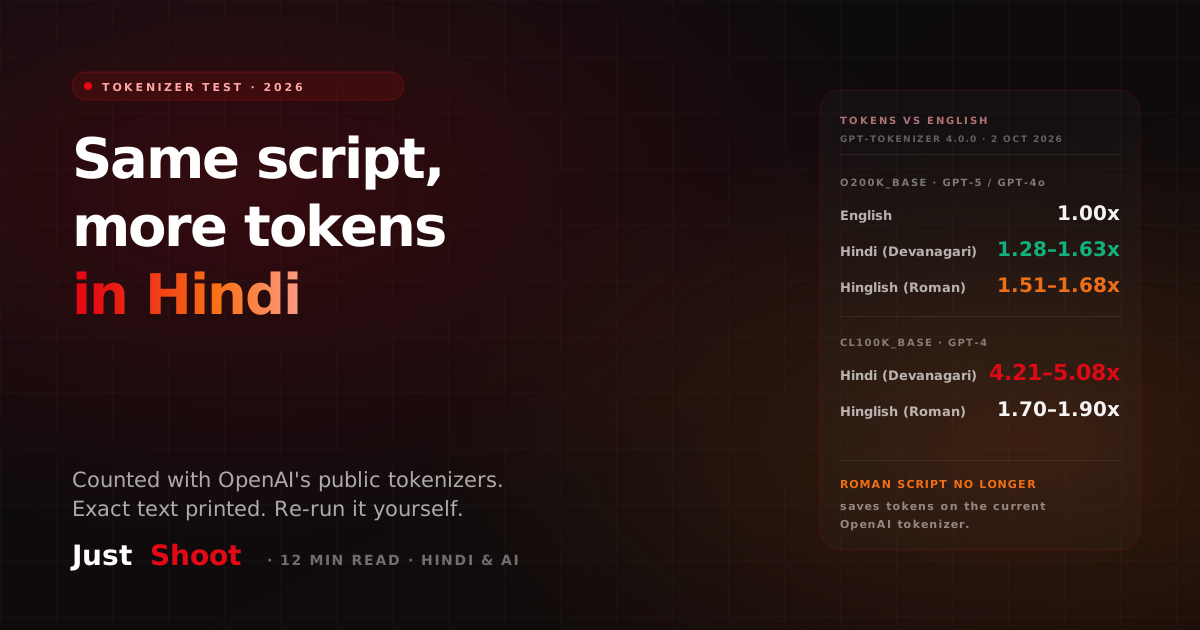
A Hindi Script Costs More Tokens Than the Same Script in English (2026)
One YouTube script in English, Devanagari Hindi and Hinglish, run through OpenAI's public tokenizers. On GPT-5's, Hindi costs 1.28–1.63x the English tokens.
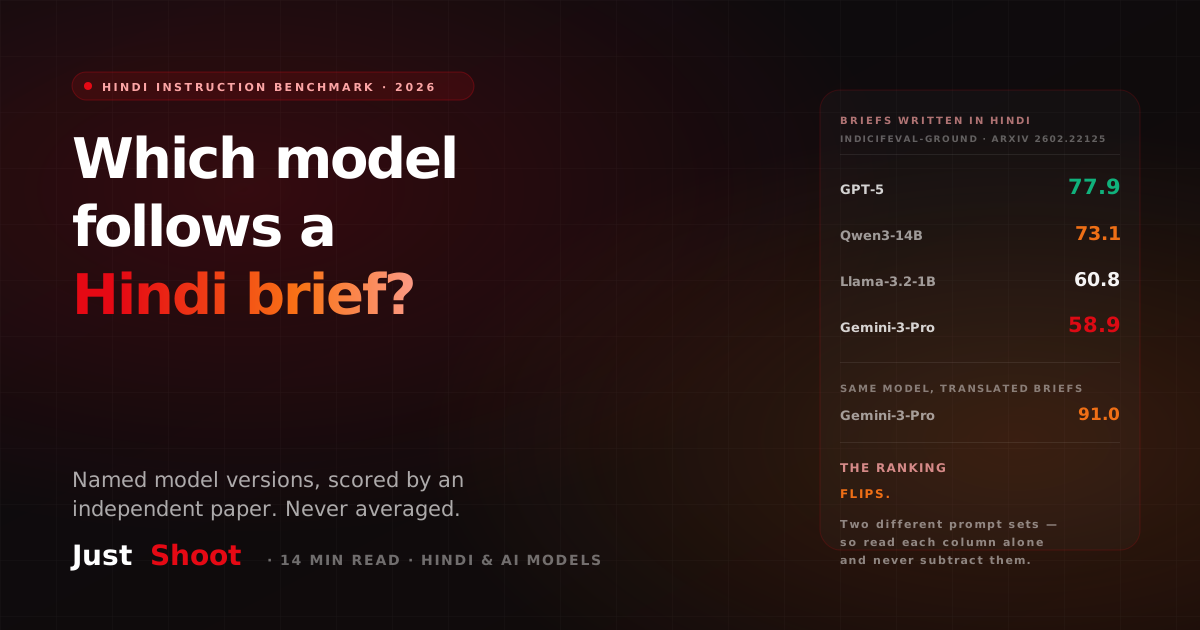
Which AI Model Actually Follows a Hindi Script Brief? (2026)
An independent February 2026 benchmark scored GPT-5, Gemini 3, Gemma 3, Llama and Qwen 3 on verifiable instruction-following in Hindi. The rankings change completely depending on whether the brief was written in Hindi or translated into it.
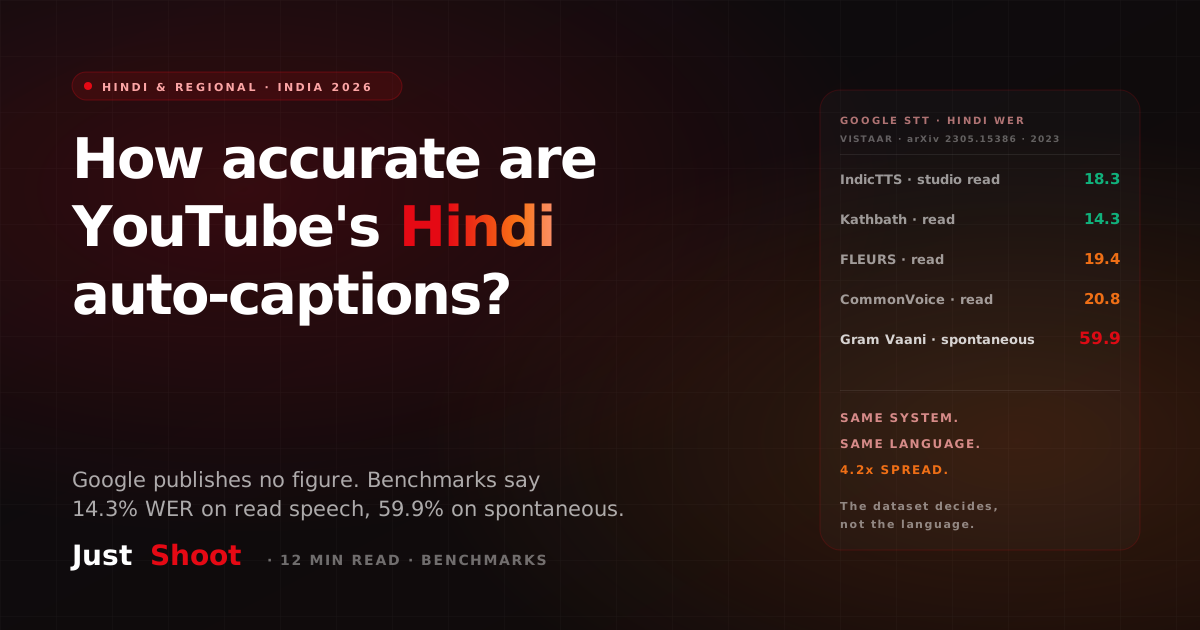
How Accurate Are YouTube's Auto-Captions in Hindi? (2026)
Google publishes no Hindi accuracy figure for YouTube captions. The nearest dated benchmarks put Hindi ASR between 14% and 60% word error rate, depending entirely on the dataset.