How Accurate Are YouTube's Auto-Captions in Hindi? (2026)
Google publishes no Hindi accuracy figure for YouTube captions. The nearest dated benchmarks put Hindi ASR between 14% and 60% word error rate, depending entirely on the dataset.
How Accurate Are YouTube's Auto-Captions in Hindi? (2026)
By Ashok Sachdev, Founder of JustShoot · Published 25 September 2026 · Sources captured 25 September 2026
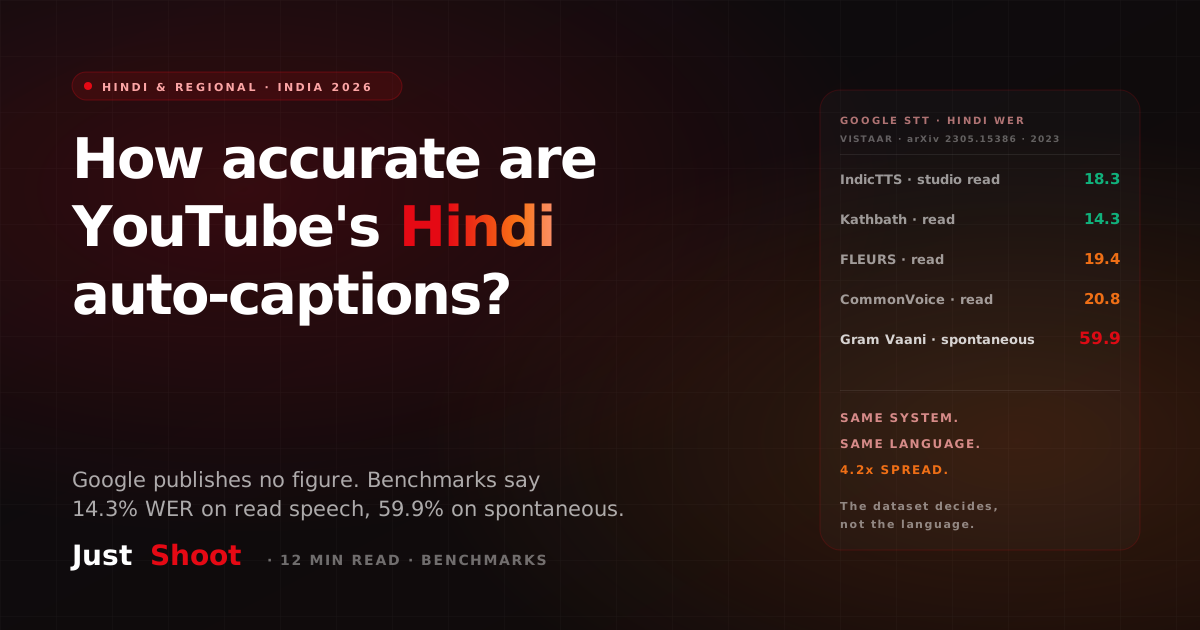
Short answer: Google has never published a Hindi accuracy figure for YouTube's own captioner. The nearest published numbers, from named and dated benchmarks, put Hindi speech recognition at 14.3% word error rate on clean read speech and 59.9% on spontaneous regional Hindi over a phone line — the same system, the same language, a 4.2x spread. The dataset decides the answer, not the language.
That spread is the whole story, and it is why every confident "Hindi captions are about 80% accurate" claim you will find is meaningless. A word error rate measured on someone reading a Wikipedia sentence in a quiet room tells you nothing about what happens to you talking at normal speed, mixing English in, with a fan running.
Below are the actual figures, each with its paper, its date and the dataset it was measured on. Then the part nobody writes about: what a garbled caption track actually costs a creator, and the one fix that is entirely in your hands.
The number Google does not publish
Start with what is missing, because it shapes everything else.
YouTube's Help documentation lists Hindi among the languages automatic captioning supports — alongside Bengali, Gujarati, Kannada, Malayalam, Marathi, Nepali, Punjabi, Tamil and Telugu, in a list of roughly 67 languages. What it does not do is quote an accuracy number. Instead it carries a warning: automatic captions "might misrepresent the spoken content due to mispronunciations, accents, dialects, or background noise," and it advises creators to "always review automatic captions and edit any parts that haven't been properly transcribed" (YouTube Help, Use automatic captioning, accessed 25 September 2026).
The closest Google has come to publishing a YouTube-domain figure is its own research. The Google USM paper — Scaling Automatic Speech Recognition Beyond 100 Languages, arXiv:2303.01037, submitted 2 March 2023 — evaluates on what it calls the YouTube Caption ASR benchmark. On en-US it reports 13.7% WER for the USM-CTC variant and 14.4% for USM-LAS. Across the 73 languages it fine-tuned on 90,000 hours of supervised data, it claims under 30% WER.
There is no per-language Hindi row in that paper. So the honest position is: Google reports a single-digit-to-low-teens error rate for English YouTube audio, an under-30% ceiling for a 73-language group that includes Hindi, and nothing more specific.
What the published Hindi numbers actually say
For Hindi specifically, the most useful public source is Vistaar: Diverse Benchmarks and Training Sets for Indian Language ASR (Bhogale et al., arXiv:2305.15386, submitted 24 May 2023). It collates 59 benchmarks across language and domain combinations and evaluates three public and two commercial systems. Here is the Hindi row, exactly as printed — word error rate, so lower is better:
| System | Kathbath | Kathbath-Hard | FLEURS | CommonVoice | IndicTTS | MUCS | Gram Vaani | Avg |
|---|---|---|---|---|---|---|---|---|
| Google STT | 14.3 | 16.7 | 19.4 | 20.8 | 18.3 | 17.8 | 59.9 | 23.9 |
| IndicWav2vec | 12.2 | 16.2 | 18.3 | 20.2 | 15.0 | 22.9 | 42.1 | 21.0 |
| Azure STT | 13.6 | 14.9 | 24.3 | 14.6 | 15.2 | 15.1 | 42.3 | 20.0 |
| Nvidia-medium | 14.0 | 15.6 | 19.4 | 20.4 | 12.3 | 12.4 | 41.3 | 19.4 |
| Nvidia-large | 12.7 | 14.2 | 15.7 | 21.2 | 12.2 | 11.8 | 42.6 | 18.6 |
| IndicWhisper | 10.3 | 12.0 | 11.4 | 15.0 | 7.6 | 12.0 | 26.8 | 13.6 |
Source: Vistaar, arXiv:2305.15386, Hindi results, 24 May 2023. IndicWhisper is the paper's own model, fine-tuned on 10,700 hours across 12 Indian languages.
Now read the datasets, because without them the table is decoration:
- Kathbath / Kathbath-Hard — crowd-sourced read speech, people reading prompted sentences.
- FLEURS — read speech, Wikipedia sentences, studio-ish conditions.
- CommonVoice — volunteers reading sentences into whatever microphone they own.
- IndicTTS — studio-recorded read speech by trained speakers. The cleanest condition in the table, and note it produces the lowest errors.
- MUCS — the Hindi set from the 2021 multilingual challenge.
- Gram Vaani — spontaneous telephone speech in regional variations of Hindi. Real calls, real dialects, real background.
Six of those seven columns are, broadly, someone reading. One is a person speaking naturally on a phone. Google STT scores 14.3 on the first kind and 59.9 on the second. That is not a small degradation; nearly three words in five are wrong. Even IndicWhisper, purpose-built for Indian languages and the best system in the table, goes from 10.3 to 26.8.
A YouTube video is much closer to the Gram Vaani column than the IndicTTS one. You are not reading a prompt sheet in a studio. That is the single most important thing to take from this page.
One caveat, because it changes the reading
The 59.9 figure is Google STT evaluated on Gram Vaani without training on it. The Gram Vaani challenge itself — Bhanushali et al., Gram Vaani ASR Challenge on spontaneous telephone speech recordings in regional variations of Hindi, Interspeech 2022 — released roughly 1,108 hours (1,000 unlabelled training, 100 labelled training, 5 development, 3 evaluation) and reported baselines on its own evaluation set of 29.7% WER for a TDNN-HMM system and 32.9% WER for a Conformer end-to-end system, both trained on that 100 labelled hours.
So spontaneous Hindi is not hopelessly unrecognisable — it is unrecognisable to a system that has not heard speech like yours. In-domain training roughly halves the error. You cannot fine-tune YouTube's captioner, which is exactly why the gap matters to you and not to a researcher.
The comparison you are not allowed to make
It is tempting to line up USM's 13.7% on en-US YouTube against Google STT's 14.3% on Hindi Kathbath and conclude Hindi captions are about as good as English ones. Do not do that. One is spontaneous long-form video audio; the other is prompted read speech. They are different systems, different years and different tasks. Putting them side by side without saying so is the specific error this page exists to avoid — and it is how most "Hindi captions are 85% accurate" claims get manufactured.
Hinglish is a separate, harder problem
If you speak the way most Indian creators actually speak, your audio is not Hindi. It is Hindi with English embedded in it, sentence by sentence and sometimes word by word.
That has its own benchmark. Multilingual and code-switching ASR challenges for low resource Indian languages (Diwan et al., arXiv:2104.00235, submitted 1 April 2021) built tasks around two code-switched pairs — Hindi-English and Bengali-English — over roughly 600 hours of transcribed speech across all tasks. Its baseline reached 32.45% WER on the code-switching test sets, against 30.73% for the plain multilingual task.
Two things follow. First, code-switching costs measurable accuracy even against a multilingual baseline built by the same team on the same challenge. Second, and this is the part that bites Indian creators specifically: the recogniser must also decide which script a switched word belongs in. "Growth" spoken mid-Hindi-sentence can land as Latin "growth", as Devanagari "ग्रोथ", or as something else entirely — and a viewer searching your channel for one spelling will not find the other.
Which means the English-to-Hindi ratio in your script is not a stylistic question only. It is a prediction of how much of your caption track lands in the wrong script. The free Hinglish ratio checker gives you that split on a pasted script in seconds — no sign-up — and it is worth knowing before you record, not after you read the captions.
What a bad caption track actually costs you
Accuracy is abstract until you trace where the caption text goes. Four places, in rough order of how much they matter to a growing channel:
- Search inside YouTube. The caption track is text YouTube can index. If your key phrase is garbled in the transcript, one of the signals attached to your video is carrying the wrong words.
- The auto-translate chain. Translated subtitles are generated from the caption text, not from your audio. So a recognition error does not stay one error — it is translated, faithfully, into every language a viewer selects. Errors compound down the chain rather than cancelling out. This is the mechanism that makes a single mis-heard product name wrong in a dozen languages at once.
- Accessibility. For a viewer who relies on captions, a 27% error rate is not a minor annoyance; it is a video they cannot follow. (Descriptively — this page is not advice on what you are obliged to provide.)
- Repurposing. Shorts, clips and anything that burns captions in inherits whatever the recogniser guessed.
The one thing you control
You cannot retrain YouTube's captioner, tune it to your accent, or tell it how you spell your own channel name. You can replace its output entirely — and you already have the material.
Upload your own caption file. If you wrote a script before you filmed, the transcript is 90% done before the camera was on: you are timing text you already own rather than correcting text a machine guessed. Creators who work from a written script have a caption asset as a by-product; creators who improvise are stuck editing a 27%-error draft line by line.
This is the least glamorous argument for scripting and one of the most concrete. It is also why we build the nine-stage script pipeline around a written draft rather than a bullet outline. If you write in Hindi, write in Hindi natively rather than translating English — a translated script reads like a translated script, and it also captions worse, because the phrasing is not what a Hindi speaker would naturally say. And if you are going wider than one language, how localisation actually works is the next thing to read; the cost of dubbing into an Indian language is the budgeted version of the same decision.
On pricing: the trial is ₹0 for 7 days with 2 scripts, no card. Starter is ₹499/mo for 3 scripts, Creator ₹999/mo for 7 scripts, Pro ₹1999/mo for 15 scripts, and Studio is custom. Fixed scripts per month, no rollover, GST included, monthly only.
FAQ
How accurate are YouTube's Hindi auto-captions, in one number? There is no single honest number, because Google does not publish one. The nearest published benchmarks show Hindi speech recognition at 14.3% word error rate on clean read speech and 59.9% on spontaneous regional Hindi over a phone (Vistaar, arXiv:2305.15386, May 2023). Your audio sits closer to the second figure than the first.
Are Hindi captions worse than English ones? Probably, but the published figures do not let you state it cleanly. Google's USM paper reports 13.7% WER on its English YouTube caption benchmark (arXiv:2303.01037, March 2023) and no Hindi equivalent. Comparing that to a Hindi read-speech score is a dataset mismatch, not a language comparison.
Do captions get worse when I mix English into Hindi? Yes, measurably. The 2021 multilingual and code-switching challenge reported 32.45% WER on its Hindi-English and Bengali-English code-switching test sets against 30.73% on the plain multilingual task (arXiv:2104.00235). Separately, switched words can be transcribed in either Devanagari or Latin script, which fragments how your own terms appear in the transcript.
Will uploading my own caption file help? It replaces the machine's guess with your text, so every downstream use — in-platform indexing, translated subtitles, accessibility, burned-in clips — reads what you actually said. It is the only part of this chain a creator fully controls.
Why can't Google just fix Hindi captioning? It is partly a data-domain problem rather than a model problem. The Gram Vaani challenge baselines dropped to 29.7% WER (TDNN-HMM) and 32.9% (Conformer) on spontaneous Hindi once trained on 100 labelled hours of that exact speech (Interspeech 2022), roughly half the zero-shot error. A general captioner cannot be fine-tuned on your voice, your dialect and your room.
Sources
All captured 25 September 2026. Every figure on this page is traceable to one of these; none are averaged across source types, and none are estimated.
- Bhogale, Sundaresan, Raman, Javed, Khapra, Kumar — Vistaar: Diverse Benchmarks and Training Sets for Indian Language ASR, arXiv:2305.15386, submitted 24 May 2023 (v2, 2 August 2023). 59 benchmarks; IndicWhisper fine-tuned on 10,700 hours across 12 Indian languages.
- Zhang et al. — Google USM: Scaling Automatic Speech Recognition Beyond 100 Languages, arXiv:2303.01037, submitted 2 March 2023 (v3, 25 September 2023). YouTube Caption ASR benchmark; en-US 13.7% (USM-CTC) / 14.4% (USM-LAS); under 30% WER across 73 languages fine-tuned on 90,000 hours.
- Diwan et al. — Multilingual and code-switching ASR challenges for low resource Indian languages, arXiv:2104.00235, submitted 1 April 2021. Hindi-English and Bengali-English code-switching; ~600 hours; baseline 32.45% WER code-switching vs 30.73% multilingual.
- Bhanushali et al. — Gram Vaani ASR Challenge on spontaneous telephone speech recordings in regional variations of Hindi, Interspeech 2022 (ISCA Archive). ~1,108 hours released; evaluation-set baselines 29.7% WER / 15.1% CER (TDNN-HMM) and 32.9% WER / 19.0% CER (Conformer).
- YouTube Help — Use automatic captioning, support.google.com/youtube/answer/6373554, accessed 25 September 2026. Hindi listed among supported languages; accuracy caveat and review advice quoted verbatim.
Written by Ashok Sachdev, founder of JustShoot. Benchmark figures belong to their authors and are cited, not restated as ours. Interest disclosed: we sell a script-writing product, and "write the script first" is both this page's conclusion and our business.
Which AI Model Actually Follows a Hindi Script Brief? (2026)
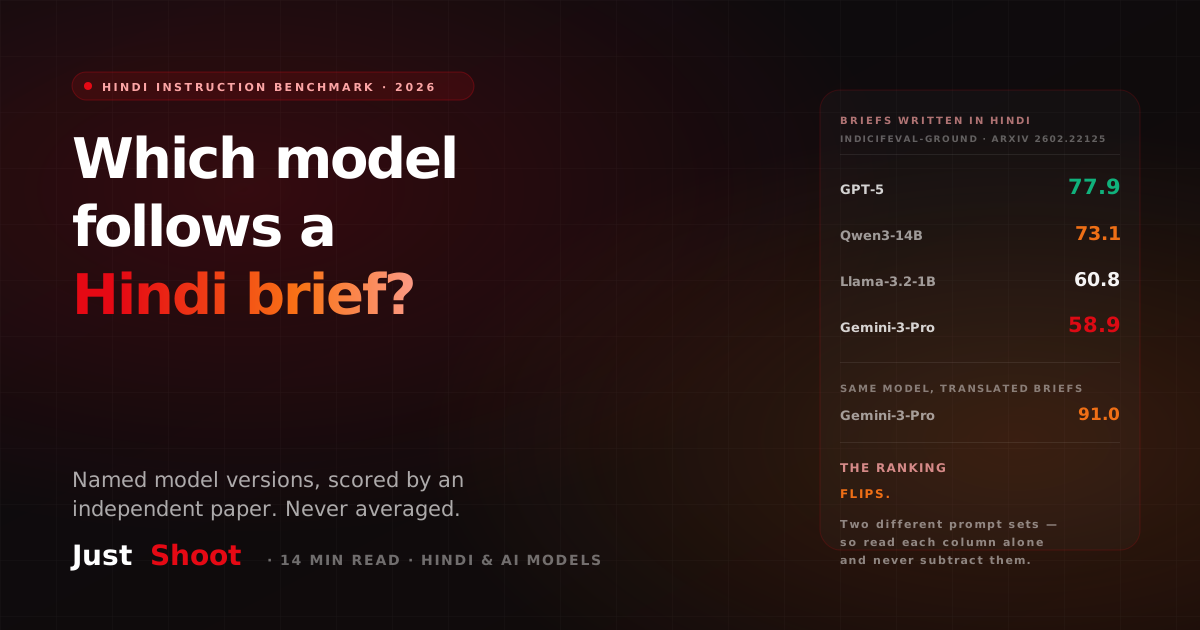
An independent February 2026 benchmark scored GPT-5, Gemini 3, Gemma 3, Llama and Qwen 3 on verifiable instruction-following in Hindi. The rankings change completely depending on whether the brief was written in Hindi or translated into it.
How to Check If Your YouTube Script Sounds AI-Generated (2026)
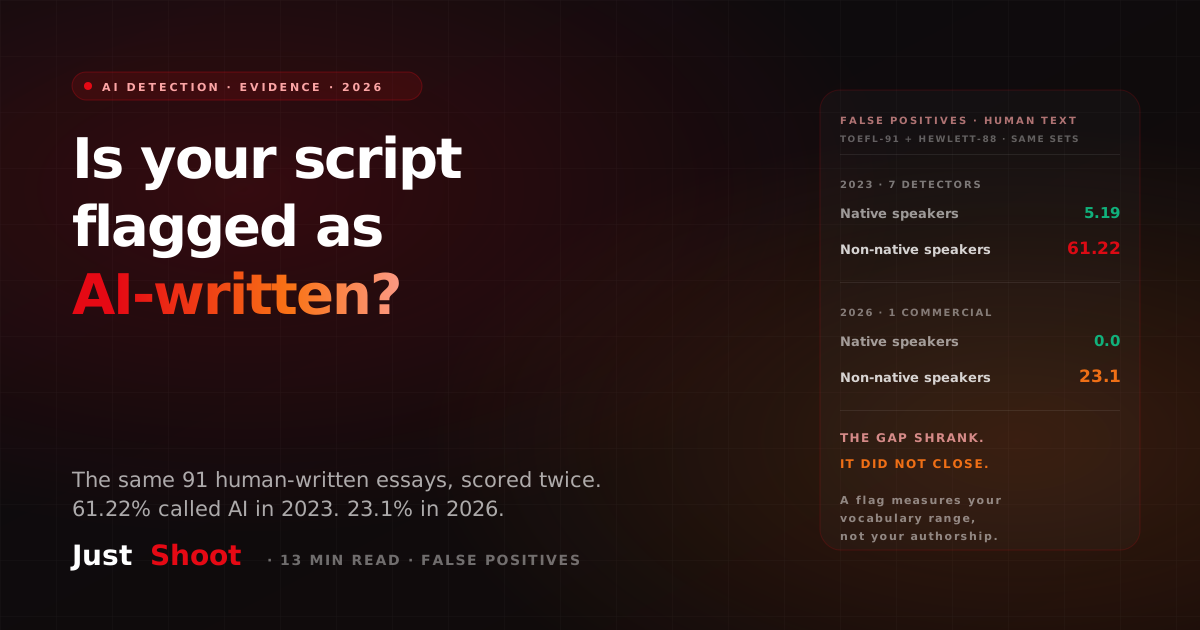
The same 91 human-written essays were scored by AI detectors twice: 61.22% were flagged as AI in 2023, 23.1% in 2026. Native-speaker essays scored 5.19% and 0.0%.
Best AI Malayalam YouTube Script Generator (2026)
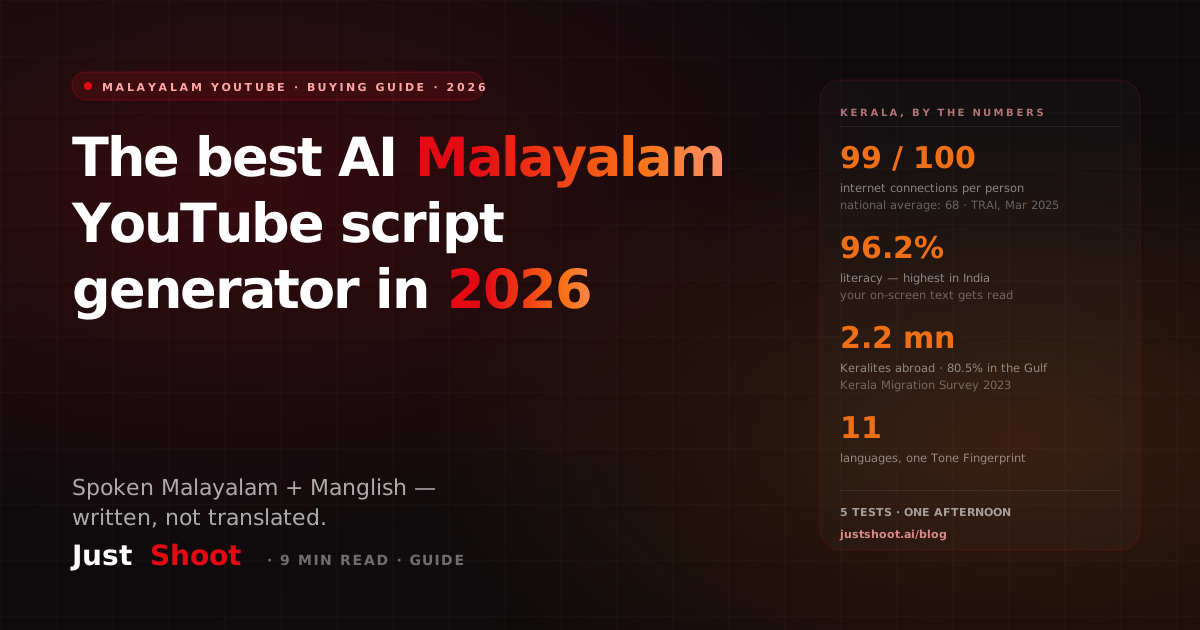
Which AI writes Malayalam YouTube scripts natively — spoken register, Manglish code-mix, dialect held steady? A buying guide for Kerala creators, with Kerala's real connectivity numbers and five tests to run before you pay.