How to Check If Your YouTube Script Sounds AI-Generated (2026)
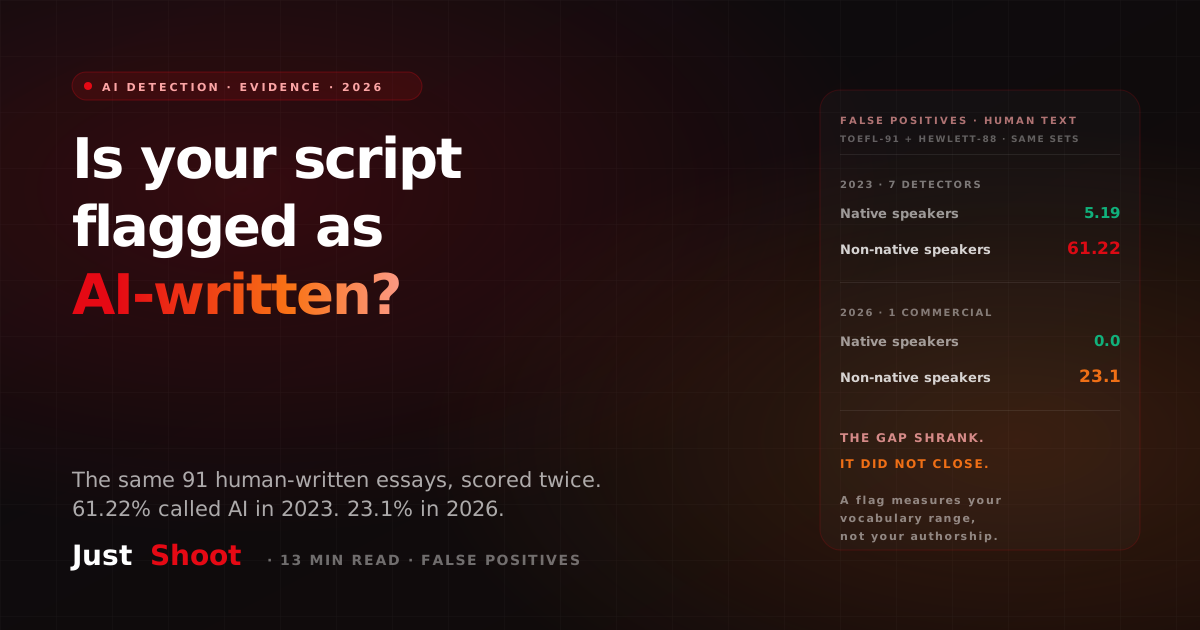
The same 91 human-written essays were scored by AI detectors twice: 61.22% were flagged as AI in 2023, 23.1% in 2026. Native-speaker essays scored 5.19% and 0.0%.
How to Check If Your YouTube Script Sounds AI-Generated (2026)
By Ashok Sachdev, Founder of JustShoot · Published 25 September 2026 · Sources captured 25 September 2026
Short answer: You cannot get a trustworthy yes or no from a detector. The same 91 human-written essays by non-native English speakers have been scored twice by published research: 61.22% were flagged as AI in 2023, and 23.1% in 2026. Native-speaker essays from the same studies scored 5.19% and 0.0%. If English is not your first language, a flag measures your vocabulary range, not your authorship.
That is the whole finding, and it is worth more to you than any score you can generate today. A detector reading "87% AI" on a script you wrote yourself, at 2am, from your own notes, is not broken — it is doing exactly what it was trained to do, and what it was trained to do is not what you think.
Below are the actual published numbers, each with its paper, its date and the corpus it was measured on. Then the part that changes how you read a flag, and the honest limits of everything on this page — including our own tool.
What "flagged" means, measured twice on the same essays
There is one human-written corpus that has been run through AI detectors in two separate, published, peer-reviewed-or-preprinted studies, three years apart. That makes it the only place where you can watch the false-positive rate move over time rather than argue about it.
The corpus: 91 TOEFL essays written by Chinese students under supervised exam conditions, plus 88 US 8th-grade essays from the Hewlett Foundation's Automated Student Assessment Prize dataset. Every one of them is human-written. Anything a detector flags is, by definition, a false positive.
| Study | Date | Detector(s) | Non-native English FPR | Native English FPR |
|---|---|---|---|---|
| Liang, Yuksekgonul, Mao, Wu, Zou — Patterns / arXiv:2304.02819 | detectors accessed 15 Mar 2023; v3 10 Jul 2023 | 7 off-the-shelf detectors, averaged | 61.22% | 5.19% |
| Al Ali, Helcl, Libovický — arXiv:2602.05769v1 | 6 Feb 2026 | 1 commercial multilingual detector (Plagramme) | 23.1% | 0.0% |
Read the columns, not the rows. Between 2023 and 2026 the false-positive rate on non-native English writing fell by a large margin — the 2026 authors note the improvement explicitly, from Liang's 61.3% mean (or 48% for Liang's single best detector) down to the 23.1% they observed. That is real progress and it deserves saying.
But the gap did not close. On the native corpus the 2026 detector scored a clean 0.0%. On the non-native corpus, 23.1%. Roughly one in four genuinely human passages, written by someone whose English is a second language, still came back flagged — while the native-speaker set came back perfect. The 2026 paper puts that gap at ΔFPR = 23.1 percentage points.
The number everyone quotes is a rounding of a number they have not read
You will see "61.3%" in every article about this. The primary paper says 61.22%. You will see "5.1%" for the native-speaker figure; the primary paper says 5.19% in the passage where it reports the average across detectors. The 2026 paper restates its predecessor as 61.3% and 5.1%, and everyone downstream has copied the restatement.
The rounding is harmless. The habit is not, because it means almost nobody quoting this figure has opened the paper — and the two figures in the table above get averaged together constantly, which is the actual error. They cannot be averaged. Different detectors (seven vs one), different years, different sample handling (the 2026 run capped each dataset at 100 documents and truncated each to 512 words). "About 40% of non-native writing gets flagged" is a number nobody measured.
Two more figures from the 2023 study that matter more than the average
- 89 of the 91 TOEFL essays — 97.80% — were flagged by at least one of the seven detectors. If your plan is to paste your script into five free detectors and see what happens, this is what you are buying. Run enough detectors and you will manufacture a flag on anything.
- All seven detectors unanimously agreed on 18 of the 91 essays — 19.78%. Unanimous agreement, on human-written exam scripts, that they were machine-generated.
Why this lands on Indian creators, and the gap in the evidence
Here is the part most pages on this topic will not tell you: there is no published false-positive rate for Indian English, for Hindi, or for Hinglish. Not from the researchers, not from the vendors.
The 2023 corpus was Chinese TOEFL candidates. The 2026 follow-up was primarily a Czech study — its headline result is that Czech non-native speakers' text has higher entropy than native speakers' (p < 10⁻¹⁴), the opposite of the English finding, and that its Czech detectors showed no systematic bias at all. The English figures in the table are a side experiment in that paper, not its subject.
So the 23.1% is the closest published proxy for a second-language English writer, and it is a proxy. It is not an Indian number. Anyone quoting a specific Indian-English false-positive rate is inventing it. What the evidence does support is the direction: detectors trained to reward lexical variety penalise writers with a narrower English register, and a large share of Indian creators writing English scripts sit in that register by circumstance rather than by ability.
Hinglish has no evidence base at all. A script that switches between Devanagari and Latin script mid-sentence is outside every corpus these detectors were benchmarked on, so a score on it is not a measurement of anything.
What the detector companies publish about themselves
Vendors do publish accuracy figures. They are just answering a different question.
- Copyleaks publishes over 99% accuracy and a 0.2% false-positive rate, citing testing across 20,000+ human-written papers — though a lower figure (0.03%) also appears elsewhere on its own site, with no date attached to either.
- GPTZero publishes "no more than 1%" false positives and 99% accuracy on its benchmarking page (dated 30 January 2025, model updated monthly), with 96.5% on mixed human/AI documents. It states it tests on diverse data "from ESL learners" — and publishes no numerical breakdown for them.
- Turnitin publishes a false-positive rate of under 1% at document level and suppresses AI scores in the 1–19% band precisely to avoid acting on them.
- Pangram (arXiv:2402.14873, submitted 21 Feb 2024, latest version 29 Jul 2024) claims in its abstract that its classifier "is not biased against nonnative English speakers" — a qualitative claim; the abstract carries no non-native FPR number.
Both sets of numbers are true at once, and the arithmetic is the point. A vendor's ≤1% is an average over a benchmark that is mostly native-English text. The 23.1% is a rate computed only on the population you belong to. Averaging a mostly-native corpus does not give you your own odds — it hides them. The single most useful thing a detector company could publish is a per-population breakdown, and as of today none of the four above publishes one with a number in it.
What we did not do, and why
The honest version of this post does not include our own detector scores.
We considered running one identical script through the named detectors and publishing the results. We did not, for one reason: a free web detector returns a number on a screen that nobody else can reproduce, against a model version the vendor changes monthly (GPTZero says so on its own page). A screenshot of "82% AI" is not evidence — it is an anecdote with a percent sign. The published research above is reproducible, dated, and has its data and code posted. That is what belongs in a citation.
And a related disclosure about our own tool: the free AI Script Robot-Score is not an AI-authorship detector and does not claim to be one. It is a rule-based style scorer that runs in your browser and grades four spoken-word tells — sentence-rhythm uniformity, hollow-authority filler, the Hook→3-points→CTA template, and written-blog cadence — and shows you the exact phrases that triggered each one. It will not tell you whether a machine wrote your script, because nothing reliably can. It tells you whether your script reads like something a person says out loud, which is the question you can actually act on.
The experiment that proves a flag is not about authorship
This is the most useful result in the 2023 paper and the one nobody cites.
The researchers took the genuine, human-written US 8th-grade essays and asked ChatGPT to "simplify word choices as if written by a non-native speaker." Nothing about the authorship changed — a human still wrote them. The average misclassification rate across detectors rose from 5.19% to 56.65%.
Then they ran it in reverse, asking ChatGPT to "enhance the word choices to sound more like that of a native speaker" on the real TOEFL essays. Misclassification dropped, and text perplexity rose.
Same authors. Same authorship. Opposite verdict — driven entirely by word choice. Whatever these detectors measure, it is lexical range and predictability, not provenance. Which means a flag on your script is feedback about vocabulary and phrasing. It is not an accusation, and it is not proof of anything.
That also explains why "write more naturally" prompting does not move the needle much, and why the tells are mechanical rather than mysterious — we covered those separately in why AI scripts sound robotic, and the voice question itself in can AI write scripts in your voice.
So what should you actually do
Five things, in order, all of which follow from the numbers above rather than from vibes:
- Stop treating a score as a verdict. 97.80% of genuinely human exam essays were flagged by at least one detector. A single flag carries almost no information.
- Never run one script through many detectors. That is how you guarantee a flag. If you must test, pick one, note its date, and treat the result as one weak signal.
- If someone flags your work, ask what corpus their tool's false-positive rate was measured on. No vendor above publishes a non-native breakdown. That is a fair question and there is currently no answer to it.
- Add the things a detector reads as human: specifics, dates, first-person detail. Numbers you looked up. What happened to you on a shoot. A named place. This is not gaming a detector — it is the same edit that makes a script worth watching, and it happens to raise the lexical variety these tools reward.
- Fix it once at the source, not per draft. Word choice, sentence rhythm and language mix are properties of a voice, not of a draft. Capture them once and every script inherits them.
That last point is the whole reason our nine-stage pipeline builds a Tone Fingerprint before it writes anything, and it is why a generic prompt cannot substitute: a prompt has no record of how you build a sentence. If you write Hinglish, the free Hinglish ratio checker will tell you your actual Devanagari-to-Latin split, which is the one input every detector on this page is silently unequipped to handle.
On pricing: the trial is ₹0 for 7 days with 2 scripts, no card. Starter is ₹499/mo for 3 scripts, Creator ₹999/mo for 7 scripts, Pro ₹1999/mo for 15 scripts, and Studio is custom. Fixed scripts per month, no rollover, GST included, monthly only.
FAQ
How do I check if my YouTube script sounds AI-generated? Not with an AI detector, because its answer is unreliable for second-language English writers — 23.1% of genuinely human non-native essays were flagged in a February 2026 measurement, against 0.0% of native-speaker essays (arXiv:2602.05769). Check the mechanical tells instead: sentence lengths that are all the same, hollow authority phrases, a rigid hook-three-points-CTA shape, and connectors you would never say out loud.
Are AI detectors accurate? On their own benchmarks, yes — Copyleaks, GPTZero and Turnitin each publish accuracy above 98% and a false-positive rate near or under 1%. On non-native English writing specifically, the independently measured figures are 61.22% false positives in 2023 (Liang et al., arXiv:2304.02819) and 23.1% in 2026. Both can be true: the vendor figures are averages over corpora that are mostly native-English text.
Is there a published false-positive rate for Hindi or Indian English? No. As of 25 September 2026 we could not find one from any detector vendor or any research group. The nearest published proxies are Chinese TOEFL essays (2023 and 2026) and a Czech-language study (2026). Any specific Indian-English figure you see quoted is not sourced.
Does YouTube penalise AI-written scripts? YouTube's policies target inauthentic, mass-produced and undisclosed synthetic content, not the use of a writing tool. Nothing in the detector research above is a YouTube signal — these are third-party classifiers with no connection to the platform.
Will rewriting my script to beat a detector make it better? Only if you rewrite it the right way. The 2023 study showed that simplifying word choice in real human essays pushed misclassification from 5.19% to 56.65%, so the lever is lexical variety and specificity. Adding real detail, exact numbers and first-person experience raises that variety and also makes the video better. Padding with thesaurus words raises it and makes the video worse.
Sources
All captured 25 September 2026. Every figure on this page is traceable to one of these. Figures from different studies are reported side by side and never averaged together, because the detectors, years and sample handling differ.
- Liang, Yuksekgonul, Mao, Wu, Zou — GPT detectors are biased against non-native English writers, Patterns (Cell Press), 10 July 2023; preprint arXiv:2304.02819v3. 91 TOEFL essays (Chinese educational forum) and 88 US 8th-grade essays (Hewlett Foundation ASAP dataset). Seven off-the-shelf detectors — Originality.AI, Quil.org, Sapling, OpenAI's detector, Crossplag, GPTZero, ZeroGPT — accessed 15 March 2023. Average false positive rate 61.22% on TOEFL essays; 18 of 91 (19.78%) flagged unanimously; 89 of 91 (97.80%) flagged by at least one. Word-choice simplification of the US essays moved the cross-detector average from 5.19% to 56.65%. Data and code published on GitHub and Zenodo.
- Al Ali, Helcl, Libovický — Different Time, Different Language: Revisiting the Bias Against Non-Native Speakers in GPT Detectors, arXiv:2602.05769v1, 6 February 2026 (Charles University; University of Oslo). Primary study in Czech: non-native entropy higher than native (p < 10⁻¹⁴), no systematic bias found across three detector families. Side experiment on Liang et al.'s English sets with the commercial Plagramme detector: TOEFL-91 FPR 23.1%, Hewlett (native) FPR 0.0%, ΔFPR 23.1 points; entropy–output correlation negligible (0 < ρ < 0.04). Each dataset capped at 100 documents, truncated to 512 words.
- GPTZero — How AI Detection Benchmarking Works at GPTZero, gptzero.me, page dated 30 January 2025, accessed 25 September 2026. 99% accuracy; 96.5% on mixed documents; "no more than 1%" false positives; model updated monthly; ESL data mentioned without a numerical breakdown.
- Copyleaks — published AI-detector accuracy claims, copyleaks.com, accessed 25 September 2026. Over 99% accuracy; 0.2% false-positive rate across 20,000+ human-written papers; a 0.03% figure also appears on the site. No date attached to either figure and no non-native breakdown.
- Turnitin — published AI writing detection guidance, accessed 25 September 2026. Under 1% false-positive rate at document level; AI scores in the 1–19% range are suppressed rather than shown.
- Technical Report on the Pangram AI-Generated Text Classifier, arXiv:2402.14873, submitted 21 February 2024 (latest version 29 July 2024). Abstract states the classifier "is not biased against nonnative English speakers"; no non-native false-positive figure in the abstract.
Written by Ashok Sachdev, founder of JustShoot. Research figures belong to their authors and are cited, not restated as ours. Interest disclosed: we sell an AI script-writing product, and a page arguing that detector flags are unreliable is a page that happens to suit us — which is exactly why every number above is someone else's, dated, and linked.
How Accurate Are YouTube's Auto-Captions in Hindi? (2026)
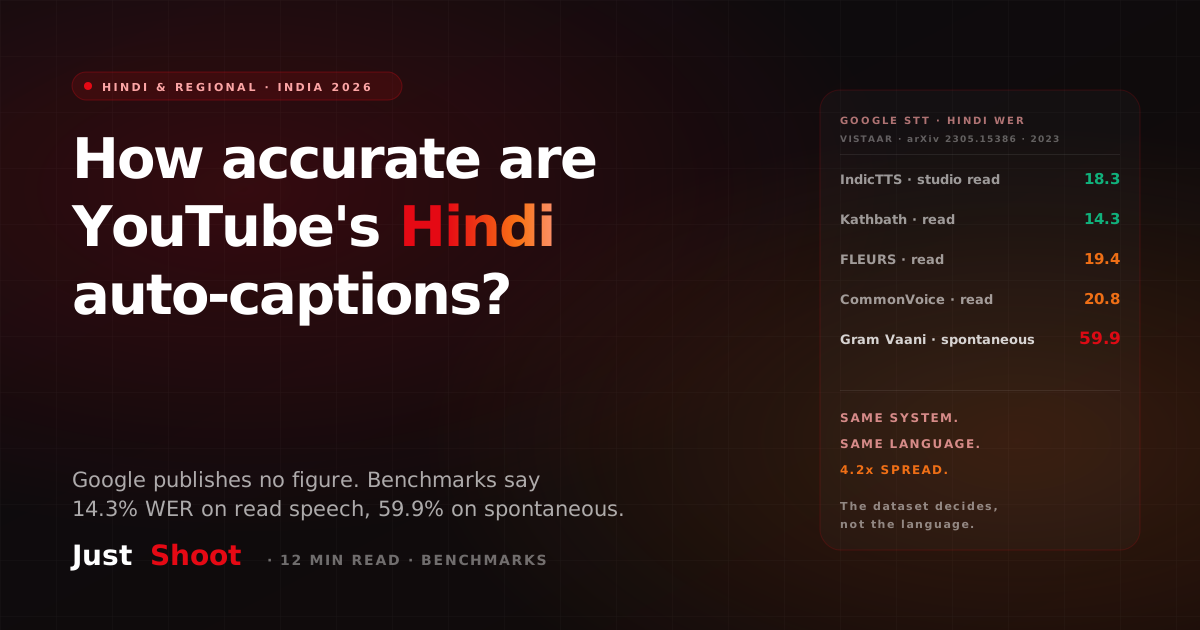
Google publishes no Hindi accuracy figure for YouTube captions. The nearest dated benchmarks put Hindi ASR between 14% and 60% word error rate, depending entirely on the dataset.
Which AI Model Actually Follows a Hindi Script Brief? (2026)
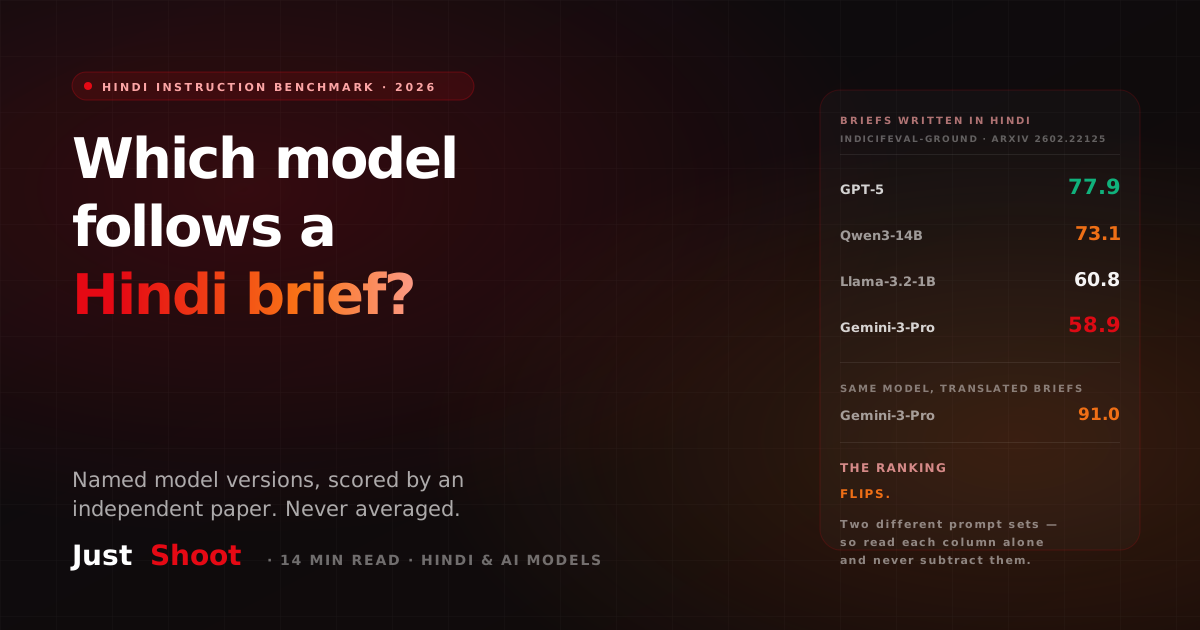
An independent February 2026 benchmark scored GPT-5, Gemini 3, Gemma 3, Llama and Qwen 3 on verifiable instruction-following in Hindi. The rankings change completely depending on whether the brief was written in Hindi or translated into it.
Best AI Malayalam YouTube Script Generator (2026)
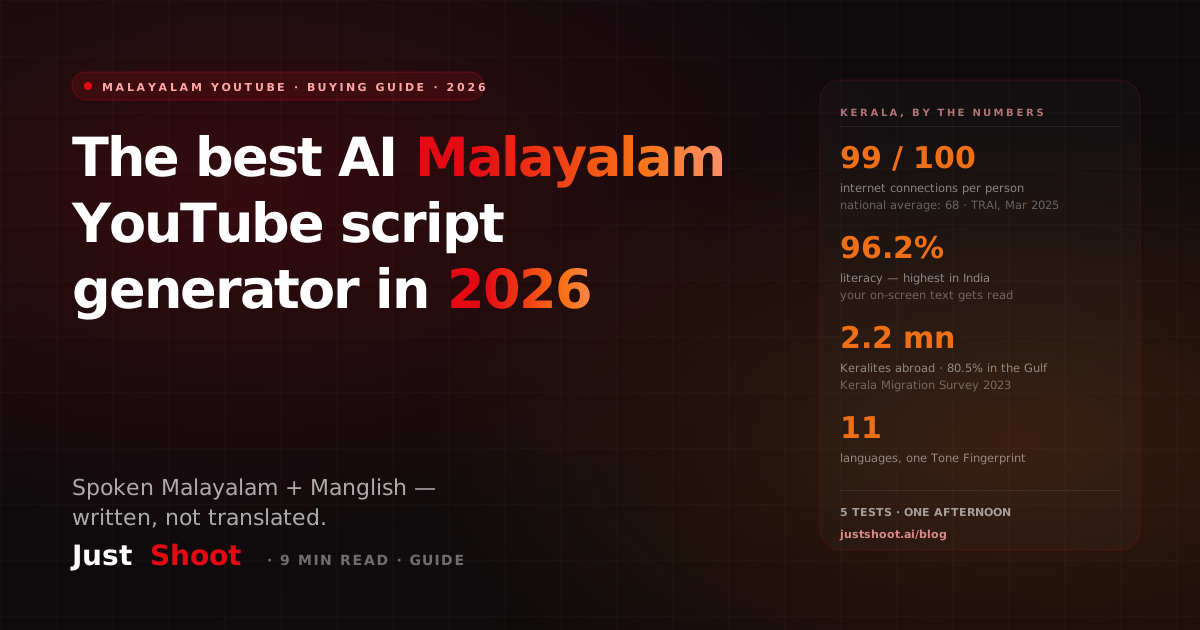
Which AI writes Malayalam YouTube scripts natively — spoken register, Manglish code-mix, dialect held steady? A buying guide for Kerala creators, with Kerala's real connectivity numbers and five tests to run before you pay.