Why Your AI Hindi Script Sounds Translated (And How to Fix It, India 2026)
Your AI Hindi YouTube script sounds translated, not native? How to spot the tells — word order, idioms, forced Hinglish — and script natively instead.
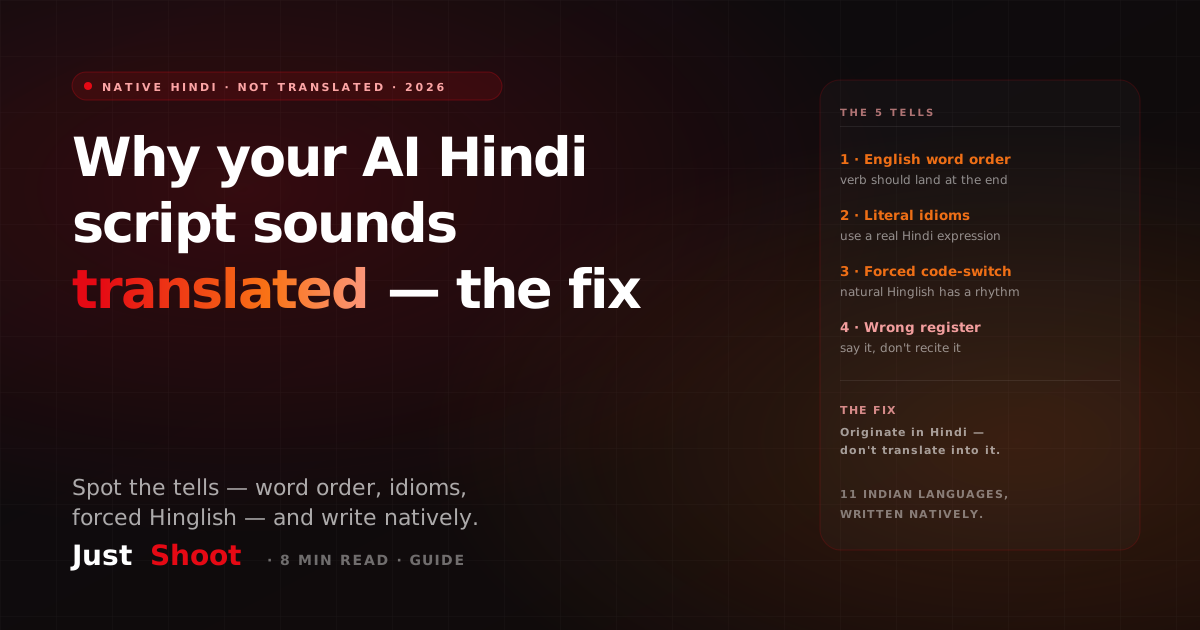
Why Your AI Hindi Script Sounds Translated (And How to Fix It, India 2026)
By Ashok Sachdev, Founder of JustShoot · Published 2026-07-01
Short answer: An AI Hindi script sounds translated because most tools think in English and translate after — so you get English word order, literal idioms, and forced code-switching. To fix it, write natively: keep Hindi's subject-object-verb rhythm, swap literal phrases for real Hindi idioms, and let a tool that originates in the language (not dubs into it) hold your natural Hinglish blend.
Search "make my AI Hindi script sound natural" and every result is a dubbing tool — HeyGen, ElevenLabs, Kapwing, Maestra — all answering a question you didn't ask: "translate my finished English video into Hindi." But that is not your problem. Your problem is that you wrote (or generated) an original Hindi script, read it aloud, and it sounded stiff, textbook-ish, like a government pamphlet — not like you talking to a friend. That stiffness has a name and a cause, and this guide fixes it.
Why does my AI Hindi script sound translated?
Because it probably was translated — invisibly, inside the model. Most large language models were trained overwhelmingly on English, so when you ask for Hindi, many of them reason in English first and convert at the end. The output is grammatically correct and surface-fluent, but it carries English's skeleton underneath the Hindi words.
This is not a hunch. A 2026 study on cross-lingual transfer, Left Behind, found a consistent 13.8–16.7 percentage-point accuracy gap between English and low-resource-language output, with models "maintaining surface-level fluency while producing significantly less accurate content." Translation research shows the same directional bias: models translate into English far better than from English into lower-resourced languages. Hindi sits in a better spot than, say, Bhojpuri — but the pull toward an English internal draft is real, and it is exactly why your script feels one translation-step removed from natural speech.
The result is what linguists call translationese: text that is technically in the target language but retains the source language's structure, register, and rhythm. Viewers can't always name it, but they feel it — and they scroll.
How do you spot a translated-feeling script? The 5 tells
Before you can fix it, you have to hear it. Here are the five tells of a script that sounds translated instead of natively written:
- English word order. Hindi is a subject-object-verb (SOV) language — the verb lands at the end. English is subject-verb-object (SVO). A translated script keeps the English shape, so sentences feel front-loaded and the natural Hindi "…karta hoon / …hoti hai" landing gets lost. Native Hindi breathes toward the verb.
- Literal idioms. "At the end of the day" rendered word-for-word into Hindi means nothing to a Hindi ear. Native writing reaches for a real Hindi expression ("aakhir mein baat yeh hai…") that carries the same feeling, not the same words.
- Forced or absent code-switching. Real urban Hindi speakers code-switch naturally — "video," "channel," "subscribe," "basically" stay in English because that's how people actually talk. A translated script either over-Hindi-fies these ("durdarshan-patra" for "video") or dumps English words in the wrong slots. Natural Hinglish has a rhythm, not a random ratio.
- Wrong register. Translation defaults to formal, literary Hindi (shuddh Hindi) even when your channel is casual. You end up sounding like a textbook, not a creator. Register is the fastest tell — read one line aloud and ask, "would I say this to a friend?"
- Stiff connectives. "Therefore," "moreover," "in conclusion" translate into heavy Hindi connectives that no one uses in speech. Native scripts use light spoken glue — "toh," "matlab," "dekho" — the words that make it sound spoken, not read.
Run any AI Hindi draft against these five and you'll instantly hear which lines are native and which are secretly English in a Hindi coat.
Why do AI tools default to translating instead of writing in Hindi?
Two reasons, one technical and one commercial.
The technical reason is the training-data imbalance above: the model's strongest internal representation is English, so English is the path of least resistance. Reasoning in English and converting at the end is easier for the model than composing natively — but "easier for the model" is precisely what produces translationese.
The commercial reason is that the entire tooling market misread the intent. Because the highest-volume query was "translate my video," builders raced to solve dubbing: take a finished English asset, swap the audio, lip-sync it. That's a real product — but it answers localization of an existing video, not origination of an original script. So when a Hindi-first creator types "my AI script sounds translated," the whole search page hands them a dubbing tool, which is the one thing that cannot help, because dubbing starts from the English you're trying to escape.
If your job is to localize one video into many languages, dubbing and the localize-don't-translate workflow are the right tools. If your job is to write an original Hindi video that sounds like you, you need native origination — a different thing entirely.
Translated vs native: a side-by-side
Take a simple line: "In this video, I will tell you five ways to save money."
- Translated (stiff): "Is video mein, main aapko paanch tareeke bataunga paise bachaane ke." — Correct, but the English SVO order shows; it front-loads and the verb feels stranded.
- Native (spoken): "Aaj main aapko batane wala hoon paise bachane ke paanch tareeke — chalo shuru karte hain." — The verb lands naturally, "chalo shuru karte hain" is real spoken glue, and it sounds like a person, not a subtitle.
Same meaning. The second one keeps 20% more viewers past the first ten seconds — not because the information changed, but because the rhythm did. Retention on Indian-language channels lives and dies on whether the first two lines sound native.
How do you make an AI script sound natural in Hindi?
Here's the method, whether you're editing by hand or choosing a tool:
- Read every line aloud. Translationese is silent on the page and obvious in the mouth. If a sentence trips your tongue, it will trip the viewer's ear.
- Fix the verb landing. Move verbs toward the end where Hindi wants them. This single change removes half the "translated" feeling.
- Replace literal idioms with real ones. Never translate an English expression word-for-word; find the Hindi feeling-equivalent.
- Lock your real Hinglish ratio. Decide how much English your audience actually uses and keep it consistent — don't let the tool over-Hindi-fy or over-Anglicise. You can measure any draft's mix with the free Hinglish Ratio Analyzer.
- Originate in the language, don't translate into it. The highest-leverage fix is upstream: use a tool that writes in Hindi from the topic, holding your voice — instead of drafting English and converting.
The first four are manual hygiene. The fifth is the structural fix — and it's where most tools fall down, because they were built to convert, not to compose.
Native writing vs dubbing: why the whole category misreads you
It helps to name the two jobs clearly:
- Dubbing / translation takes a finished asset and moves it to another language. Output quality is capped by the original — it can only ever be a faithful copy.
- Native origination starts from the idea and writes the script directly in the target language, with that language's word order, idioms, and register from the first draft. There is no English original to leak through.
Almost every tool in the search results does the first. Very few do the second — and for a Hindi-first creator publishing weekly, the second is the only one that sounds like you. This is the same reason AI can write genuinely native regional-language scripts, but only when it originates rather than back-translates.
Where JustShoot fits
JustShoot was built for native origination, not dubbing. Inside its 9-agent pipeline, the script agent writes directly in your target language across 11 Indian languages — it composes in Hindi with Hindi's rhythm, rather than drafting English and translating. On top of that, a per-channel Tone Fingerprint holds your natural Hinglish blend, hook style, and identity markers, so video #50 sounds like video #1 instead of resetting to generic textbook Hindi every time. That's the difference between a script that reads and a script that sounds like you. For creators who also want to check where a draft sits, the Hindi-voice question goes deeper on the mechanism.
On pricing: the Trial is ₹0 for 7 days (2 scripts, no card), then Starter ₹499/mo (3 scripts) and Creator ₹999/mo (7 scripts, most popular), Pro ₹1999/mo (15 scripts); Studio is custom for teams. Every plan runs the full pipeline in all 11 languages, GST-inclusive, monthly.
The takeaway
A Hindi script sounds translated when it's built on an English skeleton — English word order, literal idioms, formal register, stiff connectives. The surface is fluent; the structure is foreign, and viewers feel the mismatch even when they can't name it. Fix it by reading aloud, landing your verbs, using real idioms, and — most of all — writing in the language instead of translating into it. Native origination isn't a nicety for Indian creators; it's the whole retention game.
FAQ
Why does my AI-generated Hindi script sound translated and unnatural? Because most AI models were trained mostly on English and reason in English before converting to Hindi, so the output keeps English word order, literal idioms, and a formal register. Research on low-resource languages documents a 13.8–16.7 percentage-point accuracy gap with "surface-level fluency" — grammatically correct but structurally English underneath. The fix is to write natively in Hindi rather than translate into it.
How do I make an AI Hindi script sound more natural? Read every line aloud, move verbs toward the end (Hindi is subject-object-verb), replace literal English idioms with real Hindi expressions, keep your actual Hinglish ratio consistent, and use light spoken connectives (toh, matlab, dekho) instead of heavy literary ones. Best of all, use a tool that originates the script in Hindi instead of translating an English draft.
What's the difference between native Hindi writing and dubbing? Dubbing takes a finished video and swaps its audio into another language — its quality is capped by the original English. Native writing starts from the idea and composes directly in Hindi with Hindi's rhythm, so there's no English original leaking through. For an original Hindi video, native origination sounds far more natural than dubbing.
Can AI write in Hindi natively instead of translating? Yes, but only tools built to originate in the language do it well. Many general chatbots draft in English internally and convert, which produces translationese. A pipeline that composes directly in Hindi and holds your personal Hinglish blend — like JustShoot's per-channel Tone Fingerprint across 11 Indian languages — writes natively rather than back-translating.
Why does word order make a Hindi script sound off? Hindi is a subject-object-verb (SOV) language — the verb naturally lands at the end of the sentence. English is subject-verb-object (SVO). When a script keeps the English shape, sentences feel front-loaded and the natural Hindi landing is lost, which is one of the biggest reasons a script "sounds translated" even when every word is correct.
Written by Ashok Sachdev, founder of JustShoot — the AI content workspace that writes YouTube scripts natively in your voice, in 11 Indian languages, for Indian creators.
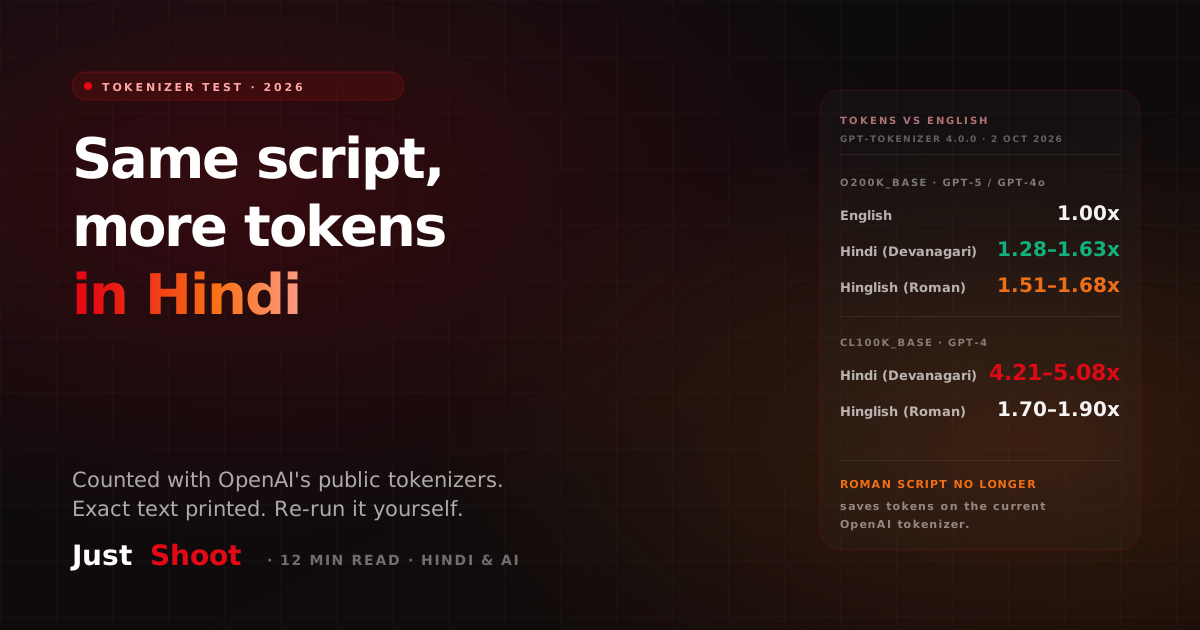
A Hindi Script Costs More Tokens Than the Same Script in English (2026)
One YouTube script in English, Devanagari Hindi and Hinglish, run through OpenAI's public tokenizers. On GPT-5's, Hindi costs 1.28–1.63x the English tokens.
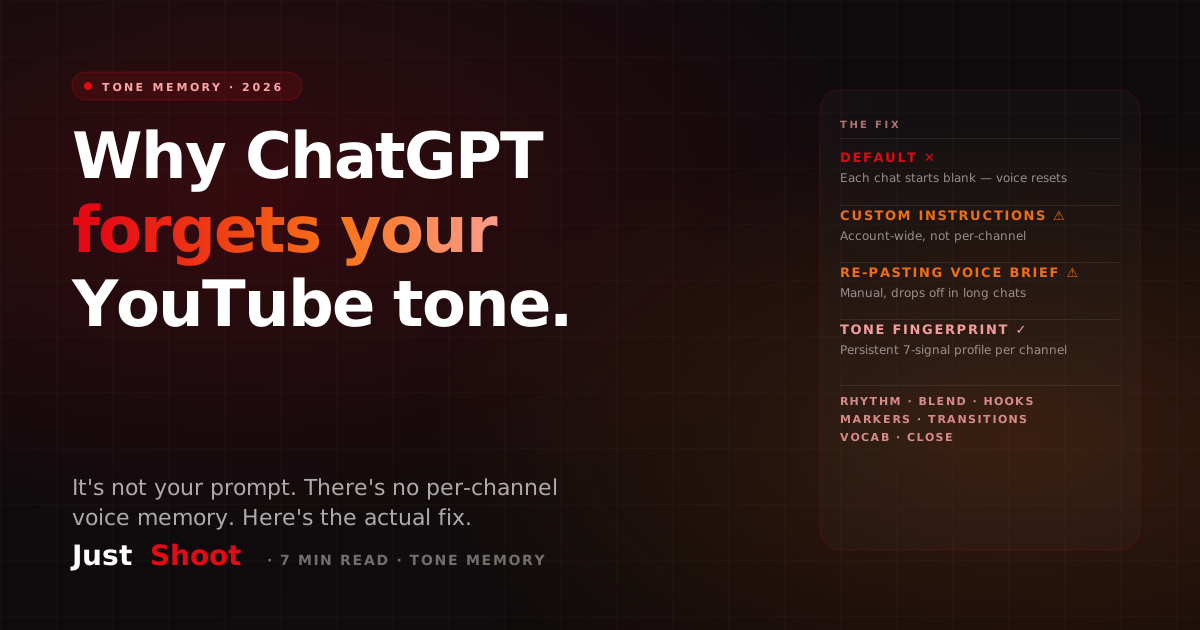
Why ChatGPT Forgets Your YouTube Tone (And How to Fix It in 2026)
ChatGPT can't remember your YouTube channel's tone between sessions — and Custom Instructions don't fix it. Here's what does, for Indian creators in 2026.
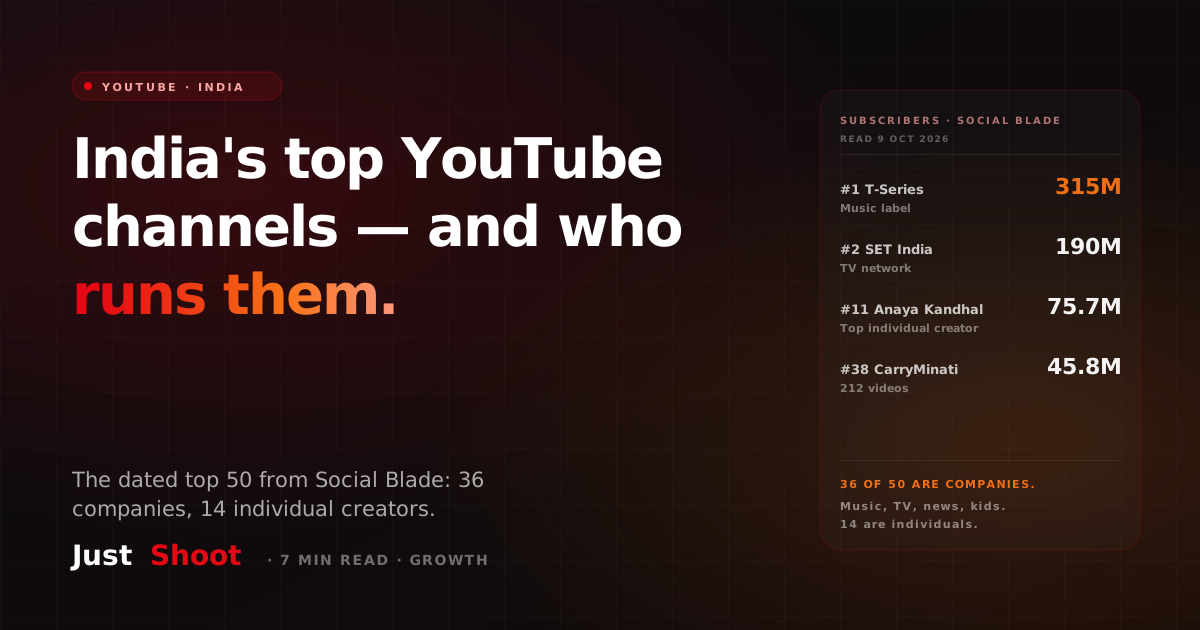
The Most-Subscribed YouTube Channels in India — and What They Have in Common (2026)
T-Series leads India's YouTube with 315 million subscribers. Of the top 50 channels, 36 belong to music labels, TV networks, news and kids' brands. Only 14 are individual creators.