InVideo AI Script Quality Review (2026): What the Writer Gets Right, Where It Breaks
InVideo AI writes scripts built to be rendered, not spoken. An honest 2026 review of its script quality — what holds up, where it breaks, and what to pair it with.
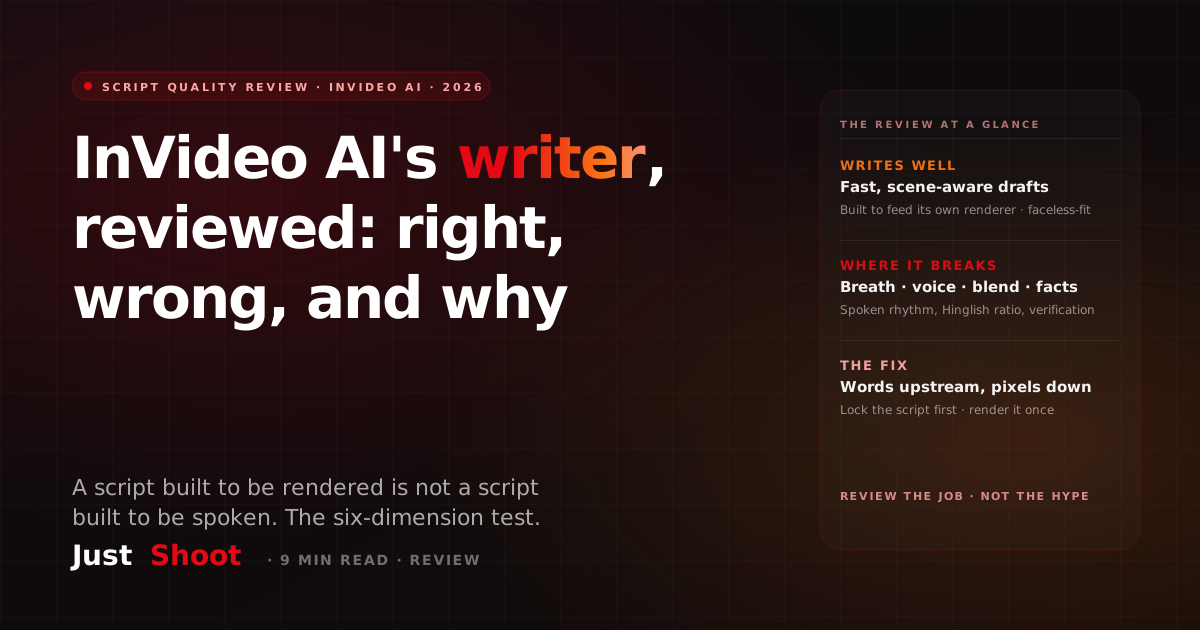
InVideo AI Script Quality Review (2026): What the Writer Gets Right, Where It Breaks
By Ashok Sachdev, Founder of JustShoot · Published 11 July 2026
Short answer: InVideo AI's built-in script writer is a competent scene writer for videos InVideo itself will render — fast, structured around visuals, consistent across a project. Judged as a YouTube script a human will deliver on camera, it breaks on the four dimensions that decide retention: spoken rhythm, personal voice, Hindi–English code-switching, and factual grounding. Keep it if your channel is faceless; put a dedicated script layer in front of it the moment the words have to come out of your mouth.
Disclosure first: I'm the founder of JustShoot, a script-first tool, so I have a horse in this race. Second disclosure: this is a positioning review, not a lab benchmark. Every claim about InVideo AI here comes from its own public positioning as we documented it in our full InVideo AI vs JustShoot head-to-head — I'm not inventing test results, and where InVideo's feature set is simply silent on something, I say "silent" rather than "bad." If you want the tool-vs-tool decision, read the head-to-head. This page answers a narrower question the head-to-head didn't: taken purely as a writer, how good is the thing InVideo puts words on the page with — and what should you do about its gaps?
What is InVideo AI's script writer actually for?
You can't review a writer fairly without asking what it was hired to do. InVideo AI is a text-to-video platform: prompts go in, a rendered video comes out, with AI agents holding context across the project and script writing listed as one stage in that generation flow. Which means the script it writes is not the product. The script is an intermediate artifact — a set of instructions that exists so the render pipeline downstream can pick visuals, pace scenes, and drive a voiceover model.
That one design fact predicts almost everything about the writing, good and bad. A script whose job is to be rendered gets optimized for renderability: clean scene boundaries, narration a synthetic voice can read, phrasing that maps to stock or generated footage. Nobody at InVideo made the writer "bad at your voice" — they made it excellent at feeding a renderer, and those are different jobs with different failure modes.
So this review scores the writer twice: once for the job it was built for, once for the job Indian creators keep hiring it for.
The six dimensions a YouTube script lives or dies on
Retention isn't mystical. When a script fails on YouTube, it fails on one of six measurable dimensions. Here's the rubric, and where a writer-inside-a-generator lands on each:
| Dimension | What good looks like | Writer-inside-a-generator (InVideo AI) |
|---|---|---|
| Hook (0–30s) | A specific, curiosity-loaded open in your register | Serviceable template hooks; specificity depends entirely on your prompt |
| Retention beats | Re-hooks placed every 45–60s without being asked | Scene changes ≠ re-hooks; visual variety carries the pacing instead |
| Spoken rhythm | Breath-length sentences that survive being said aloud | Narration prose — built for a voiceover model, which never runs out of breath |
| Voice consistency | Video 40 sounds like video 1 | Project-level context only; nothing persists a personal voice across projects |
| Language register | The exact Hindi–English blend your audience expects | Multi-language voiceover, yes; code-switching ratio control is nowhere in its positioning |
| Factual grounding | Claims verified before you commit | Explicitly not the product's job — verification stays with you |
Three of those rows deserve a closer look — two where the writer honestly earns its keep, and the cluster where it breaks.
What does InVideo AI's script writer do well?
Credit where it's due, because a review that finds nothing good is marketing wearing a costume.
Speed to a structured first draft. For a faceless channel — listicles, explainers, stock-footage essays — the writer produces a usable, scene-segmented draft in minutes, already shaped for the renderer that will consume it. That's not a small thing. Most creators lose their publishing cadence to the blank page, not to bad tools.
Scene-aware structure by default. Because the writer sits inside a storyboard-and-timeline platform, its output arrives pre-chunked into visual units. If your video is its visuals, this is exactly the right shape — the script and the b-roll plan are born already agreeing with each other, with no copy-paste seam where formatting dies.
Context that holds across a project. InVideo's agents keep project context, so a revision pass doesn't reset the brief. Within one video, the writing stays coherent — ask anyone who has fed a long script through a chatbot in three sessions how rare that is.
Notice the pattern: every genuine strength is downstream of the same design target. The writer is good at the parts of writing that serve the render.
Where does the script quality break?
The same design target sets the failure modes. Four of them, in ascending order of cost to an Indian creator:
1. It writes for a voice that never breathes. A synthetic narrator reads whatever it's given, so nothing in the pipeline pressures the prose toward speakability. Sentences run long. Clauses stack. Read one aloud and you'll hit the wall a voiceover model doesn't have: lungs. A script you'll deliver on camera has to be written in breath-lengths, with the emphasis where your face will be — and no renderer-serving writer has a reason to do that.
2. The register defaults to generic. Our head-to-head put it plainly: generic narration unless you push hard on prompts. You can prompt your way toward personality — every video, every time, re-describing your own delivery from scratch. That's not a voice; that's a tax. The distinction matters because audiences don't subscribe to information, they subscribe to a specific person's way of saying it.
3. Code-switching isn't a dial anywhere. For most Indian channels the Hindi–English blend is the identity — a 70:30 tech explainer and a 40:60 finance channel are different personas, and the audience polices drift instantly. InVideo positions multi-language voiceover, which is a different capability entirely: reading many languages is not the same as mixing two in your proportions. Nothing in its published feature set claims blend control, so I'll score it the honest way: absent. If you've never measured your own ratio, run a transcript through the free Hinglish ratio checker — you can't ask any tool to hit a target you haven't named.
4. Nothing checks the claims. Fact verification is explicitly outside InVideo's job description — reasonable for a render platform, expensive for you. A wrong stat in a rendered video costs a re-render; the deeper risk is that a fluent writer makes unverified claims sound settled, and metered regeneration quietly discourages the rewrite that scrutiny would trigger. Finance and health creators, this is your row of the table.
There's also an economic wrinkle worth naming: on a usage-metered plan, script iteration and render iteration are the same spend. Every structural rewrite you discover after generating costs another cycle. Writers and renderers improve differently — words are cheap to iterate, video is not — which is the whole argument for locking the script before anything renders.
Should you replace InVideo AI, or pair it?
Wrong question order. First ask what kind of channel you run.
Faceless channel: don't replace it — fix its input. The render half of InVideo is the strong half; the fix is feeding it a script that was already written, voiced, and fact-checked upstream, then letting it do the one job it's genuinely built for. The exact lock-the-script-first workflow is laid out in the head-to-head, so I won't restate it here.
On-camera creator: you likely never needed the renderer — you are the renderer. What you needed was the writing layer: research, a script in your register, verification, and the packaging around it. That's the job JustShoot was built for — a tone fingerprint derived from your actual uploads drives every script, so the blend ratio and rhythm are measured from you rather than prompted at from memory.
A dedicated script layer, priced: Trial ₹0 (7 days, 2 scripts total, no card) · Starter ₹499/mo (3 scripts/mo) · Creator ₹999/mo (7 scripts/mo, most popular) · Pro ₹1999/mo (15 scripts/mo) · Studio custom for teams. GST-inclusive, monthly, no rollover — and every plan runs the full pipeline, research through fact-check through shorts; plans differ only in script count. Details at justshoot.ai/#pricing.
Review verdict
As a scene writer for its own renderer: solid, and honestly better-shaped for that job than a general chatbot. As the writer of record for a channel where a human speaks: it breaks exactly where retention is decided — breath, voice, blend, verification — and no amount of prompting converts a renderer-serving writer into a persistent model of you. The mature setup isn't loyalty to either tool; it's respecting the seam. Words upstream, pixels downstream.
FAQ
Is InVideo AI's script writer good enough on its own? For faceless, visuals-led channels — often yes, especially with strong prompts. For on-camera channels, no: its scripts are optimized to drive a renderer, so spoken rhythm, personal voice, and Hindi–English blend control fall outside what the writer is built to hold.
Why do video generators write generic scripts? Because the script isn't their product — the rendered video is. The writing gets optimized for scene segmentation and narration a voiceover model can read, not for one specific human's delivery. Generic output is a design consequence, not a bug someone forgot to fix.
Can InVideo AI match my Hinglish ratio? Its positioning covers multi-language voiceover, not code-switching ratio control — nothing published suggests you can set or hold a specific Hindi–English blend. Measure your real ratio with the free Hinglish checker first; whatever tool writes for you needs that number as a target.
Does harder prompting fix the script quality? It improves individual videos and fixes nothing structurally. Prompt effort doesn't persist as a voice model, so every session restarts from generic — the drift shows up across videos, not within one. A tone fingerprint built from your uploads is the structural version of that effort, paid once.
What's the best workflow if I'm keeping InVideo AI? Write, verify, and lock the script in a script-first tool, then hand the locked text to InVideo as narration input for the render. You iterate words where words are cheap, spend render cycles once, and keep the SEO and shorts packaging the script layer already produced.
Before you judge any writer — theirs, ours, or your own — know your actual blend: the Hinglish ratio checker is free and takes two minutes. And if the scripts should sound like you, plans start at ₹0 — 7 days, 2 scripts, no card.
— Ashok Sachdev, Founder, JustShoot
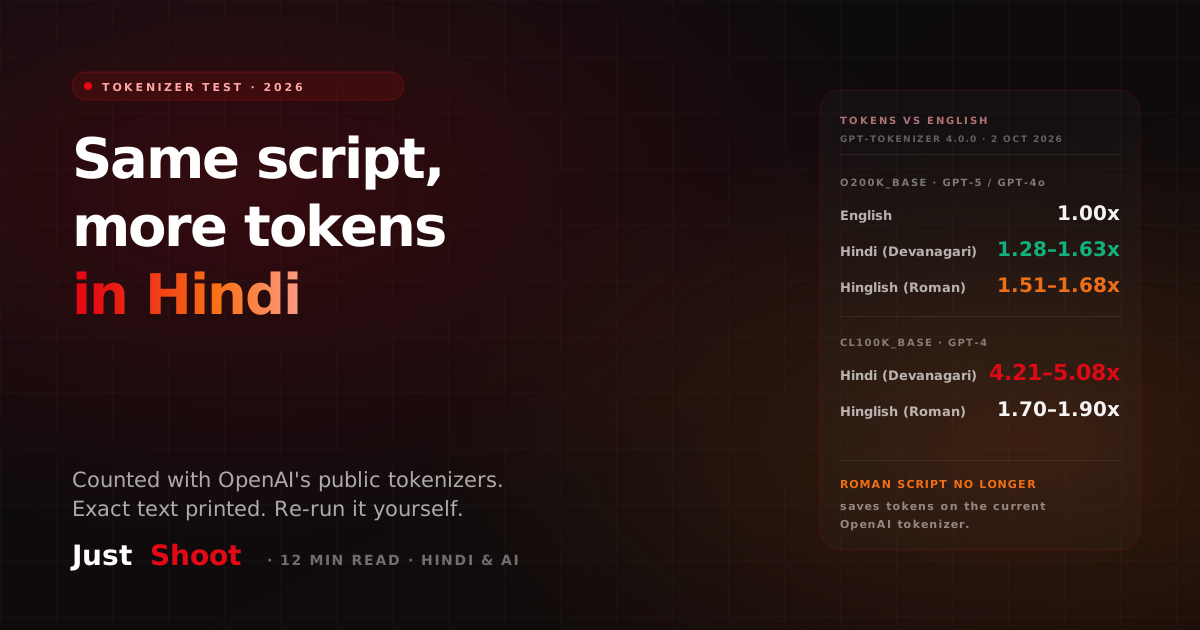
A Hindi Script Costs More Tokens Than the Same Script in English (2026)
One YouTube script in English, Devanagari Hindi and Hinglish, run through OpenAI's public tokenizers. On GPT-5's, Hindi costs 1.28–1.63x the English tokens.
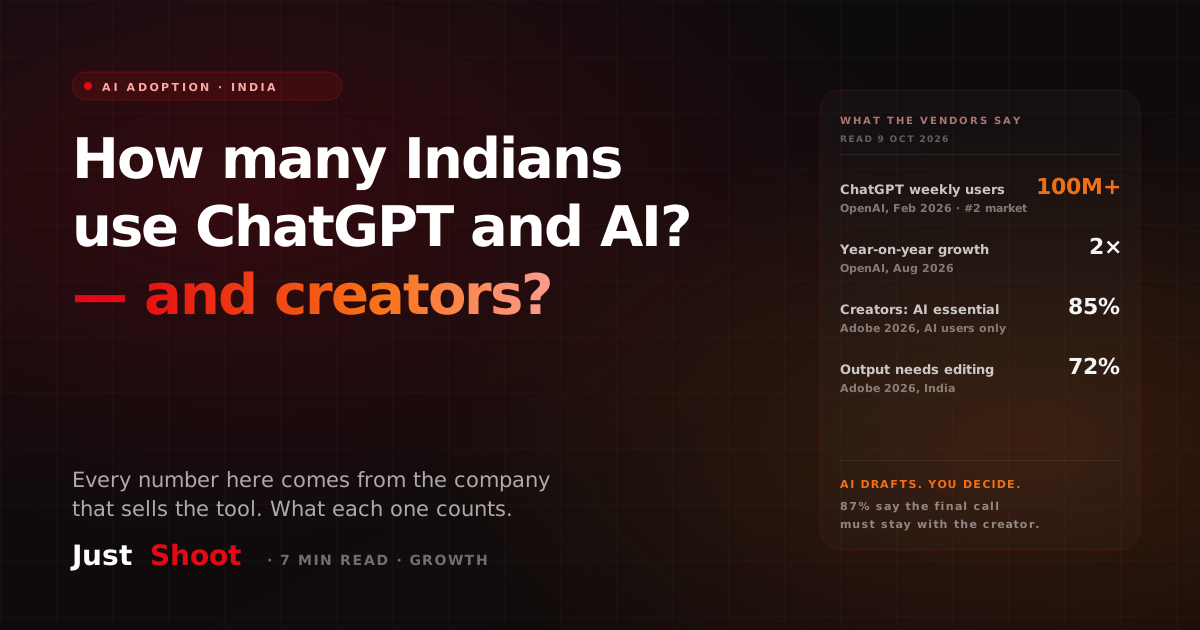
How Many Indians Use ChatGPT and AI Tools — and How Many Creators Do (2026)
OpenAI says India has 100 million weekly ChatGPT users. Adobe says almost every Indian creator it surveyed uses AI. What each number measures, and who measured it.
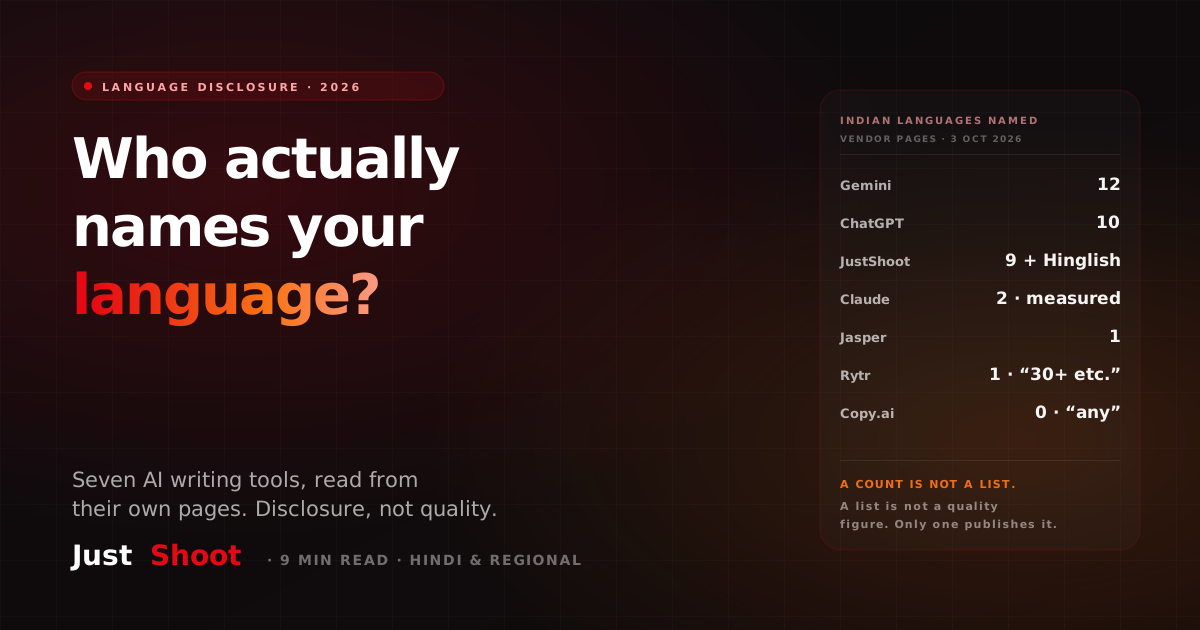
Which AI Writing Tools Actually Publish an Indian-Language List (2026)
Seven AI writing tools, checked on 3 October 2026: which name their Indian languages, which only give a count, and which say 'any language' and name none.