How Many Indians Watch YouTube on a TV Screen (2026)
Connected TV in India: Ormax's 129.2 million viewers, FICCI–EY's 68 million households, YouTube's own TV claims — and what each changes for creators.
How Many Indians Watch YouTube on a TV Screen (2026)
By Ashok Sachdev, Founder of JustShoot · Published 4 October 2026 · Sources read 3–4 October 2026
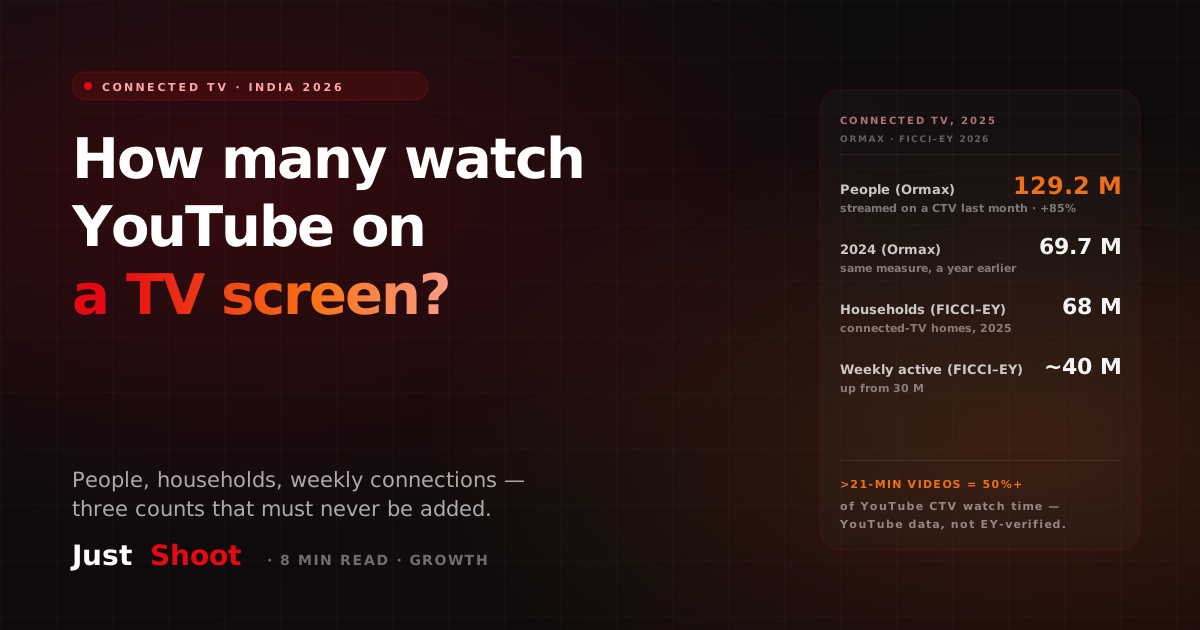
Short answer: Ormax Media counts 129.2 million Indians who streamed video on a connected TV in the last month in 2025, up 85% from 69.7 million in 2024. FICCI–EY counts 68 million connected-TV households, about 40 million of them active each week. These measure different things — people, households and weekly connections — so they should never be added together.
That growth matters to anyone making YouTube videos in India, because a TV is a different screen from a phone. Viewers sit further back, watch longer, and often watch together. This page gives each published number with its source and what it actually counts. Then it covers the one figure that changes a creator decision, and how much weight it can carry.
Three different counts — keep them apart
The most common mistake with connected-TV statistics is mixing up what is being counted. The three main figures for India in 2025 count three different things.
| What is counted | 2025 figure | Change | Source |
|---|---|---|---|
| People who streamed video on a connected TV in the last month | 129.2 million | up from 69.7 million in 2024 (+85%) | Ormax Media, The Ormax OTT Audience Report: 2025, published 19 September 2025 |
| Households with a connected TV | 68 million | — | FICCI–EY, Media and Entertainment Report 2026, p. 31 |
| Connected TVs active each week | about 40 million | up from 30 million | FICCI–EY 2026, p. 31 |
Ormax counts individuals; one household TV can have three or four viewers. FICCI–EY counts homes and connections. So 129.2 million people and 68 million households are not in conflict, and dividing one by the other does not give a reliable "viewers per TV" number either, because the two studies use different methods. Use whichever count matches the question you are asking.
For scale, Ormax puts India's total online video audience in 2025 at 601.2 million people, or 41% of the population. Connected TV is roughly a fifth of that by Ormax's count — still a minority screen, but growing far faster: 85% in a year, against 9.9% for the online video audience as a whole.
Where the money is moving
Advertisers follow audiences, so ad spend is a second, independent signal. FICCI–EY reports that connected-TV ad revenue grew 42% to ₹99 billion in 2025 (p. 31). The same report says sports and entertainment streaming platforms grew ad revenue 34% partly because of higher connected-TV rates.
That is a market-wide number, not YouTube's share, and FICCI–EY does not split it by platform. It tells you that brands are paying more to reach people on a TV screen. It does not tell you what any one YouTube channel earns from it.
What YouTube says about its own TV audience
The FICCI–EY report also carries a page of YouTube-specific figures (p. 61). Two are about TV:
- 75 million people aged 18+ reached on YouTube via connected TV in April 2025.
- Videos longer than 21 minutes account for over 50% of YouTube's connected-TV watch time.
Read these with the page's own disclaimer: "All data has been provided and compiled by Google India, and has not been verified by EY." They are YouTube's figures about YouTube, printed in an independent report — not independent findings. They are still useful, but they deserve the same caution as any company's numbers about itself.
The one creator-relevant number, and how far to push it
The 21-minute figure is the one creators will want to act on. If over half of YouTube's TV watch time is on videos longer than 21 minutes, should you make longer videos?
Three cautions before you do:
- It describes the TV screen only. Most Indian YouTube viewing still happens on phones. A number about TV watch time says nothing about phone viewers.
- It is a share of watch time, not of views. Long videos naturally take a bigger share of watch time even if fewer people click them — one 40-minute view counts for as much watch time as eight 5-minute ones.
- It is YouTube's own data, unverified by EY. The footnote is on the page.
What it does support is narrower: if your videos are already long-form — explainers, documentaries, podcasts, cooking, deep reviews — a growing share of your audience may be watching them on a TV. That changes some production choices, but not the length of every video. For the length decision itself, use our guide to how long a YouTube video should be, and for turning a target length into a word count, our script length by words per minute.
What changes when your viewer is on a TV
None of these points come from the reports above. They follow from the screen itself, and they are worth checking against your own channel analytics, where YouTube reports watch time by device type.
The thumbnail is picked from across the room. On a TV, the home screen is viewed from a couple of metres away, and the remote is slower than a thumb. Small text and busy compositions get lost. Fewer words, bigger faces and one clear subject matter more than on mobile. If you want concepts built that way, the free YouTube thumbnail ideas generator gives three concepts per topic with the text overlay, emotion and layout spelled out — then judge each one by how it reads at small size.
On-screen text needs to be larger, and Hindi needs extra care. Devanagari has a top line and stacked marks that blur sooner than Latin letters at the same size. If your captions or titles are in Hindi, set them larger than you would for an English video and check them on an actual TV.
People watch together. A family watching on a TV is a shared audience. Language choice, humour and pacing that work for one viewer on headphones can land differently in a living room.
Viewers stay longer, but chapters still help. Long-form viewers on a TV are more likely to stay, but they also skip with chapters. Clear chapter titles let them jump to the part they came for instead of leaving.
Where JustShoot fits
JustShoot writes the script and the storyboard shot list for long-form videos — structure and visuals are the parts that matter more when the viewer is on a TV. It runs the full pre-production pipeline in your channel's own voice, in 11 languages.
Pricing is per script: Trial ₹0 (7 days, 2 scripts lifetime, no card) · Starter ₹499/mo (3 scripts) · Creator ₹999/mo (7 scripts, most popular) · Pro ₹1999/mo (15 scripts) · Studio custom. No rollover, GST included, monthly only. Details on the pricing page.
For the wider numbers on India's YouTube economy — GDP, jobs, and which "India" statistics are actually global — see India's YouTube creator economy in numbers.
FAQ
How many people in India watch YouTube on TV? YouTube says it reached 75 million people aged 18+ on connected TVs in April 2025, a figure printed in the FICCI–EY 2026 report with a note that EY did not verify it. Independently, Ormax counts 129.2 million Indians who streamed any video on a connected TV in 2025, across all platforms.
How many connected TVs are there in India? FICCI–EY puts connected-TV households at 68 million in 2025, with about 40 million connected TVs active each week, up from 30 million.
Is connected TV growing in India? Yes. Ormax reports the connected-TV audience grew 85% in a year, from 69.7 million in 2024 to 129.2 million in 2025. FICCI–EY reports connected-TV ad revenue grew 42% to ₹99 billion in 2025.
Should I make longer YouTube videos because of TV viewers? Not on that basis alone. YouTube's figure that videos over 21 minutes make up more than half of its TV watch time describes TV only, measures watch time rather than views, and is YouTube's own unverified data. If your format is already long-form, design for the TV screen; if it is not, the TV figure is not a reason to change.
What should change in a YouTube video for TV viewers? Thumbnails with fewer words and bigger subjects, larger on-screen text (especially in Devanagari), clear chapters, and pacing that works for a shared audience in a room. Check your own YouTube Analytics device breakdown to see how much of your watch time is on TV before changing anything.
Sources, read 3–4 October 2026. Ormax Media, The Ormax OTT Audience Report: 2025 (ormaxmedia.com, published 19 September 2025; full report by subscription, figures from the public summary). FICCI–EY, Stories, scale and impact: Unlocking India's media and entertainment economy, March 2026 — pp. 31 and 61 (the YouTube figures on p. 61 are marked as provided by Google India and not verified by EY). The production advice in the "What changes" section is our own and is not drawn from these reports.
India's YouTube Creator Economy in Numbers (2026)
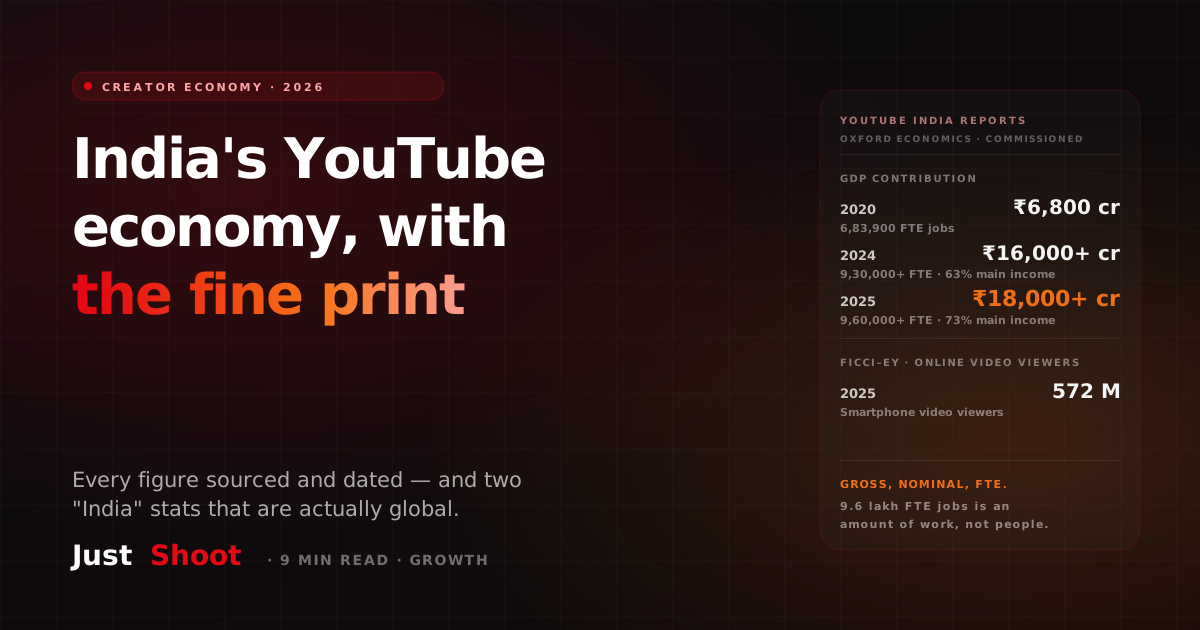
₹18,000 crore, 9.6 lakh jobs, 73% earning their main income: what YouTube's 2025 India report says, its fine print, and two figures the press got wrong.

Which AI Writing Tools Actually Publish an Indian-Language List (2026)
Seven AI writing tools, checked on 3 October 2026: which name their Indian languages, which only give a count, and which say 'any language' and name none.

Can AI Turn Your Hindi Script Into the Actual Video Yet? (2026)
What Google Veo 3.1, Kling 3.0, HeyGen and Synthesia publish about clip length, Hindi audio and Indian-language lip-sync, read from their docs on 2 Oct 2026.