How to Write a Comedy Skit Script for YouTube (Hinglish, India 2026)
Write a YouTube comedy skit that lands — the one-line premise, setup-escalation-punchline beats, the rule of three, callbacks, and Hinglish comic timing for Indian creators.
How to Write a Comedy Skit Script for YouTube (Hinglish, India 2026)
By Ashok Sachdev, Founder of JustShoot · Published 2026-06-29
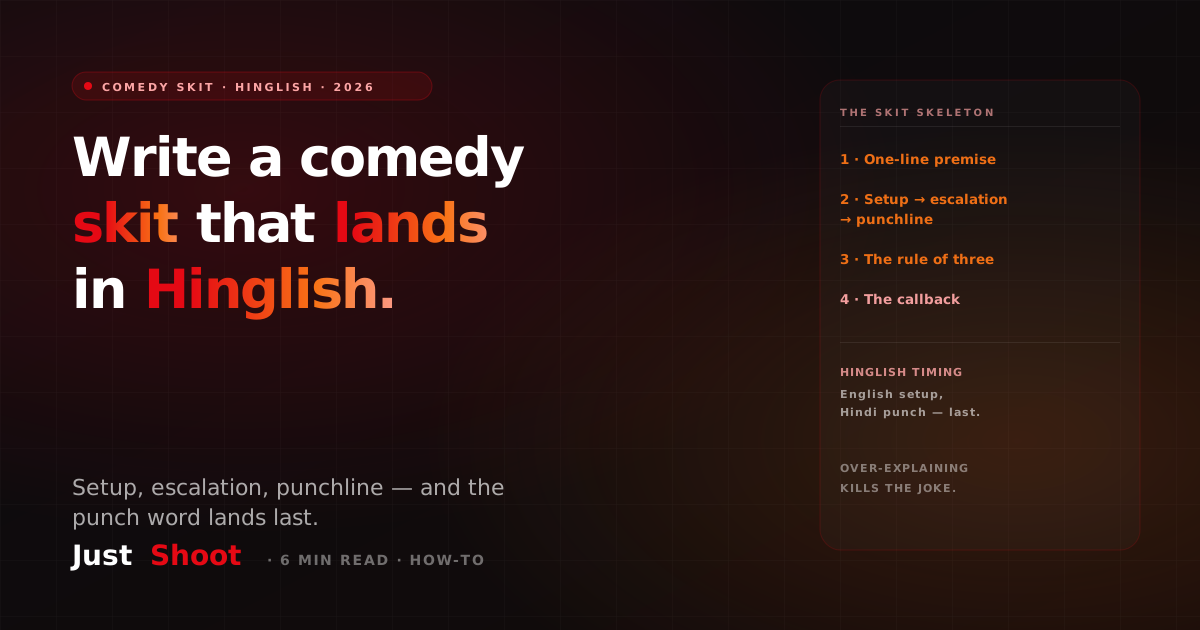
Short answer: A YouTube comedy skit script needs four things: a premise you can state in one line ("a guy who answers every question with a counter-question"), a beat structure of setup → escalation → punchline, the rule of three (the joke pays off on the third repetition, not the first), and tight comic timing where the punch word lands at the end of the sentence. In Hinglish, the punch usually lands harder in the language your audience thinks in — so the setup can be neutral, but the punchline drops into Hindi. The fastest way to kill a joke is to over-explain it; write the beat, land the punch, and cut.
I build a scripting tool for Indian creators, and comedy is the niche where structure matters most and gets taught least. A skit is not improvised on camera by anyone who is consistently funny — it is built. Here is the skeleton.
Why a skit script is different from a normal script
A normal YouTube script optimizes for retention through information or story. A skit optimizes for laughs per minute — and a laugh is a precise mechanical event: you build an expectation, then break it. Miss the timing by one sentence and the same words die. That is why comedy is written tightly even when it looks loose on camera. The "natural" delivery is rehearsed; the "spontaneous" punchline is positioned. (For where a skit sits against other formats, our storytelling-frameworks guide covers narrative structure; this is the comedy-specific variant.)
The four building blocks
1 · The one-line premise
If you cannot state the skit's premise in a single sentence, the audience will not be able to hold it either. "Two friends, one always one-ups the other's problem." "A delivery guy who refuses to leave until you rate five stars." The premise is the engine — every beat must spin off it. Write the premise first, on its own line, before any dialogue.
2 · Setup → escalation → punchline
Every comedic beat has three parts. The setup plants a normal expectation. The escalation raises the stakes or repeats the pattern with a twist. The punchline breaks the expectation. A skit is a string of these beats, each escalating from the last, so the energy climbs to a final biggest break. Map the beats before you write dialogue — most flat skits fail because the writer wrote jokes, not a rising sequence.
3 · The rule of three
Comedy pays off on the third repetition. First time establishes the pattern, second time confirms it, third time breaks it — that break is the laugh. Two repetitions feel incomplete; four feels like you are milking it. This is the most reliable structural tool in sketch writing: set a pattern, confirm it, subvert it.
4 · The callback
The strongest skit endings reach back to a throwaway line from the opening and pay it off at the end. A callback rewards the viewer for watching the whole thing and signals craft. Plant a small odd detail early — a phrase, an object, a tic — and bring it back transformed at the close. It is the difference between a skit that ends and a skit that lands.
Hinglish comic timing: where the punch lands
Hinglish is a comedy superpower most Indian creators underuse. The trick is code-switching for impact: deliver the setup in whichever language is neutral, then drop the punchline into the language your audience emotionally lives in — usually Hindi for the punch.
- English setup, Hindi punch: "He said he'd be there in five minutes. Woh paanch minute, do ghante ka tha."
- Hindi setup, English punch: "Pure confidence se bola usne — and then he completely forgot my name."
The mechanical rule is universal: the punch word goes last. "Tumne mera birthday yaad rakha — first time in five years" lands; "First time in five years tumne mera birthday yaad rakha" does not. Rewrite every punchline so the funny word is the final word the viewer hears. Getting the blend ratio right for your audience is its own craft — our Hinglish ratio tool shows where your natural blend sits.
How to write the skit: a 5-step process
- Write the one-line premise. If you can't, the skit isn't ready.
- Map 3-5 beats, each a setup-escalation-punchline, each escalating from the last.
- Plant one callback detail in the opening beat to pay off at the end.
- Write the dialogue, punch word last. Read each punchline aloud — if the laugh-word isn't the final word, reorder.
- Cut every line that explains a joke. If a beat needs a follow-up sentence to "get it," the joke failed — fix the beat or delete it.
Over-explaining is the universal skit killer. Trust the audience; land the punch and move.
Where JustShoot fits
Inside JustShoot's 9-agent pipeline, the script agent drafts skit beats in your comedic voice and Hinglish blend ratio — so the timing, the code-switch, and your recurring bits stay consistent across every skit, instead of every video sounding like a different writer. You keep full control of the punchlines; the structure and the blank-page problem get handled.
JustShoot starts at Trial ₹0 (7 days, 2 scripts, no card), then Starter ₹499/mo (3 scripts), Creator ₹999/mo (7 scripts, most popular), Pro ₹1999/mo (15 scripts), and Studio is custom. Every plan runs the full pipeline — only the number of scripts changes.
Curious where your natural Hinglish blend sits for comedy timing? Try the JustShoot Hinglish ratio tool — free, about a minute.
FAQ
How do I write a comedy skit script for YouTube? Start with a one-line premise, map 3-5 beats of setup-escalation-punchline that each escalate, use the rule of three (the joke pays off on the third repetition), plant a callback to pay off at the end, and write each punchline so the funny word lands last. Then cut every line that explains a joke.
What is the rule of three in comedy? A pattern is funniest when broken on its third occurrence: the first establishes it, the second confirms it, the third subverts it. Two feels incomplete and four feels like over-milking. It is the most reliable structural tool in sketch writing.
How does Hinglish comic timing work? Code-switch for impact — deliver the setup in a neutral language and drop the punchline into the language your audience emotionally lives in, usually Hindi for the punch. The universal rule is that the funny word must be the final word the viewer hears.
Why does over-explaining kill a joke? A joke works by letting the audience make the connection themselves — the laugh is the "I got it" moment. Adding a sentence that explains the joke removes that moment and signals you don't trust the audience. If a beat needs explaining, the beat is broken; fix it or cut it.
Can AI write a comedy skit for me? AI can structure beats, hold your premise, and keep your Hinglish blend consistent across skits, which removes the blank page. But comic taste — which punchline is actually funny — stays yours. The best workflow is AI-built structure plus your own judgment on the punch.
Ashok Sachdev is the founder of JustShoot, an AI content OS that writes YouTube scripts in your own voice for Indian creators. Connect on LinkedIn.
A Hindi Script Costs More Tokens Than the Same Script in English (2026)
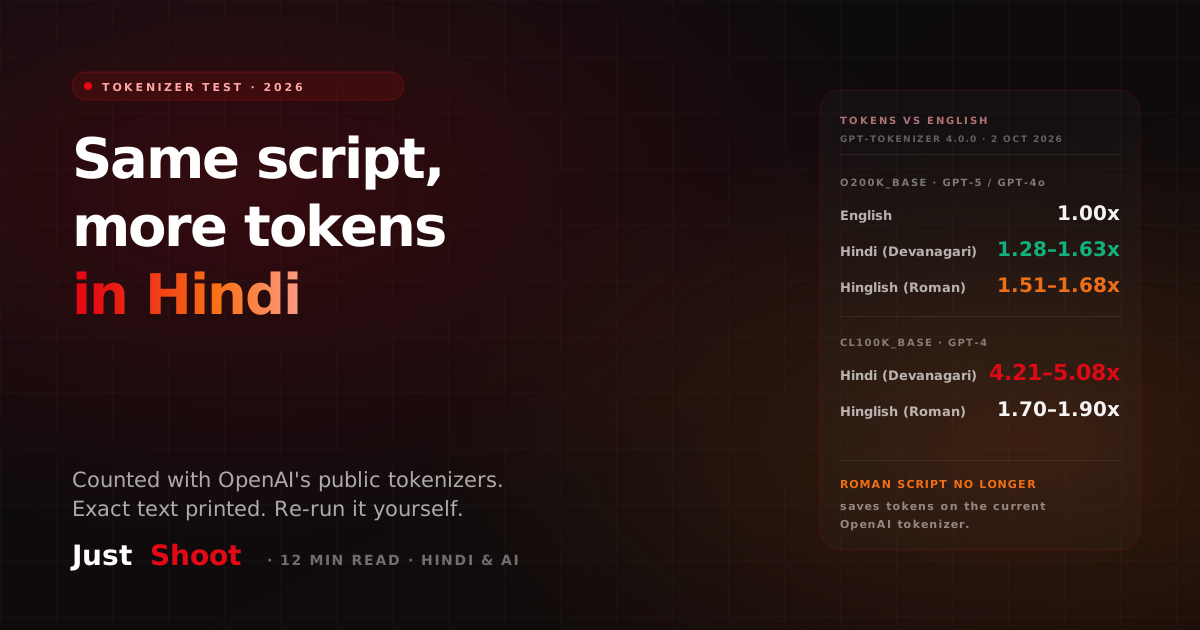
One YouTube script in English, Devanagari Hindi and Hinglish, run through OpenAI's public tokenizers. On GPT-5's, Hindi costs 1.28–1.63x the English tokens.
How to Check If Your YouTube Script Sounds AI-Generated (2026)
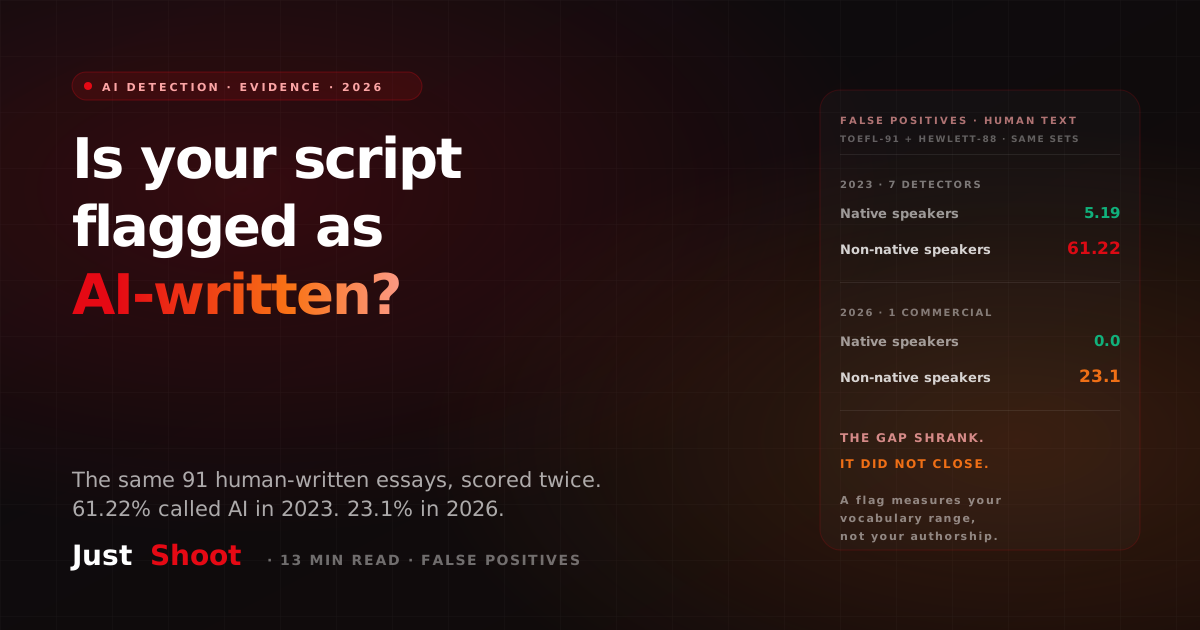
The same 91 human-written essays were scored by AI detectors twice: 61.22% were flagged as AI in 2023, 23.1% in 2026. Native-speaker essays scored 5.19% and 0.0%.
How Accurate Are YouTube's Auto-Captions in Hindi? (2026)
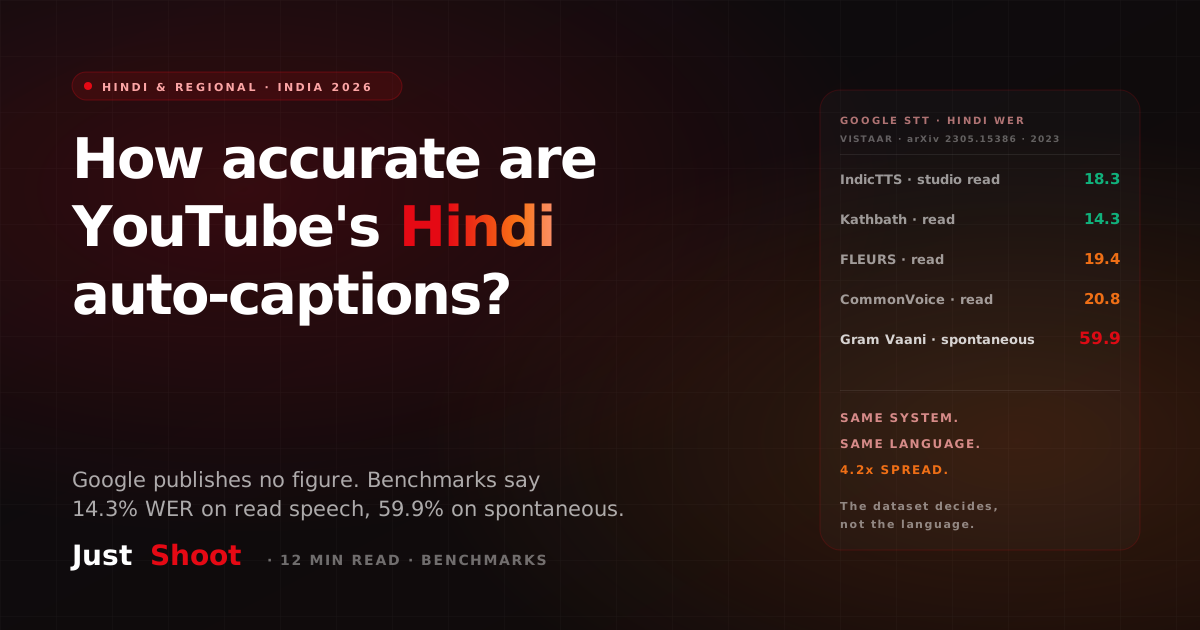
Google publishes no Hindi accuracy figure for YouTube captions. The nearest dated benchmarks put Hindi ASR between 14% and 60% word error rate, depending entirely on the dataset.