Best AI for Hinglish Script Writing 2026 — Honest Comparison (5 Tools)
Which AI fits Hinglish YouTube scripts in 2026 — JustShoot, ChatGPT, Claude, Gemini and NotebookLM compared by the job each suits, as first-party impressions.
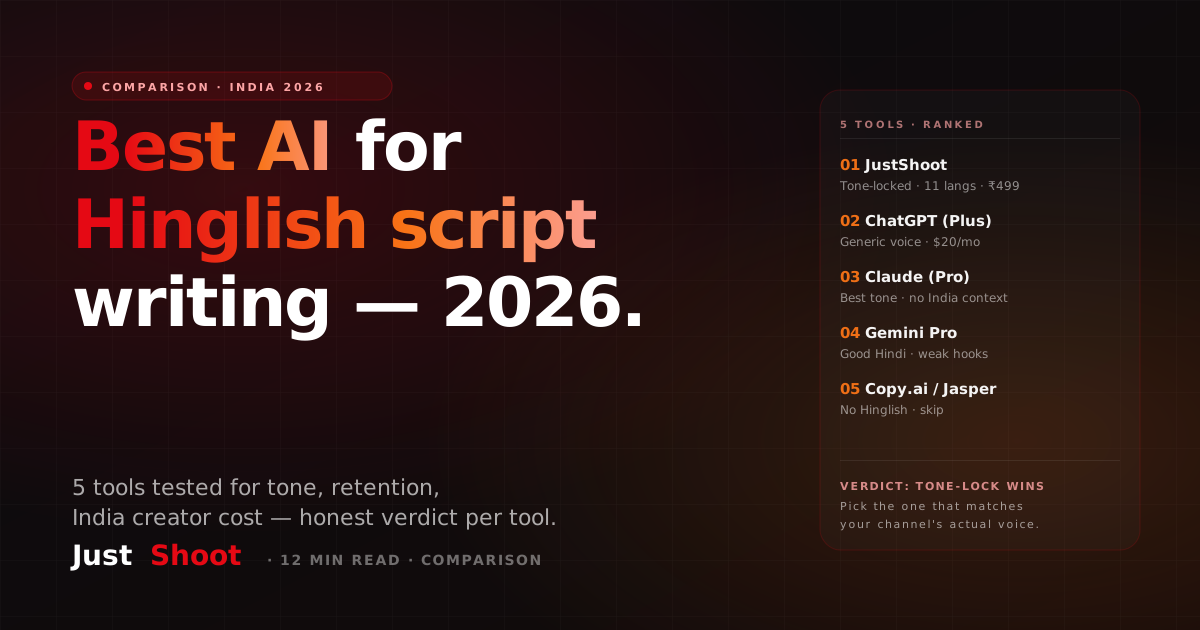
Best AI for Hinglish Script Writing 2026 — Honest Comparison Across 5 Tools
By Ashok Sachdev, Founder of JustShoot · Published 2026-05-27
Hinglish script writing is the one AI workflow where the "best general model" question stops being useful. ChatGPT, Claude, Gemini, NotebookLM and JustShoot all can output Hinglish, but how well they fit a Hinglish channel varies more than English-only comparisons suggest. This post compares all five by the job each one suits, as first-party impressions rather than a benchmark, against the question that matters: would a Dhruv Rathee, Tanmay Bhat, or Akshat Shrivastava-tier audience notice the AI?
Short answer (40 words)
For Hinglish YouTube scripts in 2026, JustShoot is the one built for per-channel tone match (its Tone Fingerprint locks blend ratio + identity markers). In my use, ChatGPT suits one-off ideation and Claude suits long-form structure. Gemini handles bilingual mid-sentence switches. NotebookLM is a research tool, not a script writer.
Why "best AI for Hinglish" is not the same as "best AI"
For English script writing, the general models have converged: ChatGPT, Claude and Gemini all produce broadly comparable English at the 1,500-word mark. The gaps are subtle (in my use, Claude is more structured, ChatGPT more conversational, Gemini more concise), and a typical creator could ship from any of them with minor edits.
Hinglish breaks this convergence. The reason — Hinglish is not a translation problem; it is a blend-ratio problem. A 65% Hindi / 35% English script is fundamentally different from a 50/50 script, and both are different from a 30% Hindi / 70% English script. Generic LLMs default to either "Hindi with English loanwords" (when asked for Hinglish) or "English with Hindi flavoring" (when asked for casual Hindi). Neither matches what an actual Indian YouTuber sounds like.
Add the per-section register shift — Hinglish creators cluster English around stats and jargon ("89 percent retail traders paisa khote hain"), and Hindi around story and emotion ("ek phone call aaya us raat"). A model that averages a 60/40 blend but distributes it randomly produces output that sounds technically correct but emotionally off.
Add identity markers — phrases only your channel uses ("bhai ek second," "asal mein," "ab maan lijiye"). Generic models do not retain them across sessions. You prompt them once, they comply that session, and forget by tomorrow.
So the "best AI for Hinglish" depends on which of these three layers you most need to solve. Below is the per-tool comparison. (Scripts are one job in the stack — for the full picture across SEO, thumbnails, Shorts and editing, see the 9 best AI tools for Indian YouTubers in 2026.)
How to read this comparison
An earlier version of this page had a table scoring each tool against seven voice signals, with blend ratios such as "averages 80/20", and said each AI was given the same brief, run three times, and the median taken. That test was run by us, cited only to our own site, and named model versions (GPT-4o, Claude 3.5, Gemini 2.0) that are now a generation old. Nobody outside JustShoot could reproduce it, so it has been removed. This site does not publish a comparison it scored itself.
What remains below is first-party judgement about which job each tool suits — useful, but not a measurement. If you want measured numbers, the most useful current benchmark for Hindi is IndicIFEval (arXiv:2602.22125v1, 26 February 2026). On briefs written natively in Hindi it reports GPT-5 at 77.9 and Gemini-3-Pro at 58.9; on English briefs translated into Hindi, the same two score 92.8 and 91.0 (prompt-level loose accuracy, as published in the paper). It measures instruction-following in Hindi, not Hinglish voice. Our walkthrough of that benchmark explains what those numbers do and do not tell you. NotebookLM is left out of the script discussion because it is a research synthesis tool, not a script writer.
Where each tool actually wins (the honest list)
This is the section you actually came for — not the marketing claim, the real use-case fit.
ChatGPT suits — ideation and one-off rewrites
Sitting on the train, brainstorming 10 video ideas? ChatGPT is faster than any specialist tool. There is no fingerprint to load, no project to spin up. You ask, it answers, you sharpen the question. For pure exploration, the generalist beats the specialist. Same for one-line rewrites ("punch this hook harder," "give me 3 alternative openers"). The Plus subscription at ~₹1,680/month is excellent value if you already use it for non-YouTube work.
ChatGPT does not win at — consistent per-channel voice, blend ratio control, identity-marker retention. Full breakdown in our ChatGPT vs JustShoot honest comparison.
Claude suits — long-form structure and research synthesis
If you hand Claude a 5,000-word research brief and ask for a 2,500-word structured script, in my use it produces a very clean hierarchy — clear beats, logical transitions, balanced section weights. For news-explainer and policy-analysis creators where structure matters more than tone signature, Claude is a strong generalist.
Where Claude is weaker for this job, in my use — holding a specific Hinglish blend ratio, keeping identity markers across sessions, and first-line hook punch.
Gemini suits — mid-sentence bilingual code-switching
Gemini handles "ab dekho — equity market mein last quarter 18 percent volatility dekhi gayi thi, lekin index funds ne overall positive returns deliver kiye" more naturally than ChatGPT or Claude in my use — the English clauses land more grammatically inside the Hindi sentence frame. Useful for stock-explainer and tech-review creators who code-switch frequently within sentences.
Gemini does not win at — consistent tone across multiple scripts (every fresh session drifts), or thumbnail/SEO/metadata packaging (those tasks aren't its strength).
NotebookLM suits — turning research material into structured briefs
NotebookLM is a research synthesis tool — feed it 5 PDFs, ask for a structured outline, get a clean brief. It is not a script writer. Use it for the research phase, then hand the brief to JustShoot's Script Writer agent or to Claude for the script pass. Full breakdown in our NotebookLM vs JustShoot comparison.
JustShoot is built for — per-channel tone-locked Hinglish + full pipeline
This is the one job that justifies a separate product. JustShoot's Tone Fingerprint extracts your blend ratio, rhythm, hooks, identity markers, signature transitions, and close pattern from 2-5 reference videos and injects them as system context into every Script Writer call. The fingerprint does not live in a chat history that resets — it is versioned and reused.
The Hinglish-specific advantage — JustShoot encodes blend ratio per emotional register. English clusters around stats and jargon; Hindi clusters around story and emotion. The Script Writer obeys both the average ratio and the per-section drift. Generic models do not.
Plus the pipeline — research, fact-check, legal review, script, storyboard, thumbnail prompts, SEO metadata, shorts scripts — all in 3 minutes of agent time per 10-minute video.
Test the gap on your own channel instead
An earlier version of this page showed a "live example" — our own output next to a paraphrased ChatGPT output for the same brief. A side-by-side chosen and judged by the vendor of one side is not evidence, so it has been removed. The fair version of that test is one you run yourself, on your own channel: give two tools the same brief and your last script as a reference, then check the Hindi–English split of each draft against your own. Our scriptwriting framework breakdown covers how to brief for voice.
Where JustShoot fits
Starter ₹499/month gives you 3 full 9-agent scripts monthly. Creator ₹999 gives 7 scripts (most popular), Pro ₹1999 gives 15 scripts, and Studio is custom (talk to us). Script-count based — no rollover, GST-inclusive, monthly only. 7-day free trial, no credit card. Tone Fingerprint tool is free to test without signup — paste a video URL, get your 7-signal breakdown in 60 seconds.
If you are currently using ChatGPT for Hinglish scripts and want to test the gap on your specific channel, the free Tone Preview is the fastest way. Full ChatGPT-specific comparison is on the JustShoot vs ChatGPT comparison page.
FAQ
Q: Why does ChatGPT's Hinglish often come out Hindi-heavy? In my use, a request for "Hinglish" tends to come back as Hindi with English loanwords rather than the blend a given channel actually uses. We have no published measurement of the ratio, so treat that as an impression. Workaround: paste a sample paragraph in your target ratio with every prompt, and check the result with a ratio checker.
Q: Is Claude or ChatGPT better for Indian creators? In my use, for structured long-form (1,500+ word scripts) Claude has the cleaner hierarchy, and for quick ideation and rewrites ChatGPT is faster and more conversational. For measured Hindi instruction-following scores, see the IndicIFEval walkthrough linked above. Both miss on per-channel tone retention — neither stores your fingerprint across sessions.
Q: Can I just use JustShoot for the script and another tool for everything else? Yes — most creators do this for the first month, then realize the storyboard + thumbnail + SEO agents save 2-3 hours per video on their own. The pipeline economics make the bundle cheaper than buying script-only.
Q: Does JustShoot work for non-Hinglish channels? Yes — all 11 supported languages (English, Hinglish, Hindi, Gujarati, Marathi, Tamil, Telugu, Bengali, Punjabi, Kannada, Malayalam) use the same Tone Fingerprint framework. The language-balance signal just defaults to 100/0 instead of 60/40. See Hinglish vs Hindi vs English breakdown for choosing your blend.
Q: How much should I budget monthly for AI tools as a Hinglish creator? Minimum stack — script (JustShoot Starter ₹499) + voice clone (ElevenLabs Starter ₹500) + B-roll free (Pexels) = ₹1,000/mo. Pro stack — JustShoot Creator ₹999 + ElevenLabs Creator ₹1,800 + Runway ₹1,500 = ~₹4,300/mo. Either pays back at ~₹50,000/mo channel revenue.
Q: Which AI is best for Hinglish script writing in 2026? Depends on the job. In my first-party view, ChatGPT suits one-off ideation, Claude long-form structure, and Gemini mid-sentence bilingual switches. For a consistent per-channel blend ratio and identity markers that survive across sessions, a tone-locked pipeline like JustShoot is the one built for that job. Measure the blend yourself rather than trusting any vendor's claim, ours included.
Try the tone-locked workflow free for 7 days
Start where your Hinglish lives — your last video. Run it through the free Hinglish Ratio tool to see your exact Hindi/English split, then run the free Tone Preview for the full 7-signal voice breakdown — both 60 seconds, no signup. When you want a script in that exact voice, the 7-day free trial (2 scripts, no card) writes your first tone-matched Hinglish draft in 30 minutes: paste your channel URL, pick 2-5 reference videos, and ship. Start free.
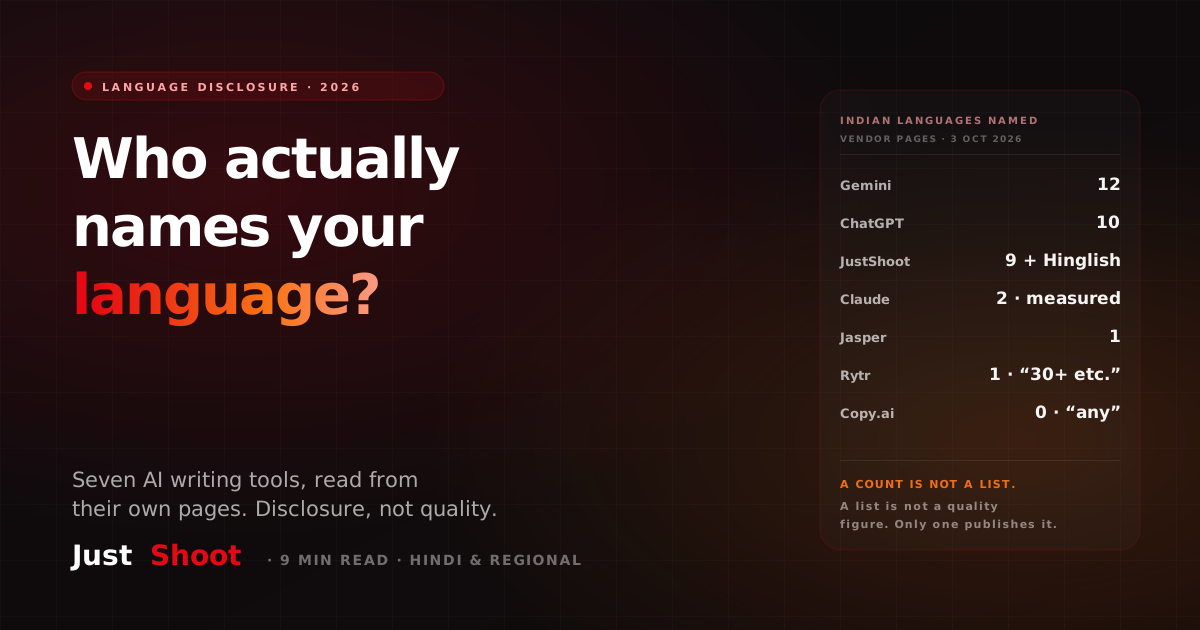
Which AI Writing Tools Actually Publish an Indian-Language List (2026)
Seven AI writing tools, checked on 3 October 2026: which name their Indian languages, which only give a count, and which say 'any language' and name none.
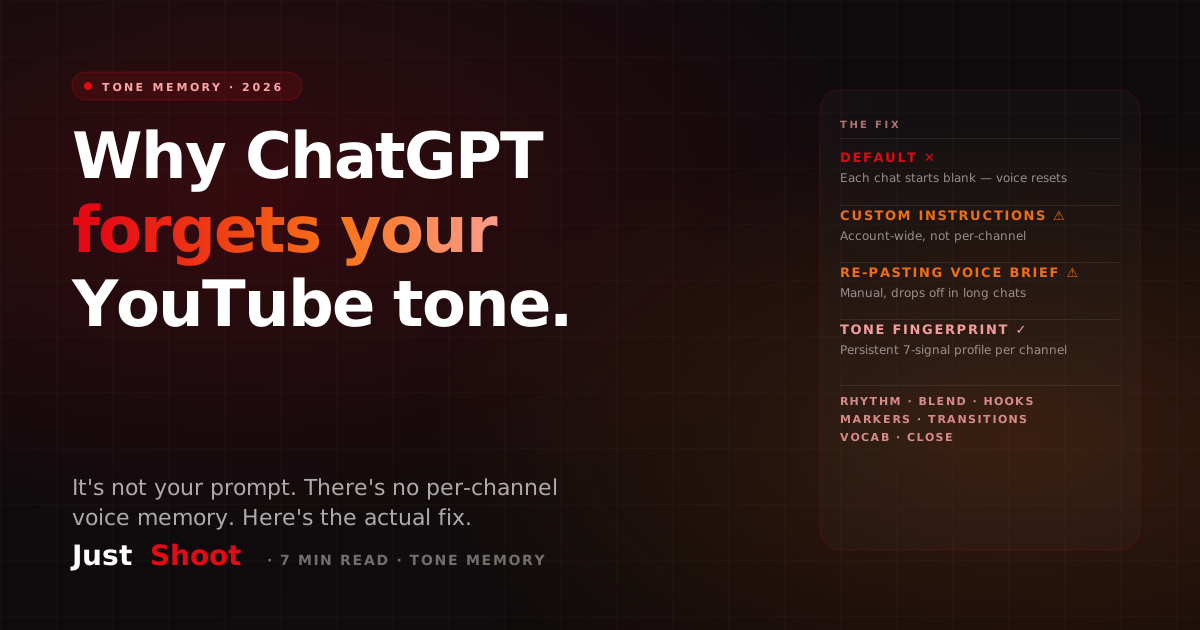
Why ChatGPT Forgets Your YouTube Tone (And How to Fix It in 2026)
ChatGPT can't remember your YouTube channel's tone between sessions — and Custom Instructions don't fix it. Here's what does, for Indian creators in 2026.
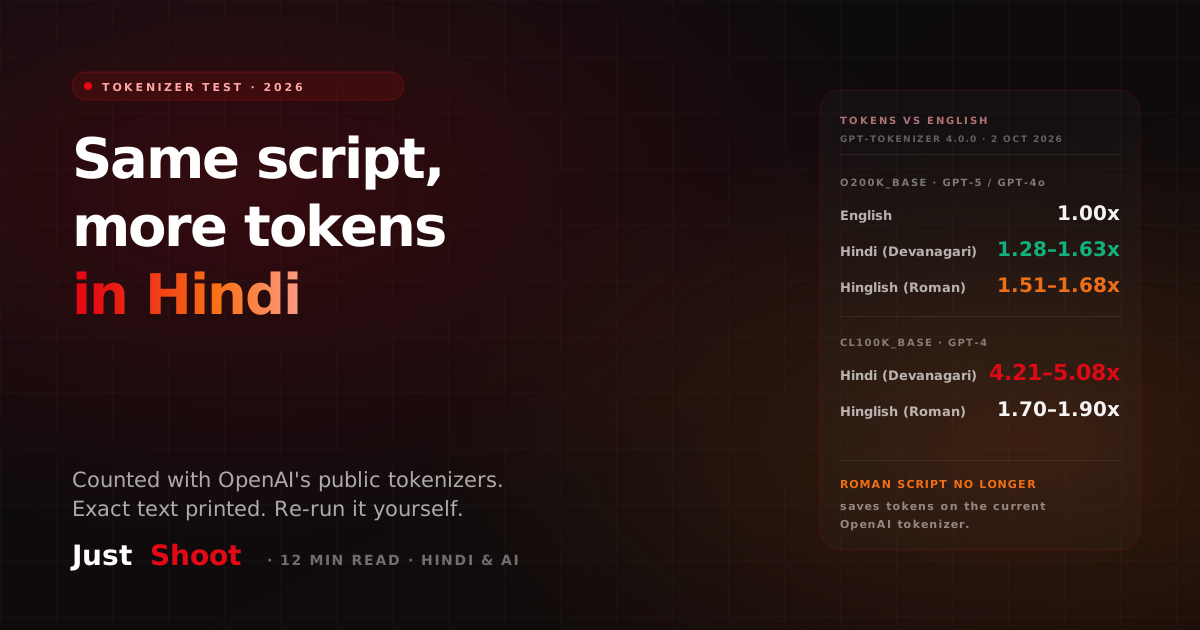
A Hindi Script Costs More Tokens Than the Same Script in English (2026)
One YouTube script in English, Devanagari Hindi and Hinglish, run through OpenAI's public tokenizers. On GPT-5's, Hindi costs 1.28–1.63x the English tokens.