How to Write an Explainer Script That Simplifies a Complex Topic (India, 2026)
How to write a YouTube explainer script that makes a complex topic click: the analogy method, a jargon audit, and the curse-of-knowledge fix.
How to Write an Explainer Script That Simplifies a Complex Topic (India, 2026)
By Ashok Sachdev, Founder of JustShoot · Published 2026-07-01
Short answer: To simplify a complex topic in a YouTube script, beat the curse of knowledge — you know it too well to see what confuses a beginner. Explain one new idea per sentence, swap every jargon word for a plain one or a concrete analogy, and show the idea before you name it. Structure it concrete-first, then label, then "so what."
The hardest videos to script are the ones where you know the topic cold. GST, compound interest, how an LLM works, RAW vs JPEG — you understand it so well that you forget what it felt like not to. That gap is why most explainer scripts confuse the exact people they're meant to help. Simplifying is not "dumbing down"; it's the skill of rebuilding a hard idea in the order a beginner's brain can actually absorb it. This guide is the script-writing method for doing that — the concept-clarity toolkit, not a generic video template.
How do you simplify a complex topic for a YouTube video?
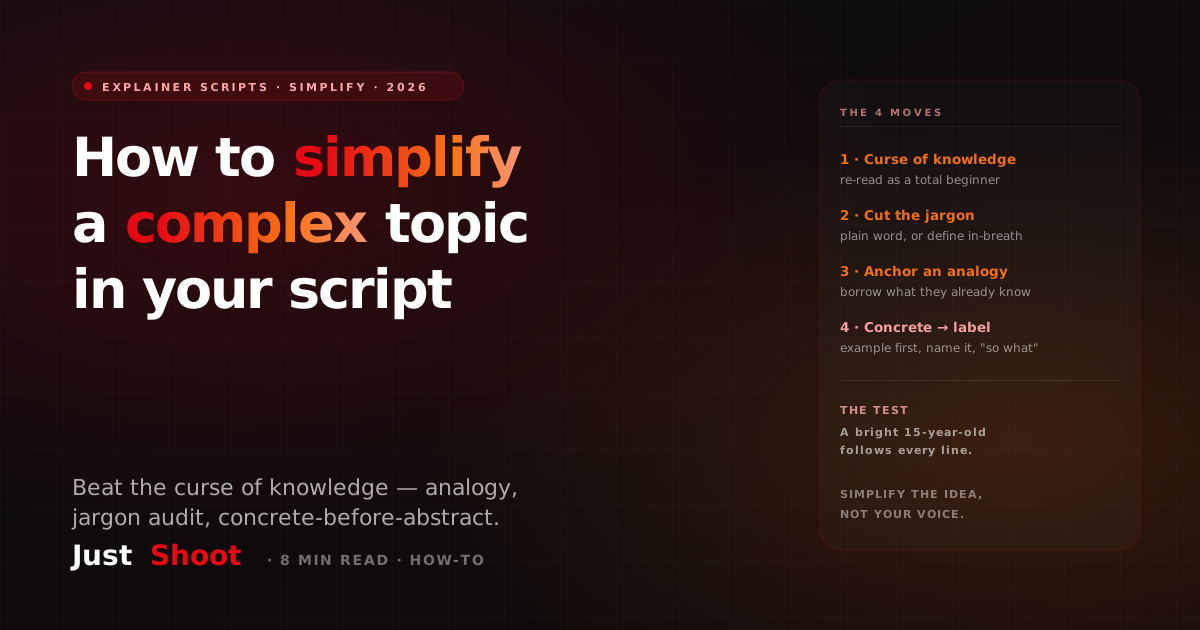
Simplifying a complex topic comes down to four moves, and you can run them on any script:
- Diagnose the curse of knowledge — find every place you skipped a step because it's "obvious" to you.
- Cut or translate the jargon — every specialist word is a tiny wall; remove it or replace it with a plain equivalent.
- Anchor with an analogy — map the unfamiliar idea onto something the viewer already understands.
- Sequence concrete-before-abstract — show a real example first, then name the concept, then explain why it matters.
Do these four and a topic that felt impossible to explain becomes a clean seven-minute video. The rest of this guide breaks down each one.
What is the curse of knowledge, and why does your explainer feel confusing?
The curse of knowledge is a cognitive bias: once you know something well, you can't easily imagine not knowing it, so you unconsciously assume your audience shares your background. It was documented by economists in 1989 and popularised for communicators in Chip and Dan Heath's book Made to Stick. It is the single biggest reason smart creators write confusing explainers.
In a script it shows up as skipped steps ("so obviously you just…"), undefined terms, and a pace that's comfortable for you but a firehose for a beginner. The fix is a deliberate reader-swap: after your first draft, read every line as if you knew nothing about the topic, and mark every point where you'd think "wait, what does that mean?" Each mark is a place to slow down, define, or show. Writing the script in your own natural teaching voice helps here — a tool that keeps your channel's voice locked lets you simplify the idea without flattening how you actually talk.
How do you use an analogy to explain a hard idea?
An analogy is the highest-leverage tool in an explainer script because it borrows understanding the viewer already has. To engineer one, find something from everyday Indian life that shares the structure of your concept, not just the surface.
- Compound interest → a snowball rolling downhill: small at first, then it picks up its own mass and grows faster the longer it rolls.
- An API → a waiter in a restaurant: you don't go into the kitchen; you tell the waiter what you want and they bring it back.
- RAM vs storage → your study desk vs your cupboard: the desk (RAM) is what you're actively working on; the cupboard (storage) holds everything else.
Two rules keep analogies honest. First, map it explicitly — say which part of the analogy equals which part of the concept, or viewers admire the image but miss the point. Second, retire the analogy before it breaks; every analogy is wrong if you push it far enough, so use it to open the door, then switch to the real thing. In Hinglish, a homely analogy ("socho aapke paas ek tiffin hai…") often lands harder than a technical English one, because it drops the viewer's guard.
How do you cut jargon without dumbing the video down?
Run a jargon audit on your draft: highlight every word a smart 15-year-old outside your field wouldn't know. For each one you have three choices — delete it (often it was decoration), replace it with a plain word, or keep it but define it the first time in the same breath. "Volatility — basically how wildly the price jumps around — is…" teaches the term instead of gatekeeping with it.
Simplifying language is not the same as removing depth. You keep every real idea; you just stop making the viewer decode vocabulary to reach it. The test is the "explain it to a bright teenager" standard: if a 15-year-old would follow it, an adult scrolling on a phone in a noisy room will too. Explainer scripts are written for the ear, not the eye — so read the draft aloud, and if you run out of breath inside a sentence, it's too long and probably too dense. This ear-first discipline is also what protects retention when the topic gets hard, the exact moment viewers usually drop off.
What is the structure of a simplify-anything explainer script?
Most confusing explainers name the abstract concept first and then try to explain it. Flip that. The order that mirrors how a brain learns is concrete → label → "so what."
- Concrete first. Open on a specific, real example or a relatable situation — no definitions yet. "You put ₹10,000 in an FD and a year later there's ₹10,700 in the account."
- Then label. Now attach the term to the thing they just pictured. "That extra ₹700 is interest — the rent the bank pays to borrow your money."
- Then 'so what'. Ladder up to why it matters to them. "Do that for thirty years and the interest starts earning its own interest — that's how ordinary salaries turn into retirement money."
One new idea per sentence keeps the ladder climbable; two new ideas in one sentence is where beginners fall off. Open the video with a hook that promises the payoff in plain language ("by the end of this you'll actually understand how EMIs work"), then walk the concrete-label-so-what ladder for each sub-idea.
How is an explainer script different from a tutorial script?
They're cousins, and creators mix them up, but the jobs differ. An explainer makes a concept click — it changes what the viewer understands. A tutorial walks through a procedure — it changes what the viewer can do. An explainer leans on analogy and mental models; a tutorial leans on ordered steps and checkpoints. Many great videos do both: explain the concept, then show the steps. If your video is mostly step-by-step, use the teaching structure in our guide to writing an educational tutorial script instead; this page is for the "help me get it" half.
Where JustShoot fits
Simplifying is a rewriting job, and rewriting is where most creators run out of time. Inside JustShoot's 9-agent pipeline, the script agent drafts your explainer in your own channel voice and English/Hindi/Hinglish mix, flags jargon, and structures the concrete-label-so-what ladder — so the idea gets simpler without your delivery getting more robotic. For creators in regulated niches, a compliance-aware review pass keeps a simplified finance or health explanation accurate, not just easy.
On pricing: the Trial is ₹0 for 7 days (2 scripts, no card), then Starter ₹499/mo (3 scripts) and Creator ₹999/mo (7 scripts, most popular), Pro ₹1999/mo (15 scripts); Studio is custom. All plans run the full pipeline, GST-inclusive, monthly. Want to check whether your current script reads clearly or like a textbook? Run it through the free Robot Score tool.
The takeaway
You don't simplify a complex topic by cutting the depth — you simplify it by rebuilding the idea in the order a beginner can climb. Spot the curse of knowledge, translate the jargon, anchor with an honest analogy, and sequence concrete-before-abstract with one new idea per sentence. Do that and the topics you were "too expert" to explain become your most-watched videos.
FAQ
How do you explain a complex topic simply on YouTube? Beat the curse of knowledge (assume the viewer knows nothing), explain one new idea per sentence, replace jargon with plain words or analogies, and sequence the script concrete-first: show a real example, then name the concept, then explain why it matters. Read it aloud to catch sentences that are too long or dense.
What is the curse of knowledge in content? It's a cognitive bias where, because you understand a topic deeply, you can't imagine not knowing it — so you skip steps and use undefined jargon that confuses beginners. The fix is to re-read your script as a total newcomer and mark every "wait, what?" moment to slow down or define.
How do you use an analogy to explain a difficult concept? Pick something the viewer already understands that shares the same structure as your concept (compound interest = a snowball rolling downhill). Map the parts explicitly — say which part of the analogy equals which part of the idea — and drop the analogy before you push it far enough to break.
Is simplifying a topic the same as dumbing it down? No. Dumbing down removes real ideas; simplifying keeps every idea but removes the vocabulary and step-skipping that made it hard to follow. You lose the jargon, not the depth — the aim is a bright 15-year-old following along, not a shallower explanation.
What's the difference between an explainer and a tutorial script? An explainer makes a concept click (changes understanding) using analogies and mental models. A tutorial walks through a procedure (changes ability) using ordered steps and checkpoints. Videos often do both, but the scripting method for each is different.
Written by Ashok Sachdev, founder of JustShoot — the AI content workspace that writes YouTube scripts in your voice for Indian creators.

A Hindi Script Costs More Tokens Than the Same Script in English (2026)
One YouTube script in English, Devanagari Hindi and Hinglish, run through OpenAI's public tokenizers. On GPT-5's, Hindi costs 1.28–1.63x the English tokens.
The Most-Subscribed YouTube Channels in India — and What They Have in Common (2026)
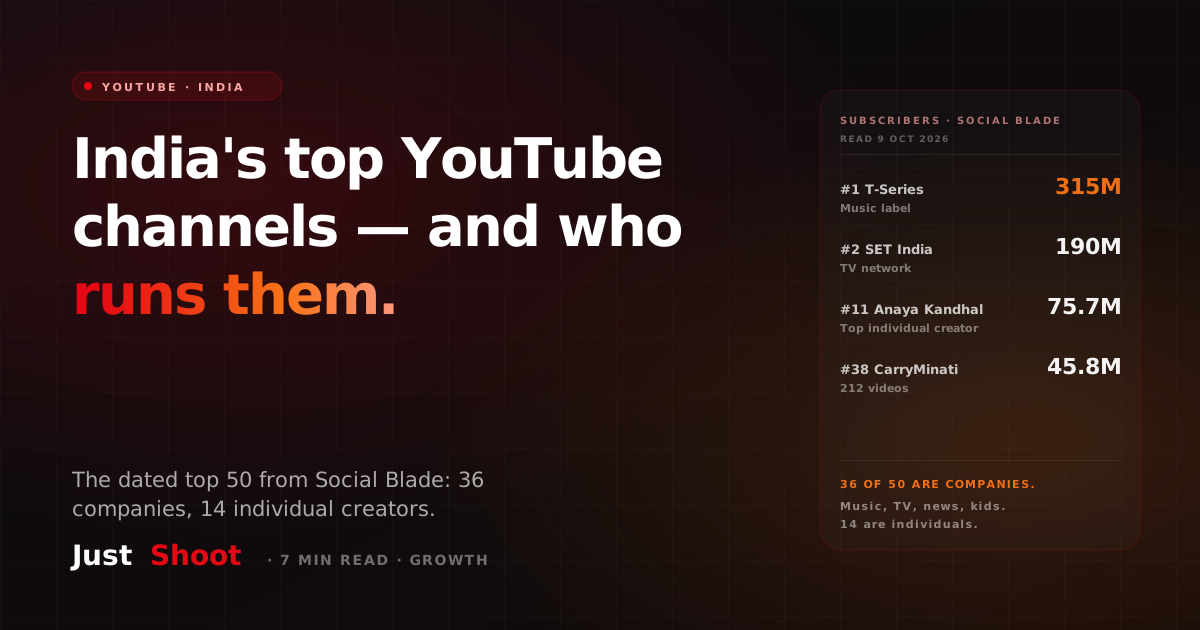
T-Series leads India's YouTube with 315 million subscribers. Of the top 50 channels, 36 belong to music labels, TV networks, news and kids' brands. Only 14 are individual creators.
How Many Indians Watch Game Streams? (2026)
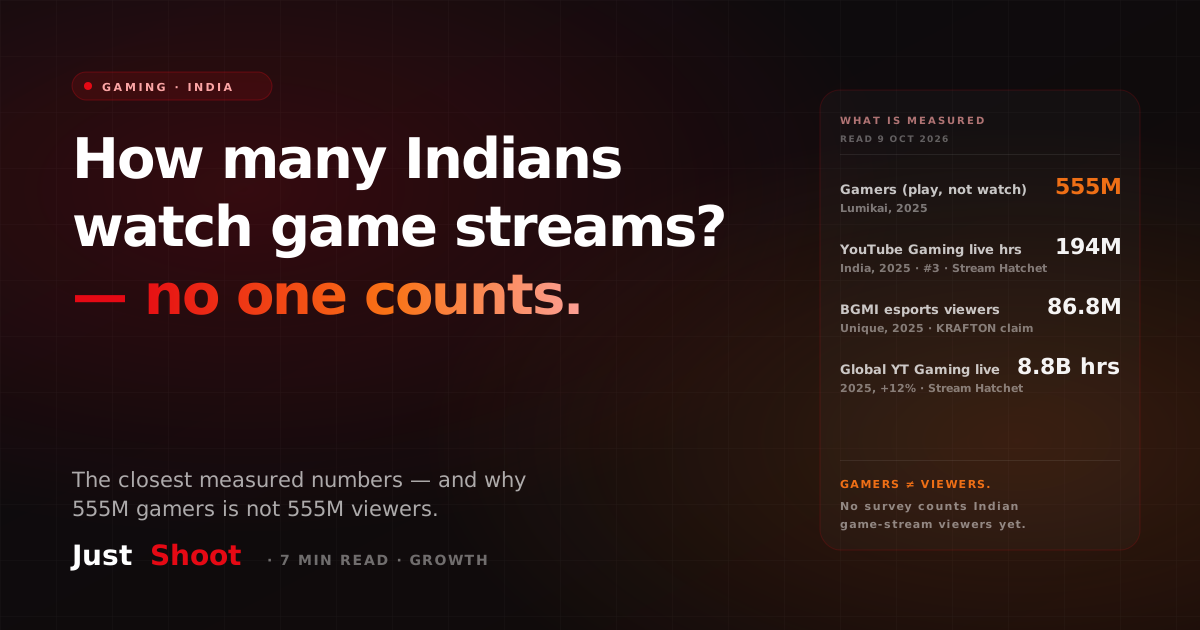
India has 555 million gamers, but nobody publishes how many watch game streams. Here are the closest measured numbers — hours watched, esports viewers — and what they count.